## Quantum Circuit Diagram: Qubit State Preparation, Transformation, and Measurement
### Overview
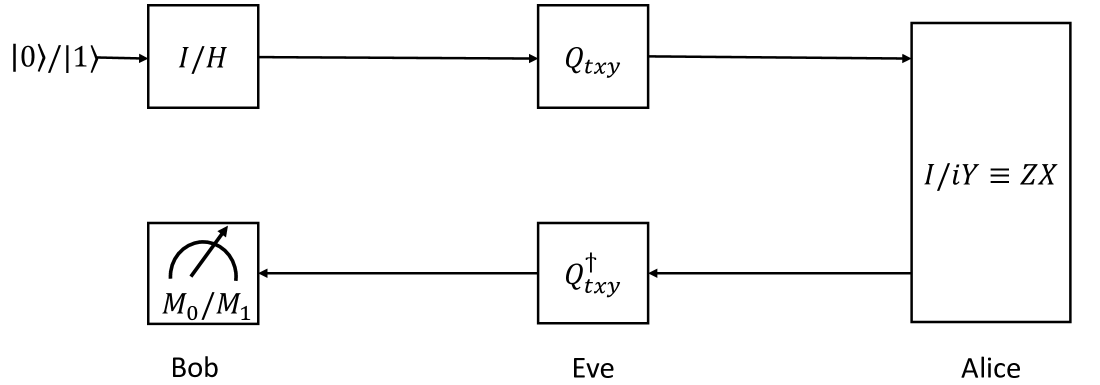
The image displays a schematic quantum circuit diagram illustrating a sequence of operations on a qubit, involving three parties: Bob, Eve, and Alice. The diagram shows the flow of a quantum state from an initial preparation, through transformations, to a final measurement. It is a technical representation using standard quantum circuit notation with boxes representing quantum gates or operations and arrows indicating the direction of qubit flow.
### Components/Axes
The diagram is structured in two horizontal rows (or "wires") representing the path of a single qubit, with components placed along them.
**Top Row (Left to Right):**
1. **Initial State:** Labeled `|0⟩/|1⟩`. This represents the qubit being prepared in either the ground state `|0⟩` or the excited state `|1⟩`.
2. **First Operation Box:** A square box labeled `I/H`. This denotes a choice between the Identity gate (`I`) and the Hadamard gate (`H`).
3. **Second Operation Box:** A square box labeled `Q_xy`. This represents a specific quantum gate or operation parameterized by `x` and `y`.
4. **Arrow:** A horizontal arrow points from the `Q_xy` box to the large box on the right.
**Right Side:**
5. **Large Vertical Box:** A tall rectangular box spanning both rows, labeled `I/iY ≡ ZX`. This indicates a composite operation or equivalence. `I/iY` likely represents the inverse of the Pauli-Y gate (`iY`), and `≡ ZX` states this is equivalent to the product of the Pauli-Z and Pauli-X gates.
**Bottom Row (Right to Left):**
6. **Third Operation Box:** A square box labeled `Q_xy†`. The `†` symbol denotes the adjoint (or inverse) of the `Q_xy` operation from the top row.
7. **Arrow:** A horizontal arrow points from the `Q_xy†` box to the measurement box on the left.
8. **Measurement Box:** A square box containing a meter symbol (a semicircle with an arrow) and labeled `M_0/M_1`. This represents a measurement in the computational basis, yielding a classical bit result of 0 or 1.
**Labels for Parties:**
* **Bob:** The label "Bob" is positioned directly below the measurement box (`M_0/M_1`).
* **Eve:** The label "Eve" is positioned directly below the `Q_xy†` box.
* **Alice:** The label "Alice" is positioned directly below the large vertical box (`I/iY ≡ ZX`).
**Flow Direction:** The arrows indicate a counter-clockwise flow: The qubit starts at the top-left (`|0⟩/|1⟩`), moves right through `I/H` and `Q_xy`, enters Alice's large operation box, then moves left along the bottom row through `Q_xy†` (Eve's operation) to the final measurement by Bob.
### Detailed Analysis
* **Sequence of Operations:**
1. **State Preparation:** A qubit is initialized as `|0⟩` or `|1⟩`.
2. **Bob's Initial Gate (Top-Left):** The qubit undergoes either no operation (`I`) or a Hadamard transform (`H`), which creates a superposition state.
3. **Eve's Gate (Top-Middle):** The qubit is acted upon by the parameterized gate `Q_xy`.
4. **Alice's Gate (Right):** The qubit passes through the operation `I/iY ≡ ZX`. This is a fixed, non-parameterized gate sequence.
5. **Eve's Inverse Gate (Bottom-Middle):** The adjoint (inverse) of Eve's initial gate, `Q_xy†`, is applied. This suggests an attempt to "undo" the `Q_xy` operation.
6. **Bob's Measurement (Bottom-Left):** The final state of the qubit is measured by Bob, resulting in a classical outcome `M_0` or `M_1`.
* **Mathematical Notation:**
* `|0⟩`, `|1⟩`: Standard Dirac notation for quantum states.
* `I`: Identity operator.
* `H`: Hadamard gate.
* `Q_xy`: A generic unitary operator dependent on parameters `x` and `y`.
* `Q_xy†`: The Hermitian adjoint of `Q_xy`, satisfying `Q_xy * Q_xy† = I` if `Q_xy` is unitary.
* `iY`: The Pauli-Y matrix multiplied by the imaginary unit `i`.
* `ZX`: The product of the Pauli-Z and Pauli-X matrices.
* `M_0/M_1`: Measurement outcomes corresponding to projecting onto the `|0⟩` or `|1⟩` state.
### Key Observations
1. **Symmetry and Inversion:** The circuit exhibits a symmetric structure around Alice's central operation. Eve applies `Q_xy` before Alice and its inverse `Q_xy†` after. This is a common pattern in quantum protocols for error correction, teleportation, or certain cryptographic schemes.
2. **Party Roles:** The labels assign specific roles: Alice performs a fixed, known operation. Eve performs a parameterized operation and its inverse. Bob performs the initial state manipulation (choice of `I` or `H`) and the final measurement.
3. **Equivalence Statement:** The label `I/iY ≡ ZX` inside Alice's box is a key technical detail. It asserts that the operation performed is equivalent to applying the Pauli-Z gate followed by the Pauli-X gate (or vice versa, as they anti-commute up to a phase). This is a non-trivial identity in quantum mechanics.
4. **Single Qubit Line:** The entire diagram operates on a single qubit, as indicated by the single continuous path of arrows.
### Interpretation
This diagram likely represents a **quantum cryptographic protocol or a quantum computation subroutine**. The structure strongly suggests a scenario involving **decoherence-free subspaces, quantum teleportation, or a specific attack/defense model in quantum key distribution (QKD)**.
* **Purpose:** The circuit tests how a specific, parameterized operation (`Q_xy` by Eve) and its inverse affect the transmission of a quantum state from Bob (as sender/measurer) through Alice's fixed channel. The final measurement by Bob reveals whether the combined operations preserved the initial state information.
* **Relationships:** The operations are chained: Bob's initial choice (`I` or `H`) sets the input state for Eve's and Alice's transformations. The symmetry of `Q_xy` and `Q_xy†` implies that if Alice's operation (`I/iY`) commutes or has a specific relationship with `Q_xy`, the net effect might be identity, allowing perfect state recovery by Bob. If not, the measurement outcome will be disturbed.
* **Notable Implication:** The equivalence `I/iY ≡ ZX` is crucial. In many quantum protocols, the Pauli operators (`X, Y, Z`) represent fundamental errors or basis changes. This specific equivalence might be used to model a particular type of noise or a deliberate transformation in a quantum communication channel. The diagram is a formal model for analyzing the success probability of transmitting the initial `|0⟩/|1⟩` state through this specific sequence of gates.