## Diagram: Matrix Multiplication Tiling (Blocking)
### Overview
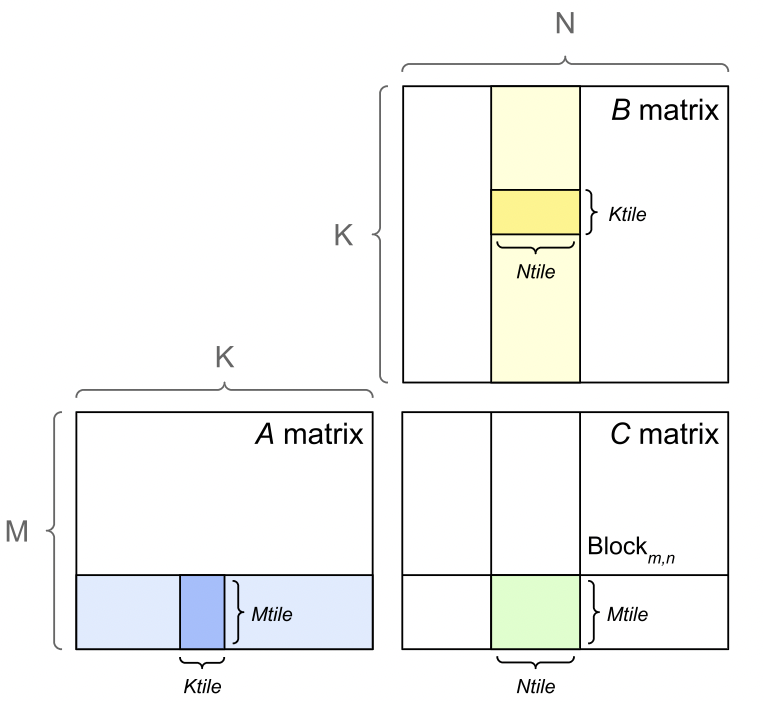
This diagram illustrates the concept of matrix multiplication using tiling (also known as blocking), a common optimization technique in high-performance computing and linear algebra. It visually demonstrates how a specific sub-block in a result matrix $C$ is computed by multiplying a corresponding row-tile from matrix $A$ and a column-tile from matrix $B$.
### Components/Axes
The diagram consists of three matrices arranged to represent the operation $C = A \times B$:
* **Matrix A (Bottom-Left):** Represents the left-hand operand.
* **Dimensions:** $M$ (height) $\times K$ (width).
* **Highlighted Region:** A horizontal strip containing a darker blue vertical block.
* **Labels:** $M$ (left axis), $K$ (top axis), $M_{tile}$ (height of the blue block), $K_{tile}$ (width of the blue block).
* **Matrix B (Top-Right):** Represents the right-hand operand.
* **Dimensions:** $K$ (height) $\times N$ (width).
* **Highlighted Region:** A vertical strip containing a darker yellow horizontal block.
* **Labels:** $K$ (left axis), $N$ (top axis), $K_{tile}$ (height of the yellow block), $N_{tile}$ (width of the yellow block).
* **Matrix C (Bottom-Right):** Represents the result matrix.
* **Dimensions:** $M$ (height) $\times N$ (width).
* **Highlighted Region:** A green square/rectangular block.
* **Labels:** $Block_{m,n}$ (the specific block being computed), $M_{tile}$ (height of the green block), $N_{tile}$ (width of the green block).
### Detailed Analysis
The diagram maps the relationship between the dimensions of the input matrices and the output matrix:
1. **Matrix A (Blue):** The diagram highlights a vertical block of size $M_{tile} \times K_{tile}$. This block represents a segment of the row-space of $A$ that is being processed.
2. **Matrix B (Yellow):** The diagram highlights a horizontal block of size $K_{tile} \times N_{tile}$. This block represents a segment of the column-space of $B$ that is being processed.
3. **Matrix C (Green):** The diagram highlights a block of size $M_{tile} \times N_{tile}$. This is the resulting sub-matrix $Block_{m,n}$.
**Dimensional Consistency:**
* The height of the block in $A$ ($M_{tile}$) matches the height of the block in $C$ ($M_{tile}$).
* The width of the block in $B$ ($N_{tile}$) matches the width of the block in $C$ ($N_{tile}$).
* The width of the block in $A$ ($K_{tile}$) matches the height of the block in $B$ ($K_{tile}$), satisfying the inner dimension requirement for matrix multiplication.
### Key Observations
* **Spatial Arrangement:** The matrices are positioned to mimic the standard mathematical notation for matrix multiplication: $A$ is placed to the left of $C$, and $B$ is placed above $C$.
* **Color Coding:**
* **Blue:** Associated with Matrix $A$ (the multiplicand).
* **Yellow:** Associated with Matrix $B$ (the multiplier).
* **Green:** Associated with Matrix $C$ (the product).
* **Tiling Logic:** The diagram explicitly shows that the computation of a single block in $C$ does not require the entire matrices $A$ and $B$, but rather specific tiles of size $K_{tile}$.
### Interpretation
This diagram is a fundamental representation of **Cache-Oblivious or Cache-Aware Tiling**.
* **Why it matters:** In standard matrix multiplication, accessing memory in a non-contiguous way (e.g., traversing columns of $B$) causes cache misses, which significantly degrades performance. By breaking the matrices into smaller tiles ($M_{tile} \times K_{tile}$ and $K_{tile} \times N_{tile}$), the algorithm ensures that the data fits into the CPU's L1/L2 cache.
* **Data Flow:** The diagram demonstrates that the green block in $C$ is the accumulation of the product of the blue block in $A$ and the yellow block in $B$. This implies that the algorithm iterates through the $K$ dimension, accumulating the result into the green block.
* **Peircean Investigative Note:** The diagram simplifies the complex operation of matrix multiplication into a geometric relationship. It suggests that the "cost" of the operation is localized to these tiles, allowing for parallelization—multiple blocks in $C$ can be computed independently if the tiling strategy is implemented correctly.