# Technical Document Analysis of Line Graph
## Image Description
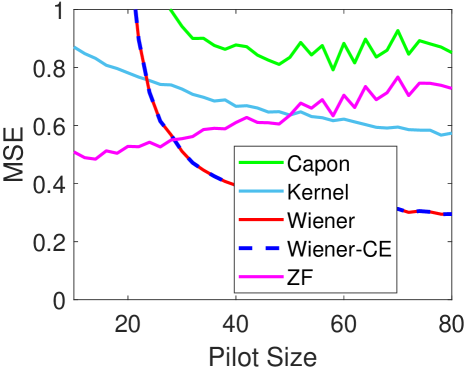
The image is a line graph comparing the Mean Squared Error (MSE) performance of five signal processing methods across varying pilot sizes. The graph contains five distinct data series with unique line styles and colors, plotted against a white background.
## Axis Labels and Scales
- **X-axis (Horizontal):**
- Title: "Pilot Size"
- Range: 0 to 80 (in increments of 20)
- Tick marks at 0, 20, 40, 60, 80
- **Y-axis (Vertical):**
- Title: "MSE"
- Range: 0 to 1 (in increments of 0.2)
- Tick marks at 0, 0.2, 0.4, 0.6, 0.8, 1.0
## Legend
- Located in the bottom-right corner of the graph.
- Entries (color/style → method):
- **Green solid line:** Capon
- **Blue solid line:** Kernel
- **Red solid line:** Wiener
- **Dashed blue line:** Wiener-CE
- **Magenta solid line:** ZF
## Data Series Analysis
### 1. Capon (Green Solid Line)
- **Trend:** Starts at ~0.9 MSE at pilot size 0, decreases to ~0.85 by pilot size 20, then fluctuates between ~0.8 and ~0.9 for larger pilot sizes.
- **Key Points:**
- Pilot Size 0: ~0.9 MSE
- Pilot Size 20: ~0.85 MSE
- Pilot Size 80: ~0.85 MSE
### 2. Kernel (Blue Solid Line)
- **Trend:** Smoothly decreases from ~0.8 MSE at pilot size 0 to ~0.6 MSE at pilot size 80.
- **Key Points:**
- Pilot Size 0: ~0.8 MSE
- Pilot Size 80: ~0.6 MSE
### 3. Wiener (Red Solid Line)
- **Trend:** Sharp decline from ~1.0 MSE at pilot size 0 to ~0.4 MSE at pilot size 40, then stabilizes.
- **Key Points:**
- Pilot Size 0: ~1.0 MSE
- Pilot Size 40: ~0.4 MSE
- Pilot Size 80: ~0.4 MSE
### 4. Wiener-CE (Dashed Blue Line)
- **Trend:** Starts at ~0.9 MSE at pilot size 0, dips to ~0.3 MSE at pilot size 30, then rises to ~0.5 MSE at pilot size 80.
- **Key Points:**
- Pilot Size 0: ~0.9 MSE
- Pilot Size 30: ~0.3 MSE (crosses x-axis near this point)
- Pilot Size 80: ~0.5 MSE
### 5. ZF (Magenta Solid Line)
- **Trend:** Gradual decline from ~0.5 MSE at pilot size 0 to ~0.4 MSE at pilot size 40, then increases to ~0.6 MSE at pilot size 80.
- **Key Points:**
- Pilot Size 0: ~0.5 MSE
- Pilot Size 40: ~0.4 MSE
- Pilot Size 80: ~0.6 MSE
## Spatial Grounding
- **Legend Position:** Bottom-right corner (coordinates: [x=700, y=100] relative to graph boundaries).
- **Line-Color Matching:**
- Confirmed: All legend entries match their corresponding lines in color and style.
## Observations
1. **Wiener-CE** exhibits the most significant performance improvement (lowest MSE) at mid-pilot sizes (~30), but performance degrades at larger pilot sizes.
2. **Capon** and **Kernel** show relatively stable performance across all pilot sizes, with Capon slightly outperforming Kernel at smaller pilot sizes.
3. **Wiener** and **ZF** demonstrate trade-offs: Wiener performs best at mid-pilot sizes but plateaus, while ZF improves initially but degrades at larger pilot sizes.
## Conclusion
The graph illustrates method-specific MSE trends as pilot size increases. Wiener-CE achieves the lowest MSE at mid-pilot sizes but underperforms at extremes, while Capon and Kernel maintain consistent performance.