## Diagram: Query Path Structure Matrix
### Overview
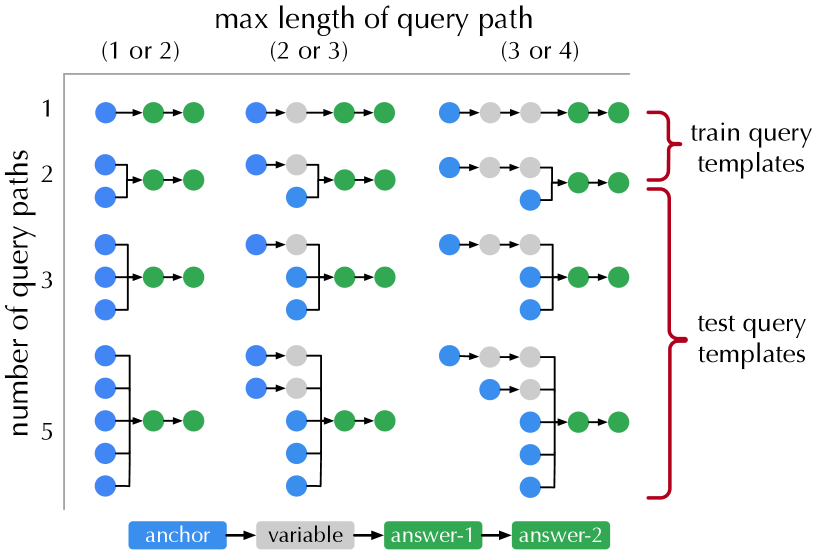
The image displays a matrix diagram illustrating the structural composition of query paths used in a computational context, likely for Knowledge Graph Question Answering (KGQA). The matrix organizes query templates based on the "number of query paths" (rows) and the "max length of query path" (columns). It distinguishes between "train query templates" and "test query templates" using brackets on the right side.
### Components/Axes
* **Horizontal Axis (Top):** "max length of query path"
* Categories: "(1 or 2)", "(2 or 3)", "(3 or 4)"
* **Vertical Axis (Left):** "number of query paths"
* Values: 1, 2, 3, 5
* **Legend (Bottom):**
* Blue circle: "anchor"
* Grey circle: "variable"
* Green circle: "answer-1"
* Green circle: "answer-2"
* **Right-side Annotations:**
* Rows 1-2: Bracketed as "train query templates"
* Rows 3-5: Bracketed as "test query templates"
### Detailed Analysis
The diagram is a grid of node-link structures. Each row represents a specific number of starting "anchor" nodes (blue), and each column represents a specific path length (number of intermediate/answer nodes).
**Legend/Node Key:**
* **Blue (Anchor):** The starting point of the query.
* **Grey (Variable):** Intermediate nodes in the path.
* **Green (Answer):** The terminal nodes of the query.
**Grid Breakdown:**
| Column | Max Length | Structure Description |
| :--- | :--- | :--- |
| **1** | 1 or 2 | Direct connection from anchor(s) to a single green "answer-1" node. |
| **2** | 2 or 3 | Connection from anchor(s) through a single grey "variable" node to a single green "answer-1" node. |
| **3** | 3 or 4 | Connection from anchor(s) through two grey "variable" nodes to two green "answer" nodes ("answer-1" and "answer-2"). |
* **Column 1 (Max length 1 or 2):**
* Row 1: 1 anchor -> 1 answer.
* Row 2: 2 anchors -> 1 answer.
* Row 3: 3 anchors -> 1 answer.
* Row 5: 5 anchors -> 1 answer.
* **Column 2 (Max length 2 or 3):**
* Row 1: 1 anchor -> 1 variable -> 1 answer.
* Row 2: 2 anchors -> 1 variable -> 1 answer.
* Row 3: 3 anchors -> 1 variable -> 1 answer.
* Row 5: 5 anchors -> 1 variable -> 1 answer.
* **Column 3 (Max length 3 or 4):**
* Row 1: 1 anchor -> 2 variables -> 2 answers.
* Row 2: 2 anchors -> 2 variables -> 2 answers.
* Row 3: 3 anchors -> 2 variables -> 2 answers.
* Row 5: 5 anchors -> 2 variables -> 2 answers.
* *Note on branching:* In rows 2, 3, and 5 of this column, the anchors are split. The top anchor connects to the first variable, while the remaining anchors connect to the second variable.
### Key Observations
* **Systematic Scaling:** The diagram demonstrates a clear increase in complexity. Moving right increases the path depth (number of variables and answers), while moving down increases the number of input anchors.
* **Training vs. Testing Split:** The dataset is partitioned. "Train" templates are limited to 1 or 2 query paths (rows 1-2), while "Test" templates include 3 or 5 query paths (rows 3-5). This suggests a setup designed to test the model's ability to generalize to more complex query structures than those seen during training.
* **Structural Consistency:** Within each column, the path structure (the sequence of variables and answers) remains consistent regardless of the number of anchors, implying that the "query template" is defined by the path length, while the "number of query paths" defines the breadth of the input.
### Interpretation
This diagram likely represents a **Knowledge Graph Question Answering (KGQA) evaluation framework**.
* **Generalization Testing:** By training on fewer query paths (1-2) and testing on more (3-5), the researchers are evaluating the model's ability to handle "multi-hop" or "multi-path" reasoning. The model must learn the underlying logic of the path (the template) and apply it to a larger set of anchors.
* **Template-Based Reasoning:** The use of "templates" suggests that the system is not just answering arbitrary questions but is likely using a structured approach where the query is decomposed into a path of specific length and type.
* **Complexity Handling:** The branching logic in the third column (where anchors are split between different variables) indicates that the system is capable of handling complex queries where different parts of the input (anchors) contribute to different parts of the reasoning chain (variables), eventually converging on the same answer set.