\n
## Diagram: Query Path Templates
### Overview
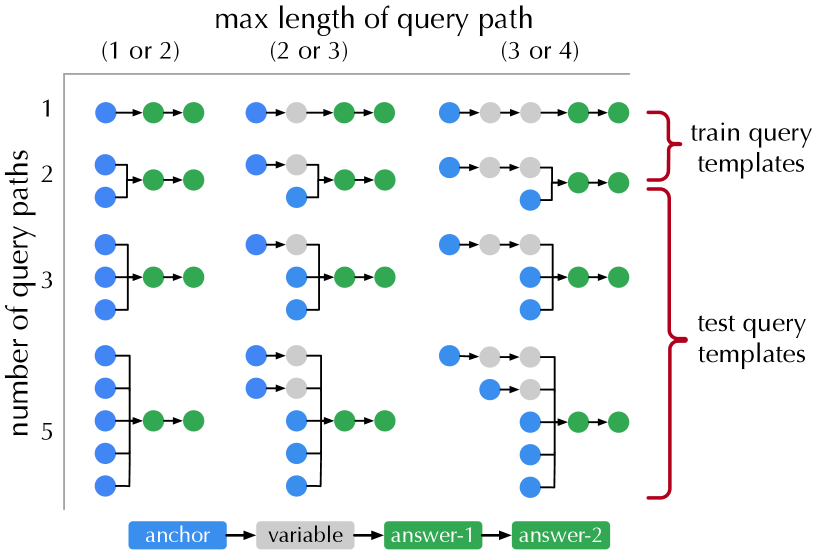
The image is a diagram illustrating different query path templates used for training and testing, categorized by the maximum length of the query path and the number of query paths. The diagram uses a node-and-arrow structure to represent the query paths, with different colored nodes indicating different elements within the query.
### Components/Axes
* **X-axis:** "max length of query path" with categories: "(1 or 2)", "(2 or 3)", "(3 or 4)".
* **Y-axis:** "number of query paths" with categories: 1, 2, 3, 4.
* **Nodes:**
* Blue: "anchor"
* Gray: "variable"
* Green: "answer-1"
* Light Green: "answer-2"
* **Arrows:** Represent the path or relationship between nodes.
* **Labels:**
* "train query templates" (red bracket on the top-right)
* "test query templates" (red bracket on the bottom-right)
* **Legend:** Located at the bottom center, defining the node colors and their corresponding meanings.
### Detailed Analysis or Content Details
The diagram presents a grid of query path examples. Each cell in the grid (defined by the X and Y axes) shows multiple query path examples. The paths are represented as sequences of nodes connected by arrows.
Here's a breakdown of the paths within each grid cell:
* **(1 or 2) max length, 1 query path:** One path: blue -> green.
* **(1 or 2) max length, 2 query paths:** Two paths: blue -> green, blue -> gray -> green.
* **(1 or 2) max length, 3 query paths:** Three paths: blue -> green, blue -> gray -> green, blue -> gray -> gray -> green.
* **(1 or 2) max length, 4 query paths:** Four paths: blue -> green, blue -> gray -> green, blue -> gray -> gray -> green, blue -> gray -> gray -> gray -> green.
* **(2 or 3) max length, 1 query path:** One path: blue -> gray -> green.
* **(2 or 3) max length, 2 query paths:** Two paths: blue -> gray -> green, blue -> gray -> gray -> green.
* **(2 or 3) max length, 3 query paths:** Three paths: blue -> gray -> green, blue -> gray -> gray -> green, blue -> gray -> gray -> gray -> green.
* **(2 or 3) max length, 4 query paths:** Four paths: blue -> gray -> green, blue -> gray -> gray -> green, blue -> gray -> gray -> gray -> green, blue -> gray -> gray -> gray -> gray -> green.
* **(3 or 4) max length, 1 query path:** One path: blue -> gray -> gray -> green.
* **(3 or 4) max length, 2 query paths:** Two paths: blue -> gray -> gray -> green, blue -> gray -> gray -> gray -> green.
* **(3 or 4) max length, 3 query paths:** Three paths: blue -> gray -> gray -> green, blue -> gray -> gray -> gray -> green, blue -> gray -> gray -> gray -> gray -> green.
* **(3 or 4) max length, 4 query paths:** Four paths: blue -> gray -> gray -> green, blue -> gray -> gray -> gray -> green, blue -> gray -> gray -> gray -> gray -> green, blue -> gray -> gray -> gray -> gray -> gray -> green.
The "train query templates" section encompasses the top two rows (number of query paths 1 and 2), while the "test query templates" section encompasses the bottom two rows (number of query paths 3 and 4).
### Key Observations
* The complexity of the query paths increases as the "max length of query path" increases.
* The number of query paths increases as the "number of query paths" increases.
* The diagram visually demonstrates how the number of possible query paths grows exponentially with the length of the path and the number of paths considered.
* The distinction between training and testing templates is based on the number of query paths, with training using simpler templates (fewer paths) and testing using more complex templates (more paths).
### Interpretation
This diagram illustrates the concept of query path templates used in a machine learning or information retrieval context. The "anchor" node likely represents a starting point for a query, the "variable" nodes represent intermediate entities or relationships, and the "answer" nodes represent the desired results. The length of the query path indicates the number of steps or relationships involved in finding the answer.
The separation of training and testing templates suggests a strategy for evaluating the performance of a system that uses these query paths. By training on simpler templates and testing on more complex ones, the system's ability to generalize to more challenging queries can be assessed. The increasing number of paths with increasing length suggests a combinatorial explosion of possible queries, which could pose challenges for both training and inference. The diagram highlights the importance of carefully designing query templates to balance complexity and coverage.