## Diagram: Query Path Templates for Training and Testing
### Overview
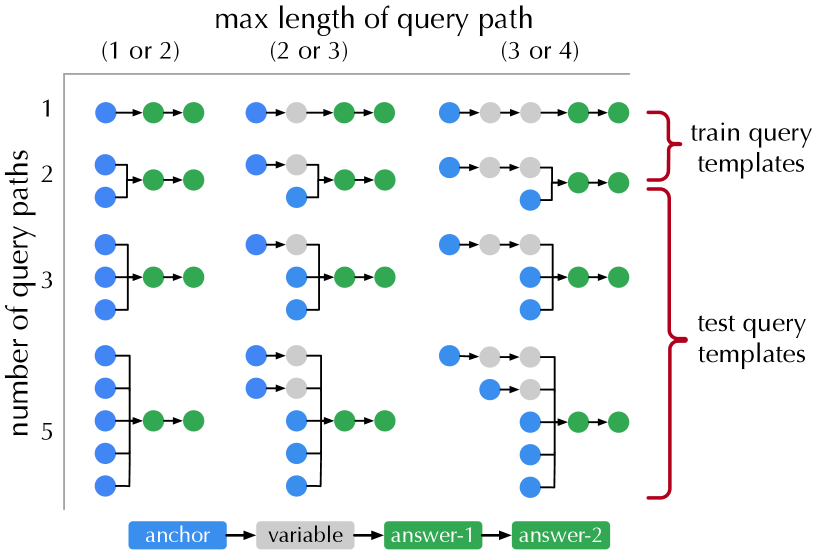
The diagram illustrates hierarchical query path structures for training and testing templates, organized by maximum query path length (1-4 edges) and number of query paths (1-5). It uses color-coded nodes (blue=anchor, gray=variable, green=answer) and red brackets to group templates.
### Components/Axes
- **Columns**:
- Left: Max path length (1 or 2)
- Middle: Max path length (2 or 3)
- Right: Max path length (3 or 4)
- **Rows**: Number of query paths (1-5, vertical axis)
- **Legend**:
- Blue: Anchor nodes
- Gray: Variable nodes
- Green: Answer nodes (answer-1/answer-2)
- **Red Brackets**:
- Left: Train query templates
- Right: Test query templates
### Detailed Analysis
1. **Left Column (1-2 edges)**:
- Paths contain 1-5 anchor → variable → answer sequences
- Example: Row 3 shows 3 parallel paths with 2 edges each
- All paths terminate in green answer nodes
2. **Middle Column (2-3 edges)**:
- Paths include 1-5 anchor → variable → variable → answer sequences
- Example: Row 4 shows 4 paths with 3 edges each
- Gray nodes increase in number with path length
3. **Right Column (3-4 edges)**:
- Paths contain 1-5 anchor → variable → variable → variable → answer sequences
- Example: Row 5 shows 5 paths with 4 edges each
- Gray nodes dominate longer paths
4. **Red Brackets**:
- Train templates: Left column (1-2 edges)
- Test templates: Right column (3-4 edges)
- Middle column (2-3 edges) appears ungrouped
### Key Observations
- Path complexity increases with maximum edge count
- Longer paths (3-4 edges) show more variable nodes
- Test templates exclusively use longest path structures
- All paths maintain anchor → variable → answer flow
- No overlapping node colors between anchor/variable/answer
### Interpretation
This diagram demonstrates hierarchical query path design for NLP tasks:
1. **Training Focus**: Shorter paths (1-2 edges) likely capture basic relationships
2. **Testing Focus**: Longer paths (3-4 edges) test complex reasoning
3. **Variable Node Growth**: Path length correlates with variable node count
4. **Template Segregation**: Clear separation between training and testing structures
5. **Answer Node Consistency**: All paths terminate in green answer nodes regardless of length
The structure suggests a progressive complexity model where training starts with simple queries and testing evaluates deeper reasoning capabilities. The color coding and bracket grouping emphasize systematic template organization for model evaluation.