\n
## Diagram: Signed Binary Multiplication
### Overview
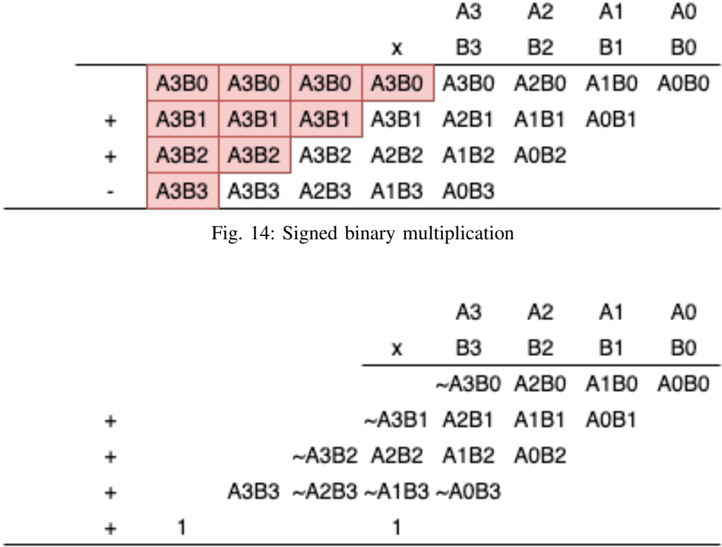
The image presents two diagrams illustrating the process of signed binary multiplication. The first diagram shows the initial partial products generated, while the second demonstrates the subsequent addition and sign extension steps. Both diagrams use a tabular format to represent the multiplication process.
### Components/Axes
The diagrams are structured as multiplication tables.
* **First Diagram:**
* Rows are labeled with A3B0, A3B1, A3B2, A3B3 (left side, in red).
* Columns are labeled with A3, A2, A1, A0 and B3, B2, B1, B0 (top side).
* The cells contain the results of multiplying the row and column labels.
* **Second Diagram:**
* Rows are labeled with +, +, +, + (left side).
* Columns are labeled with A3, A2, A1, A0 and B3, B2, B1, B0 (top side).
* The cells contain the results of adding the partial products and sign extension.
* Both diagrams have a caption: "Fig. 14: Signed binary multiplication" positioned below the first diagram.
### Detailed Analysis or Content Details
**First Diagram (Partial Products):**
The diagram shows the initial multiplication of each bit of the multiplicand (A3 A2 A1 A0) by each bit of the multiplier (B3 B2 B1 B0). The results are arranged in a grid.
* A3B0 x B3 = A3B0
* A3B0 x B2 = A3B0
* A3B0 x B1 = A3B0
* A3B0 x B0 = A3B0
* A3B1 x B3 = A3B1
* A3B1 x B2 = A3B1
* A3B1 x B1 = A3B1
* A3B1 x B0 = A3B1
* A3B2 x B3 = A3B2
* A3B2 x B2 = A2B2
* A3B2 x B1 = A1B2
* A3B2 x B0 = A0B2
* A3B3 x B3 = A1B3
* A3B3 x B2 = A0B3
**Second Diagram (Addition and Sign Extension):**
This diagram shows the addition of the partial products generated in the first diagram, along with sign extension. The tilde (~) symbol indicates the complement of a bit.
* ~A3B0 A2B0 A1B0 A0B0
* ~A3B1 A2B1 A1B1 A0B1
* ~A3B2 A2B2 A1B2 A0B2
* A3B3 ~A2B3 ~A1B3 ~A0B3
* + 1 1
### Key Observations
The first diagram demonstrates the basic multiplication operation, generating all possible partial products. The second diagram shows how these partial products are added together, with sign extension to handle negative numbers. The use of the tilde (~) indicates the complement operation, which is crucial for representing negative numbers in binary.
### Interpretation
The diagrams illustrate the algorithm for signed binary multiplication. The first diagram shows the generation of partial products, while the second diagram demonstrates the addition of these products with appropriate sign extension. This method allows for the multiplication of both positive and negative binary numbers. The sign extension ensures that the correct sign is maintained throughout the multiplication process. The diagrams provide a visual representation of the underlying principles of binary multiplication, which is fundamental to digital systems and computer arithmetic.