## Table: Signed Binary Multiplication
### Overview
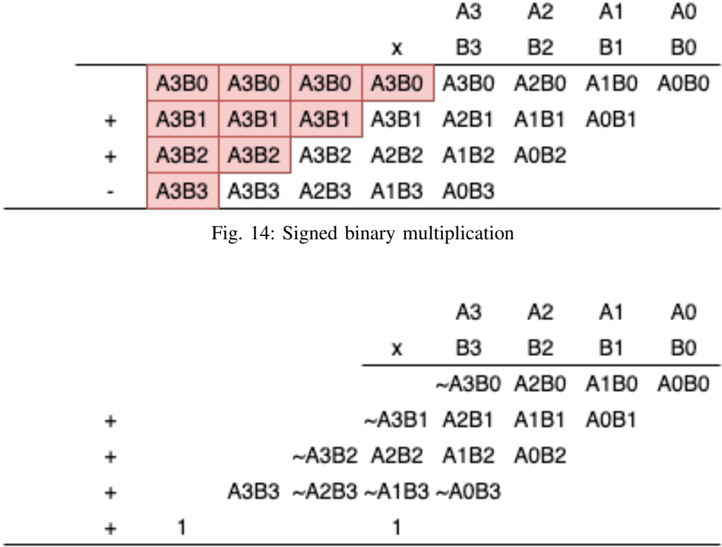
The image depicts a structured table illustrating the process of signed binary multiplication. It includes two primary sections: a detailed multiplication table and a summation table. The table uses algebraic notation (e.g., A3B0, A3B1) to represent terms, with signs (+, -) indicating positive or negative values. Red highlights emphasize specific terms in the multiplication table.
### Components/Axes
- **Headers**:
- Top row: `A3`, `A2`, `A1`, `A0` (multiplicand coefficients).
- Leftmost column: `+`, `+`, `+`, `-` (signs of the multiplier terms).
- **Multiplication Table**:
- Rows correspond to multiplier terms (e.g., `A3B0`, `A3B1`, `A3B2`, `A3B3`).
- Columns correspond to multiplicand terms (e.g., `A3`, `A2`, `A1`, `A0`).
- Entries represent products of multiplier and multiplicand terms (e.g., `A3B0`, `A2B1`).
- **Summation Table**:
- Rows represent aggregated terms (e.g., `~A3B2`, `~A2B3`).
- Final row: `1` (likely a carry or constant term).
### Detailed Analysis
1. **Multiplication Table**:
- **Row 1 (+)**:
- `A3B0` (A3 × B0), `A3B0` (A3 × B0), `A3B0` (A3 × B0), `A3B0` (A3 × B0).
- Subsequent entries: `A3B1`, `A2B1`, `A1B1`, `A0B1`.
- **Row 2 (+)**:
- `A3B2`, `A3B2`, `A2B2`, `A1B2`, `A0B2`.
- **Row 3 (+)**:
- `A3B3`, `A3B3`, `A2B3`, `A1B3`, `A0B3`.
- **Row 4 (-)**:
- `A3B3` (negative sign applied).
2. **Summation Table**:
- **Row 1**: `~A3B0`, `A2B0`, `A1B0`, `A0B0` (negative term `~A3B0` from the fourth row).
- **Row 2**: `~A3B1`, `A2B1`, `A1B1`, `A0B1`.
- **Row 3**: `~A3B2`, `A2B2`, `A1B2`, `A0B2`.
- **Row 4**: `A3B3`, `~A2B3`, `~A1B3`, `~A0B3` (negative terms from the fourth row).
- **Final Row**: `1` (likely a carry or normalization term).
### Key Observations
- **Red Highlights**: Emphasize the terms `A3B0`, `A3B1`, `A3B2`, and `A3B3` in the multiplication table, suggesting these are critical for the final result.
- **Sign Handling**: The `-` sign in the fourth row indicates a negative contribution from `A3B3`, which is later represented as `~A3B3` in the summation table.
- **Aggregation**: The summation table combines terms with `~` to denote negative values, reflecting the signed nature of the multiplication.
- **Final Term**: The `1` in the last row may represent a carry or a constant term added to the result.
### Interpretation
This table demonstrates the step-by-step process of signed binary multiplication, where:
1. **Multiplier Terms**: Each row in the multiplication table corresponds to a term in the multiplier (e.g., `A3B0`, `A3B1`).
2. **Sign Propagation**: The `-` sign in the fourth row propagates to the summation table as `~A3B3`, ensuring correct handling of negative values.
3. **Term Aggregation**: The summation table combines all terms, with `~` indicating negative contributions. The final `1` suggests a carry or normalization step, common in binary arithmetic.
4. **Red Highlights**: Likely emphasize the most significant terms (e.g., `A3B0`, `A3B1`, `A3B2`, `A3B3`) in the multiplication process.
The structure aligns with standard binary multiplication algorithms, where each term is computed, signed, and summed to produce the final result. The use of `~` for negative terms and the final `1` highlights the importance of sign management and carry propagation in signed binary operations.