## Diagram: Trilinear Operation (O = A · Bᵀ · C)
### Overview
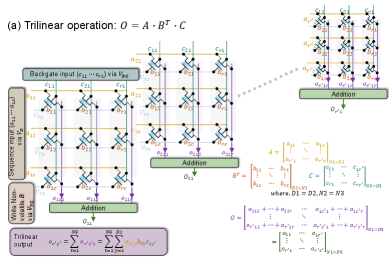
The diagram illustrates a trilinear operation (O = A · Bᵀ · C) implemented through a sequence of matrix operations and element-wise additions. It visualizes the flow of inputs through a computational graph, combining sequence and backgate inputs via weighted sums and matrix multiplications.
### Components/Axes
1. **Inputs**:
- **Sequence Input**: Labeled "Sequence input (c₁₁ ... c₁ᵣ) via V_seq" (leftmost column).
- **Backgate Input**: Labeled "Backgate input (c₁₁ ... c₁ᵣ) via V_Bd" (top row).
2. **Matrix Operations**:
- A grid of blue (B) and red (C) components, each connected to inputs via vertical/horizontal lines.
- Intermediate additions (green boxes) combine B and C components.
3. **Output**:
- Final output labeled "Trilinear output" (bottom right), derived from summing intermediate results.
### Detailed Analysis
- **Matrix Dimensions**:
- A: [D₁ × D₂], B: [D₂ × N₂], C: [N₂ × N₃] (explicitly labeled).
- Bᵀ (transpose of B) is used in the operation.
- **Equations**:
- Bᵀ = [[b₁₁, b₁₂, ..., b₁ᵣ], ..., [bᵣ₁, bᵣ₂, ..., bᵣᵣ]].
- C = [[c₁₁, c₁₂, ..., c₁ᵣ], ..., [cᵣ₁, cᵣ₂, ..., cᵣᵣ]].
- O' = ΣΣΣ (aᵢⱼ · bⱼₖ · cₖₗ) for all i, j, k, l.
- **Color Coding**:
- Blue (B) and red (C) components are consistently color-coded across the matrix.
- No explicit legend, but colors align with matrix definitions.
### Key Observations
1. **Flow Direction**: Inputs flow left-to-right (sequence) and top-to-bottom (backgate), converging in the matrix.
2. **Intermediate Steps**: Each matrix cell combines B and C components via addition before contributing to the final output.
3. **Mathematical Consistency**: The equations match the diagram’s structure, confirming the trilinear operation’s decomposition.
### Interpretation
The diagram demonstrates how a trilinear operation is implemented using matrix multiplications and additions. The sequence and backgate inputs are transformed through matrices A, B, and C, with their interactions encoded in the summation of products (aᵢⱼ · bⱼₖ · cₖₗ). This structure suggests applications in tasks requiring multi-dimensional input integration, such as neural network layers or tensor operations. The use of backgate inputs implies a mechanism to modulate sequence processing, potentially for attention or gating mechanisms in models like transformers or RNNs.