## Diagram: Software Packaging Workflow
### Overview
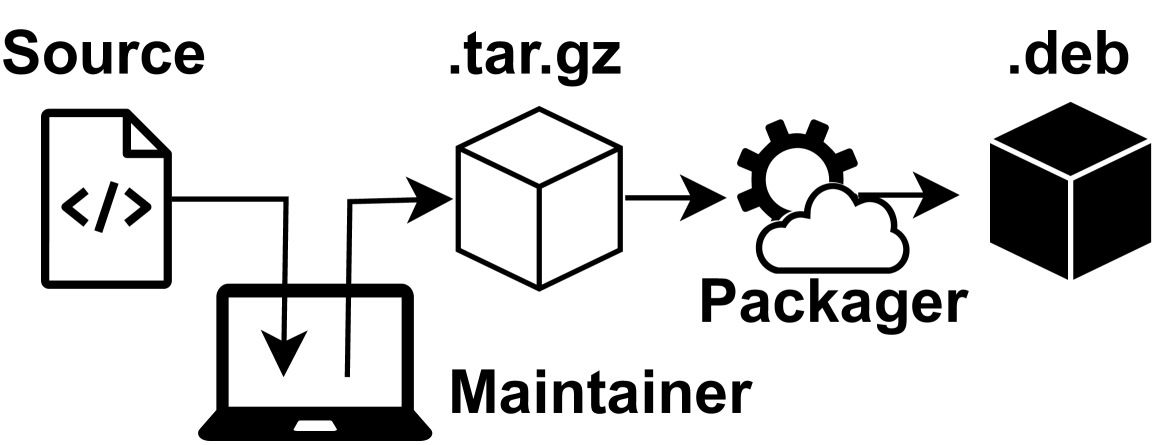
The image is a black-and-white technical diagram illustrating a linear workflow for creating a Debian package (`.deb`) from source code. It depicts a sequence of stages involving different entities and file formats, connected by directional arrows indicating the flow of the process.
### Components/Axes
The diagram consists of five primary components arranged horizontally from left to right, with one component positioned below the main flow.
1. **Source (Top-Left):** Represented by an icon of a document with a folded corner and the code symbol `</>`. The label "Source" is positioned above the icon.
2. **Maintainer (Bottom-Left):** Represented by an icon of a laptop computer. The label "Maintainer" is positioned to the right of the laptop icon.
3. **.tar.gz (Center):** Represented by an icon of a simple 3D box or cube. The label ".tar.gz" is positioned above the icon.
4. **Packager (Center-Right):** Represented by a combined icon of a gear (cog) and a cloud. The label "Packager" is positioned below the icon.
5. **.deb (Far-Right):** Represented by an icon of a solid, dark 3D cube. The label ".deb" is positioned above the icon.
**Flow Connections (Arrows):**
* An arrow originates from the "Source" icon, travels right, then down, pointing into the top of the "Maintainer" laptop icon.
* An arrow originates from the "Maintainer" laptop icon, travels up, then right, pointing into the left side of the ".tar.gz" box icon.
* An arrow points directly from the right side of the ".tar.gz" box icon to the left side of the "Packager" gear/cloud icon.
* An arrow points directly from the right side of the "Packager" gear/cloud icon to the left side of the ".deb" cube icon.
### Detailed Analysis
The diagram outlines a specific, sequential technical process:
1. **Stage 1 - Source Code:** The process begins with "Source" code, symbolized by the `</>` document.
2. **Stage 2 - Human Intervention:** The source code is acted upon by a "Maintainer," represented by the laptop. This implies a human developer or package maintainer performs manual preparation, configuration, or modification steps.
3. **Stage 3 - Archiving:** The output of the maintainer's work is a compressed tarball, denoted by the ".tar.gz" label and box icon. This is a standard format for distributing source code archives on Unix-like systems.
4. **Stage 4 - Automated Packaging:** The `.tar.gz` archive is processed by a "Packager," symbolized by the gear (automation/tool) and cloud (potentially indicating a build service or repository). This stage represents automated build scripts or tools (like `dpkg-buildpackage`) that compile the source and organize files according to Debian policy.
5. **Stage 5 - Final Artifact:** The final output is a Debian binary package, represented by the solid ".deb" cube icon. This is the installable package file.
### Key Observations
* **Role Distinction:** The diagram clearly separates the human role ("Maintainer") from the automated tool role ("Packager").
* **File Format Specificity:** It explicitly names the intermediate (`.tar.gz`) and final (`.deb`) file formats, which are specific to the Debian/Ubuntu software ecosystem.
* **Linear, Unidirectional Flow:** The process is shown as a one-way pipeline with no feedback loops or decision points, suggesting a simplified, idealized view of the packaging process.
* **Iconography:** The icons are symbolic rather than literal. The "Packager" cloud/gear combo is particularly abstract, representing a process rather than a single physical object.
### Interpretation
This diagram serves as a high-level conceptual model for the **Debian package creation pipeline**. It communicates the fundamental transformation of raw source code into a distributable, installable binary package.
* **What it demonstrates:** It illustrates the division of labor between human curation (the Maintainer who prepares the source, writes rules, and ensures policy compliance) and machine automation (the Packager that executes the build in a controlled environment). The flow emphasizes that the maintainer's output is not the final package, but a prepared source archive that feeds into an automated build system.
* **Relationships:** The arrows define a strict dependency chain. The `.deb` file cannot be created without the Packager, which requires the `.tar.gz` archive, which in turn depends on the work of the Maintainer using the original Source. Each component is a necessary precursor to the next.
* **Notable Context:** This workflow is foundational to Linux distribution maintenance. The "Maintainer" is a key role in open-source projects, responsible for the packaging and long-term support of software within a distribution like Debian or Ubuntu. The "Packager" likely refers to tools like `pbuilder`, `sbuild`, or CI/CD systems that ensure clean, reproducible builds. The diagram abstracts away complexities like dependency resolution, patching, and configuration, focusing instead on the core transformation of artifacts.