\n
## Line Chart: Dialectic with Annealing τ
### Overview
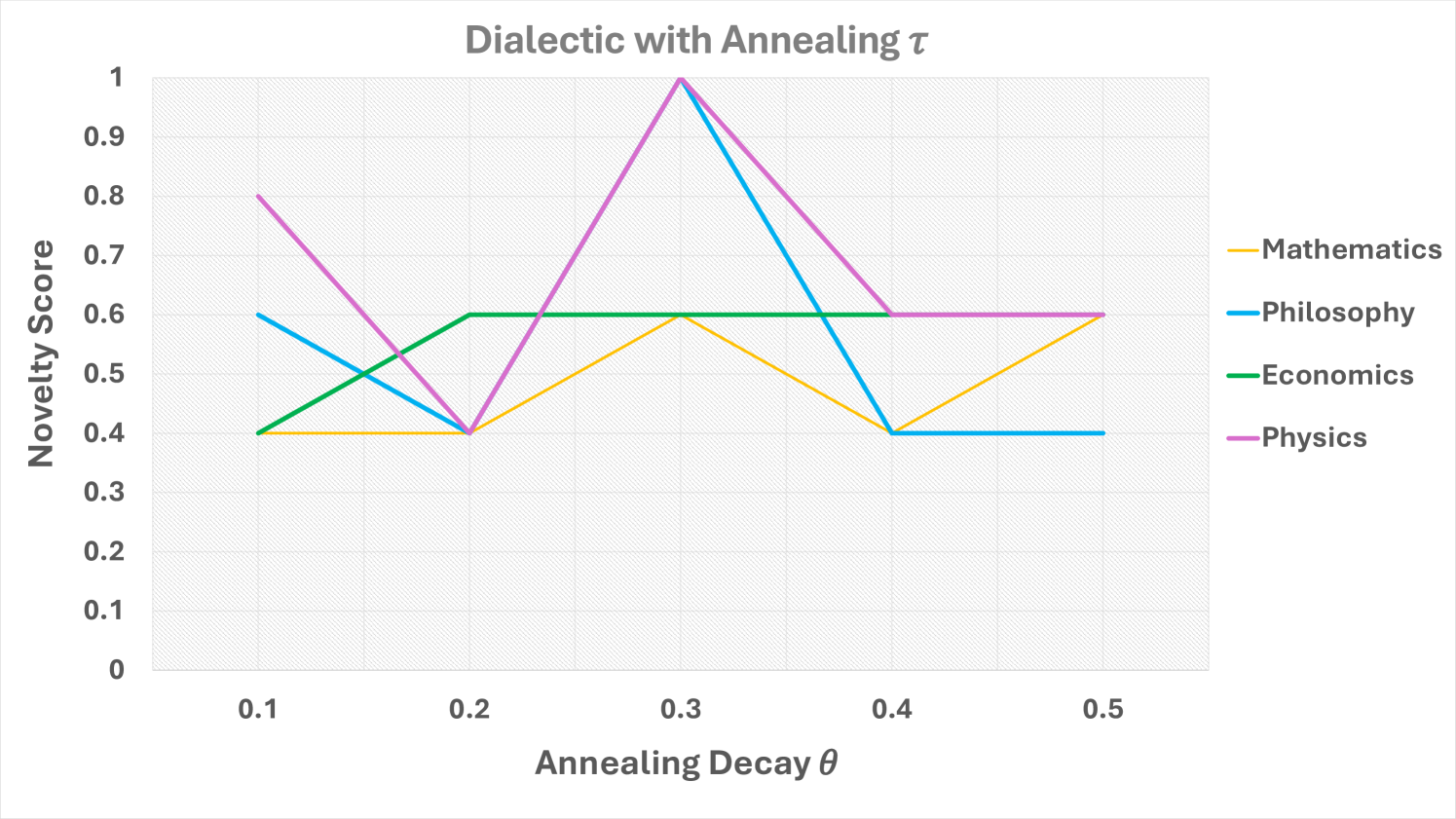
The image is a line chart titled "Dialectic with Annealing τ". It plots the "Novelty Score" (y-axis) against the "Annealing Decay θ" (x-axis) for four distinct academic subjects. The chart visualizes how the novelty score for each subject changes as the annealing decay parameter increases from 0.1 to 0.5.
### Components/Axes
* **Title:** "Dialectic with Annealing τ" (Top center, gray text).
* **Y-Axis:**
* **Label:** "Novelty Score" (Vertical text, left side).
* **Scale:** Linear scale from 0 to 1, with major tick marks at every 0.1 increment (0, 0.1, 0.2, ... 1).
* **X-Axis:**
* **Label:** "Annealing Decay θ" (Bottom center).
* **Scale:** Linear scale from 0.1 to 0.5, with major tick marks at 0.1, 0.2, 0.3, 0.4, and 0.5.
* **Legend:** Located on the right side of the chart, outside the plot area. It maps line colors to subjects:
* **Yellow/Gold Line:** Mathematics
* **Blue Line:** Philosophy
* **Green Line:** Economics
* **Purple/Magenta Line:** Physics
* **Grid:** A light gray grid is present in the background of the plot area.
### Detailed Analysis
The chart displays four data series, each representing a subject's novelty score at five discrete points of annealing decay (θ = 0.1, 0.2, 0.3, 0.4, 0.5).
**1. Mathematics (Yellow Line):**
* **Trend:** The line starts flat, dips, rises to a peak, falls, and then rises again.
* **Data Points:**
* θ = 0.1: Novelty Score ≈ 0.4
* θ = 0.2: Novelty Score ≈ 0.4 (line is flat from 0.1 to 0.2)
* θ = 0.3: Novelty Score ≈ 0.6 (peak)
* θ = 0.4: Novelty Score ≈ 0.4
* θ = 0.5: Novelty Score ≈ 0.6
**2. Philosophy (Blue Line):**
* **Trend:** The line shows a general downward trend with a significant spike at θ=0.3.
* **Data Points:**
* θ = 0.1: Novelty Score ≈ 0.6
* θ = 0.2: Novelty Score ≈ 0.4
* θ = 0.3: Novelty Score ≈ 1.0 (sharp peak, maximum value on chart)
* θ = 0.4: Novelty Score ≈ 0.4
* θ = 0.5: Novelty Score ≈ 0.4 (line is flat from 0.4 to 0.5)
**3. Economics (Green Line):**
* **Trend:** The line rises initially and then remains perfectly stable.
* **Data Points:**
* θ = 0.1: Novelty Score ≈ 0.4
* θ = 0.2: Novelty Score ≈ 0.6
* θ = 0.3: Novelty Score ≈ 0.6
* θ = 0.4: Novelty Score ≈ 0.6
* θ = 0.5: Novelty Score ≈ 0.6 (line is flat from θ=0.2 onward)
**4. Physics (Purple/Magenta Line):**
* **Trend:** The line exhibits high volatility, with a sharp drop, a dramatic peak, and a final plateau.
* **Data Points:**
* θ = 0.1: Novelty Score ≈ 0.8
* θ = 0.2: Novelty Score ≈ 0.4 (sharp drop)
* θ = 0.3: Novelty Score ≈ 1.0 (sharp peak, tied with Philosophy for maximum value)
* θ = 0.4: Novelty Score ≈ 0.6
* θ = 0.5: Novelty Score ≈ 0.6 (line is flat from 0.4 to 0.5)
### Key Observations
1. **Peak Convergence at θ=0.3:** Both Philosophy and Physics achieve their maximum novelty score of 1.0 at the same annealing decay value (θ=0.3). This is the most notable feature of the chart.
2. **Stability of Economics:** After an initial increase, the novelty score for Economics remains constant at 0.6 for all values of θ from 0.2 to 0.5, showing no sensitivity to further changes in the annealing decay parameter within this range.
3. **Volatility vs. Stability:** Physics and Philosophy show high volatility (large swings in score), while Economics is highly stable after an initial adjustment. Mathematics shows moderate, oscillating volatility.
4. **Common Starting Point:** At the lowest annealing decay (θ=0.1), Mathematics and Economics share the same novelty score (≈0.4), while Philosophy (≈0.6) and Physics (≈0.8) start higher.
5. **Final Values:** At the highest annealing decay (θ=0.5), three subjects converge: Mathematics, Economics, and Physics all have a novelty score of approximately 0.6. Philosophy is the outlier at this point with a lower score of ≈0.4.
### Interpretation
This chart likely illustrates the results of an experiment or simulation where a "dialectic" process (possibly a form of debate, idea generation, or optimization) is modulated by an "annealing decay" parameter (θ). The "novelty score" quantifies the originality or创新性 of the output.
* **Parameter Sensitivity:** The parameter θ has a profound and non-linear effect on novelty. The dramatic peak at θ=0.3 for Philosophy and Physics suggests a "sweet spot" where the annealing process maximally stimulates novel outcomes for these complex, theoretical fields.
* **Field-Specific Behavior:** The distinct patterns imply that different domains respond uniquely to the same process parameter.
* **Economics** appears robust; its novelty quickly reaches a plateau and is unaffected by further tuning of θ.
* **Philosophy and Physics** are highly sensitive, exhibiting a resonant peak. Their identical peak and final plateau (for Physics) might suggest a shared underlying structure in how novelty is generated in these fundamental disciplines under this model.
* **Mathematics** shows a cyclical response, suggesting its novelty generation might be optimized at multiple, discrete parameter settings (θ=0.3 and θ=0.5).
* **Practical Implication:** If one's goal is to maximize novel output from a dialectic process applied to Philosophy or Physics, setting the annealing decay θ to approximately 0.3 is critical. For Economics, any θ ≥ 0.2 yields the same result. For Mathematics, the choice between θ=0.3 and θ=0.5 may depend on other constraints. The chart provides a clear guide for parameter tuning based on the target domain.