## Line Chart: Parallel vs. Sequential Scaling: MATH-500
### Overview
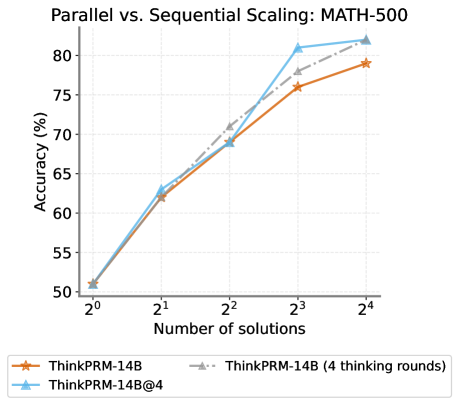
The image is a line chart comparing the accuracy of different configurations of "ThinkPRM-14B" models as the number of solutions increases. The x-axis represents the number of solutions (ranging from 2^0 to 2^4), and the y-axis represents the accuracy in percentage (ranging from 50% to 80%). Three different configurations are compared: ThinkPRM-14B, ThinkPRM-14B@4, and ThinkPRM-14B (4 thinking rounds).
### Components/Axes
* **Title:** Parallel vs. Sequential Scaling: MATH-500
* **X-axis Title:** Number of solutions
* **X-axis Scale:** 2^0, 2^1, 2^2, 2^3, 2^4
* **Y-axis Title:** Accuracy (%)
* **Y-axis Scale:** 50, 55, 60, 65, 70, 75, 80
* **Legend:** Located at the bottom of the chart.
* **ThinkPRM-14B:** Orange line with star markers.
* **ThinkPRM-14B@4:** Blue line with triangle markers.
* **ThinkPRM-14B (4 thinking rounds):** Gray dashed line with triangle markers.
### Detailed Analysis
* **ThinkPRM-14B (Orange Line):**
* Trend: The line slopes upward, indicating increasing accuracy with more solutions.
* Data Points:
* 2^0 solutions: Accuracy ≈ 51%
* 2^1 solutions: Accuracy ≈ 62%
* 2^2 solutions: Accuracy ≈ 70%
* 2^3 solutions: Accuracy ≈ 76%
* 2^4 solutions: Accuracy ≈ 79%
* **ThinkPRM-14B@4 (Blue Line):**
* Trend: The line slopes upward, indicating increasing accuracy with more solutions.
* Data Points:
* 2^0 solutions: Accuracy ≈ 51%
* 2^1 solutions: Accuracy ≈ 63%
* 2^2 solutions: Accuracy ≈ 71%
* 2^3 solutions: Accuracy ≈ 81%
* 2^4 solutions: Accuracy ≈ 81%
* **ThinkPRM-14B (4 thinking rounds) (Gray Dashed Line):**
* Trend: The line slopes upward, indicating increasing accuracy with more solutions.
* Data Points:
* 2^0 solutions: Accuracy ≈ 51%
* 2^1 solutions: Accuracy ≈ 62%
* 2^2 solutions: Accuracy ≈ 70%
* 2^3 solutions: Accuracy ≈ 79%
* 2^4 solutions: Accuracy ≈ 81%
### Key Observations
* All three configurations show an increase in accuracy as the number of solutions increases.
* ThinkPRM-14B@4 generally performs slightly better than the other two configurations, especially at 2^3 solutions.
* ThinkPRM-14B and ThinkPRM-14B (4 thinking rounds) perform very similarly.
### Interpretation
The chart demonstrates the impact of parallel and sequential scaling on the accuracy of the ThinkPRM-14B model when solving problems from the MATH-500 dataset. Increasing the number of solutions generally improves accuracy for all configurations. The "ThinkPRM-14B@4" configuration, which likely represents a parallel processing approach, shows a slight advantage over the sequential "ThinkPRM-14B" and "ThinkPRM-14B (4 thinking rounds)" configurations, especially as the number of solutions increases. This suggests that parallel scaling can be more effective in improving the model's performance on this task. The performance of "ThinkPRM-14B (4 thinking rounds)" being very close to "ThinkPRM-14B" suggests that increasing the number of thinking rounds has a limited impact on accuracy compared to increasing the number of solutions or using a parallel approach.