# Technical Document Extraction: Comparison of ReAct and LATS Reasoning Frameworks
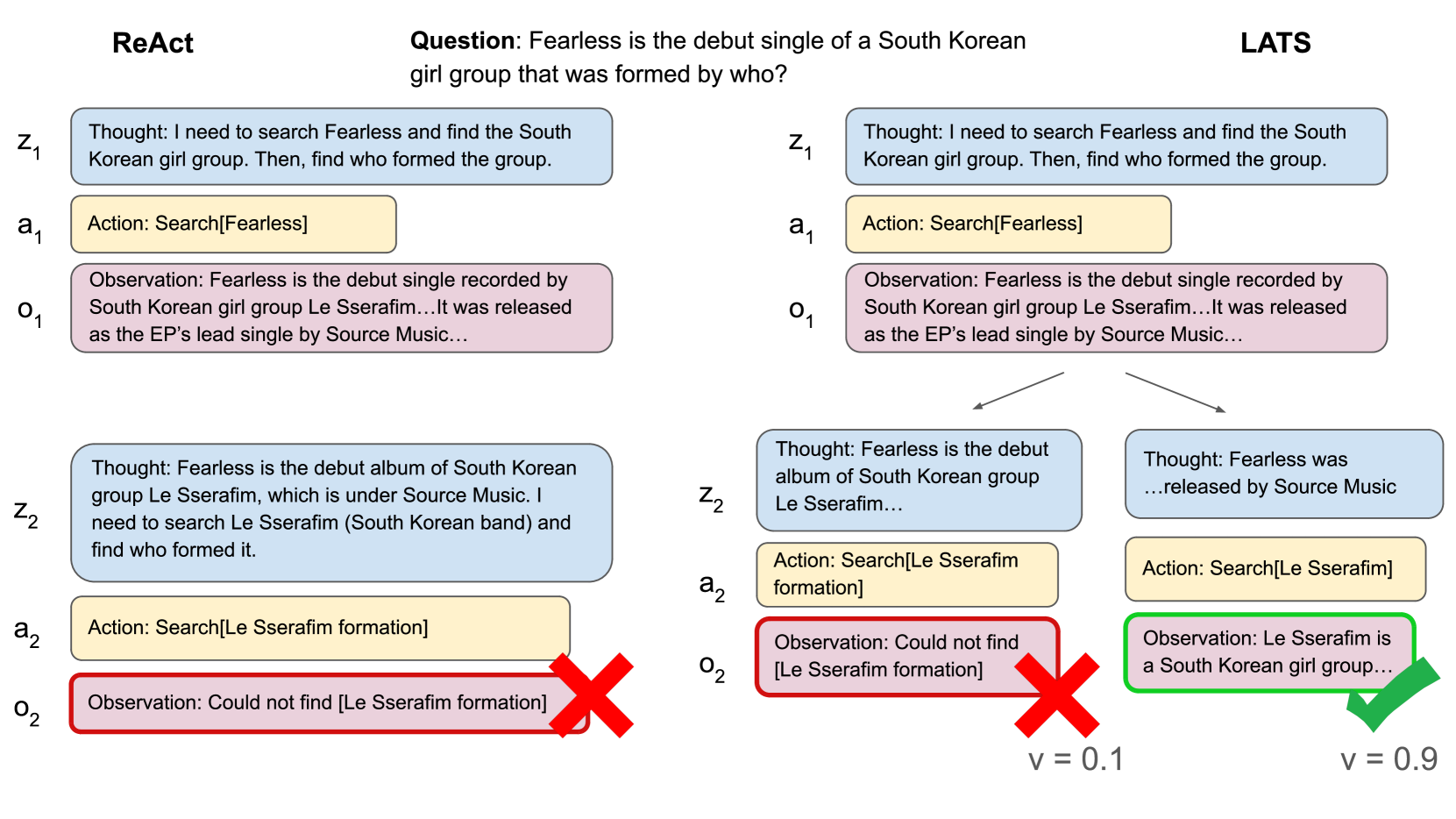
This document provides a detailed extraction and analysis of the provided image, which illustrates a comparative workflow between two Large Language Model (LLM) reasoning frameworks: **ReAct** and **LATS**.
## 1. Header Information
* **Central Question:** "Question: Fearless is the debut single of a South Korean girl group that was formed by who?"
---
## 2. Component Isolation: ReAct (Left Column)
The ReAct framework follows a linear, sequential chain of reasoning, acting, and observing.
### Step 1 ($z_1, a_1, o_1$)
* **Thought ($z_1$):** "I need to search Fearless and find the South Korean girl group. Then, find who formed the group." (Blue box)
* **Action ($a_1$):** "Search[Fearless]" (Yellow box)
* **Observation ($o_1$):** "Fearless is the debut single recorded by South Korean girl group Le Sserafim... It was released as the EP's lead single by Source Music..." (Pink box)
### Step 2 ($z_2, a_2, o_2$)
* **Thought ($z_2$):** "Fearless is the debut album of South Korean group Le Sserafim, which is under Source Music. I need to search Le Sserafim (South Korean band) and find who formed it." (Blue box)
* **Action ($a_2$):** "Search[Le Sserafim formation]" (Yellow box)
* **Observation ($o_2$):** "Could not find [Le Sserafim formation]" (Pink box with a thick red border).
* **Outcome:** This path ends with a large **Red X**, indicating a failure to retrieve the necessary information in this linear sequence.
---
## 3. Component Isolation: LATS (Right Column)
The LATS (Language Agent Tree Search) framework utilizes a branching tree structure to explore multiple reasoning paths simultaneously and evaluate them.
### Step 1 ($z_1, a_1, o_1$) - Identical to ReAct
* **Thought ($z_1$):** "I need to search Fearless and find the South Korean girl group. Then, find who formed the group."
* **Action ($a_1$):** "Search[Fearless]"
* **Observation ($o_1$):** "Fearless is the debut single recorded by South Korean girl group Le Sserafim... It was released as the EP's lead single by Source Music..."
### Step 2 Branching ($z_2, a_2, o_2$)
From the first observation, the model branches into two distinct paths:
#### Path A (Left Branch - Failure)
* **Thought ($z_2$):** "Fearless is the debut album of South Korean group Le Sserafim..."
* **Action ($a_2$):** "Search[Le Sserafim formation]"
* **Observation ($o_2$):** "Could not find [Le Sserafim formation]" (Pink box with thick red border).
* **Evaluation:** Marked with a **Red X** and a value of **v = 0.1**.
#### Path B (Right Branch - Success)
* **Thought ($z_2$):** "Fearless was ...released by Source Music"
* **Action ($a_2$):** "Search[Le Sserafim]"
* **Observation ($o_2$):** "Le Sserafim is a South Korean girl group..." (Pink box with thick green border).
* **Evaluation:** Marked with a **Green Checkmark** and a value of **v = 0.9**.
---
## 4. Key Trends and Logic Analysis
* **Structural Difference:** ReAct is depicted as a **linear chain**, whereas LATS is depicted as a **search tree**.
* **Error Recovery:** In the ReAct model, when the search for "Le Sserafim formation" fails, the process stops. In the LATS model, the system evaluates two different search strategies ($a_2$) based on the same initial observation ($o_1$).
* **Scoring Mechanism:** LATS introduces a value metric (**v**). The failed path is assigned a low value (0.1), while the successful path is assigned a high value (0.9), allowing the agent to prioritize the more promising reasoning branch.
* **Color Coding:**
* **Blue:** Thoughts ($z$)
* **Yellow:** Actions ($a$)
* **Pink:** Observations ($o$)
* **Red Border/X:** Failed or low-value path.
* **Green Border/Check:** Successful or high-value path.
## 5. Summary of Data Points
| Framework | Structure | Final Status | Evaluation Metric |
| :--- | :--- | :--- | :--- |
| **ReAct** | Linear | Failed (Red X) | N/A |
| **LATS** | Branching (Tree) | Success (Green Check) | v=0.1 (Fail) / v=0.9 (Success) |