## Diagram: Model Response to User Prompt
### Overview
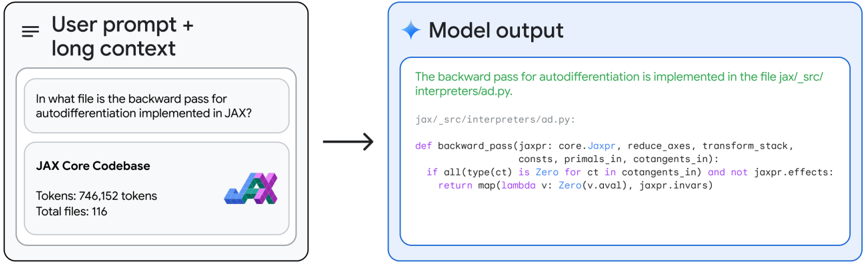
The image shows a diagram illustrating a model's response to a user prompt related to the JAX codebase. The diagram is divided into two main sections: the user prompt with context and the model's output. An arrow indicates the flow from the prompt to the output.
### Components/Axes
* **Left Section:** "User prompt + long context"
* Contains the user's question: "In what file is the backward pass for autodifferentiation implemented in JAX?"
* "JAX Core Codebase"
* "Tokens: 746,152 tokens"
* "Total files: 116"
* JAX logo
* **Right Section:** "Model output"
* The model's answer: "The backward pass for autodifferentiation is implemented in the file jax/\_src/interpreters/ad.py."
* Code snippet:
* "jax/\_src/interpreters/ad.py:"
* "def backward\_pass(jaxpr: core.Jaxpr, reduce\_axes, transform\_stack, consts, primals\_in, cotangents\_in):"
* "if all(type(ct) is Zero for ct in cotangents\_in) and not jaxpr.effects:"
* "return map(lambda v: Zero(v.aval), jaxpr.invars)"
### Detailed Analysis or ### Content Details
* **User Prompt:** The user is asking about the location of the backward pass implementation for autodifferentiation within the JAX codebase.
* **JAX Core Codebase Stats:** The codebase consists of 746,152 tokens and 116 files.
* **Model Output:** The model identifies the file "jax/\_src/interpreters/ad.py" as the location of the backward pass implementation.
* **Code Snippet:** The code snippet shows the definition of the `backward_pass` function, which takes several arguments related to JAX's internal representation (Jaxpr), reduction axes, transformation stack, constants, primal inputs, and cotangent inputs. It also includes a conditional statement that checks if all cotangents are zero and if there are no side effects. If both conditions are true, it returns a mapping of the input variables to zero.
### Key Observations
* The model accurately identifies the file containing the backward pass implementation.
* The code snippet provides context about the function's signature and a key conditional statement.
### Interpretation
The diagram demonstrates a successful query to a model about the JAX codebase. The model not only provides the correct file path but also includes a relevant code snippet, offering further insight into the implementation. The inclusion of codebase statistics (tokens and files) gives a sense of the project's scale. The code snippet shows the function definition and a conditional statement, suggesting a possible optimization or handling of special cases within the backward pass.