## Line Chart: NSGA-II with N=n+1 on LOTZ
### Overview
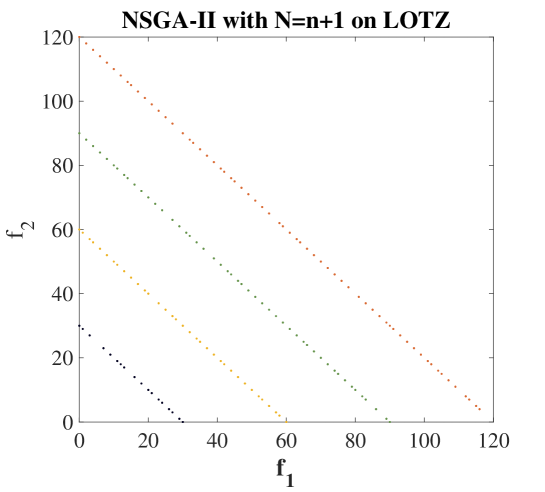
The chart visualizes a Pareto front generated by the NSGA-II evolutionary algorithm with population size N=n+1 applied to the LOTZ problem. It shows four linear trade-off curves between two objective functions, f₁ and f₂, with distinct line styles and colors.
### Components/Axes
- **X-axis (f₁)**: Ranges from 0 to 120 in increments of 20.
- **Y-axis (f₂)**: Ranges from 0 to 120 in increments of 20.
- **Legend**: Located in the top-left corner, associating four line styles with colors:
- Solid red
- Dotted green
- Dashed orange
- Dash-dot black
### Detailed Analysis
1. **Solid Red Line**:
- Connects (0, 120) to (120, 0).
- Equation: f₂ = -f₁ + 120.
- Represents the outermost Pareto-optimal boundary.
2. **Dotted Green Line**:
- Connects (0, 90) to (90, 0).
- Equation: f₂ = -f₁ + 90.
- Parallel to the red line but shifted inward.
3. **Dashed Orange Line**:
- Connects (0, 60) to (60, 0).
- Equation: f₂ = -f₁ + 60.
- Further inward, maintaining parallelism.
4. **Dash-Dot Black Line**:
- Connects (0, 30) to (30, 0).
- Equation: f₂ = -f₁ + 30.
- Innermost curve, closest to the origin.
All lines have a slope of -1, indicating linear trade-offs between f₁ and f₂. The spacing between lines suggests incremental improvements in Pareto dominance.
### Key Observations
- All curves are straight and parallel, implying a linear relationship between objectives in this problem instance.
- The lines are evenly spaced vertically (30 units apart), suggesting uniform exploration of the Pareto front.
- No outliers or non-linear segments observed.
### Interpretation
The chart demonstrates that NSGA-II with N=n+1 efficiently explores the LOTZ problem's Pareto front, generating four distinct non-dominated solutions. The linear trade-offs suggest the problem has separable objectives or constraints that allow for straightforward optimization. The uniform spacing between curves may indicate consistent algorithmic performance across different population sizes or generations. This visualization highlights the algorithm's ability to balance exploration and exploitation in multi-objective optimization.