## System Architecture Diagram: Layered Game Console Interface
### Overview
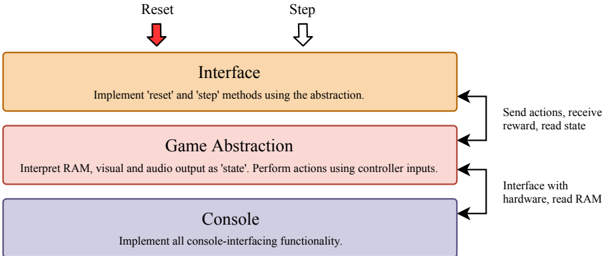
This image is a technical architecture diagram illustrating a three-layered software system designed to interface with a game console. The diagram uses color-coded boxes and directional arrows to define components, their functions, and the flow of control and data between them. The primary purpose is to abstract hardware interaction into a usable interface, likely for emulation, testing, or AI training environments.
### Components/Axes
The diagram is structured vertically into three distinct layers, from top to bottom:
1. **Top Control Inputs:**
* **Reset:** A red, downward-pointing arrow labeled "Reset".
* **Step:** A white, downward-pointing arrow labeled "Step".
* *Positioning:* Both arrows are centered above the top layer of the main diagram.
2. **Layer 1 (Top - Orange Box): Interface**
* **Label:** "Interface"
* **Function Text:** "Implement 'reset' and 'step' methods using the abstraction."
* *Positioning:* The topmost rectangular box in the main stack.
3. **Layer 2 (Middle - Pink Box): Game Abstraction**
* **Label:** "Game Abstraction"
* **Function Text:** "Interpret RAM, visual and audio output as 'state'. Perform actions using controller inputs."
* *Positioning:* The central rectangular box, sandwiched between the Interface and Console layers.
4. **Layer 3 (Bottom - Purple Box): Console**
* **Label:** "Console"
* **Function Text:** "Implement all console-interfacing functionality."
* *Positioning:* The bottom rectangular box in the main stack.
5. **Data Flow Arrows (Right Side):**
* **Between Interface and Game Abstraction:** A double-headed black arrow. The accompanying text reads: "Send actions, receive reward, read state".
* **Between Game Abstraction and Console:** A double-headed black arrow. The accompanying text reads: "Interface with hardware, read RAM".
### Detailed Analysis
The diagram defines a clear hierarchical and functional separation:
* **Control Flow:** External commands ("Reset", "Step") are injected directly into the **Interface** layer. This layer is responsible for implementing these methods by utilizing the services of the layer below it.
* **Abstraction Hierarchy:** The system is designed to hide complexity. The **Console** layer deals with raw hardware and memory (RAM). The **Game Abstraction** layer translates this low-level data (RAM, pixels, sound) into a structured "state" and translates high-level "actions" into controller inputs. The **Interface** layer then provides a simple API (`reset`, `step`) that operates on this abstracted state.
* **Data Exchange:** The double-headed arrows indicate bidirectional communication. The **Interface** sends action commands down and receives state and reward information up from the **Game Abstraction**. The **Game Abstraction** sends hardware commands down and reads raw memory (RAM) up from the **Console**.
### Key Observations
1. **Color Coding:** Each layer has a distinct color (orange, pink, purple), aiding visual separation. The "Reset" control arrow is uniquely colored red, possibly to emphasize its critical function of reinitializing the system.
2. **Terminology:** The use of terms like "state," "actions," and "reward" strongly suggests this architecture is designed for a reinforcement learning or AI agent training context, where an agent learns by taking actions in an environment and receiving rewards.
3. **Unidirectional vs. Bidirectional Flow:** Control signals (Reset, Step) flow only downward into the system. The internal communication between layers is fully bidirectional, as shown by the double-headed arrows.
4. **Encapsulation:** Each layer has a single, well-defined responsibility, promoting modularity. The Console's functionality is entirely contained, the Game Abstraction focuses on state interpretation, and the Interface focuses on method implementation.
### Interpretation
This diagram depicts a **standardized wrapper or environment for a game console**, most likely for use in machine learning research or automated testing.
* **Purpose:** It creates a clean, programmatic interface (`reset()`, `step(action)`) to interact with a game. This allows an external agent (like an AI model) to play the game without needing to understand the console's hardware specifics.
* **The "Reward" Signal:** The explicit mention of "receive reward" in the Interface↔Game Abstraction flow is the most significant clue. It confirms the system is built to provide evaluative feedback, which is the cornerstone of reinforcement learning. The reward would be calculated based on the game state (e.g., score increase, character death).
* **Abstraction Value:** By separating the "Console" (hardware emulation) from the "Game Abstraction" (state and action translation), the same AI training interface could potentially be adapted to different consoles or games by only modifying the lower layers. The high-level agent interacts only with the stable "Interface" layer.
* **Operational Flow:** A typical cycle would be: 1) External agent calls `reset()` on the Interface, which propagates down to reset the Console. 2) The agent calls `step(action)`, sending an action down. 3) The Game Abstraction translates it to controller input, the Console advances the game one frame, and the new state (and reward) propagates back up to the agent.
In essence, this is a blueprint for turning a game console into a formal **environment** for an AI agent, facilitating research in areas like game-playing AI, general reinforcement learning, and procedural content generation analysis.