## Flowchart: System Architecture for Game Controller Interface
### Overview
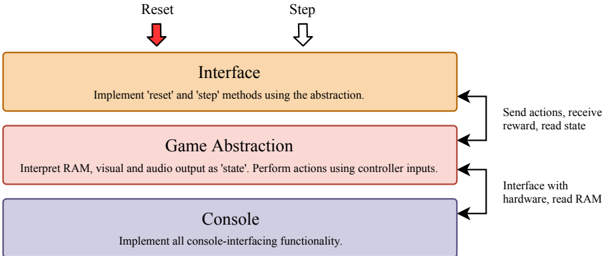
The diagram illustrates a three-layer system architecture for a game controller interface, showing the flow of data and control between hardware, game abstraction, and interface components. Arrows indicate bidirectional communication between layers, with specific functions assigned to each layer.
### Components/Axes
1. **Interface Layer** (Top)
- Label: "Interface"
- Description: "Implement 'reset' and 'step' methods using the abstraction."
- Arrows:
- Red arrow labeled "Reset" pointing downward
- Black arrow labeled "Step" pointing downward
2. **Game Abstraction Layer** (Middle)
- Label: "Game Abstraction"
- Description: "Interpret RAM, visual and audio output as 'state'. Perform actions using controller inputs."
- Arrows:
- Black arrow labeled "Send actions, receive reward, read state" pointing right
- Black arrow labeled "Interface with hardware, read RAM" pointing left
3. **Console Layer** (Bottom)
- Label: "Console"
- Description: "Implement all console-interfacing functionality."
- Arrows: None directly connected (only receives from Game Abstraction)
### Detailed Analysis
- **Interface Layer**: Contains control flow management with explicit 'reset' and 'step' operations. The red "Reset" arrow suggests emergency termination capability.
- **Game Abstraction Layer**: Acts as middleware, translating low-level hardware data (RAM, visual/audio) into game state while handling controller input processing.
- **Console Layer**: Represents the lowest level, handling direct hardware interaction and memory access.
### Key Observations
1. Bidirectional communication exists between Interface and Game Abstraction layers
2. Console layer only receives information from Game Abstraction
3. "State" is defined as a composite of RAM, visual, and audio data
4. Controller inputs are used for action execution in Game Abstraction
5. Hardware interaction occurs at both Game Abstraction and Console layers
### Interpretation
This architecture demonstrates a hierarchical control system where:
1. The Interface layer manages high-level game operations through abstraction
2. The Game Abstraction layer serves as a critical translation layer between hardware and interface
3. The Console layer provides foundational hardware access
4. The system emphasizes state management through multi-modal data interpretation (RAM, visual, audio)
5. The bidirectional arrows suggest real-time feedback loops between interface and game abstraction layers
The design prioritizes modularity, with each layer handling specific responsibilities while maintaining necessary communication channels. The explicit separation of console interfacing functionality suggests potential for hardware abstraction or cross-platform compatibility.