\n
## Handwritten Mathematical Manuscripts: Analysis of Einstein's Relativity Notes
### Overview
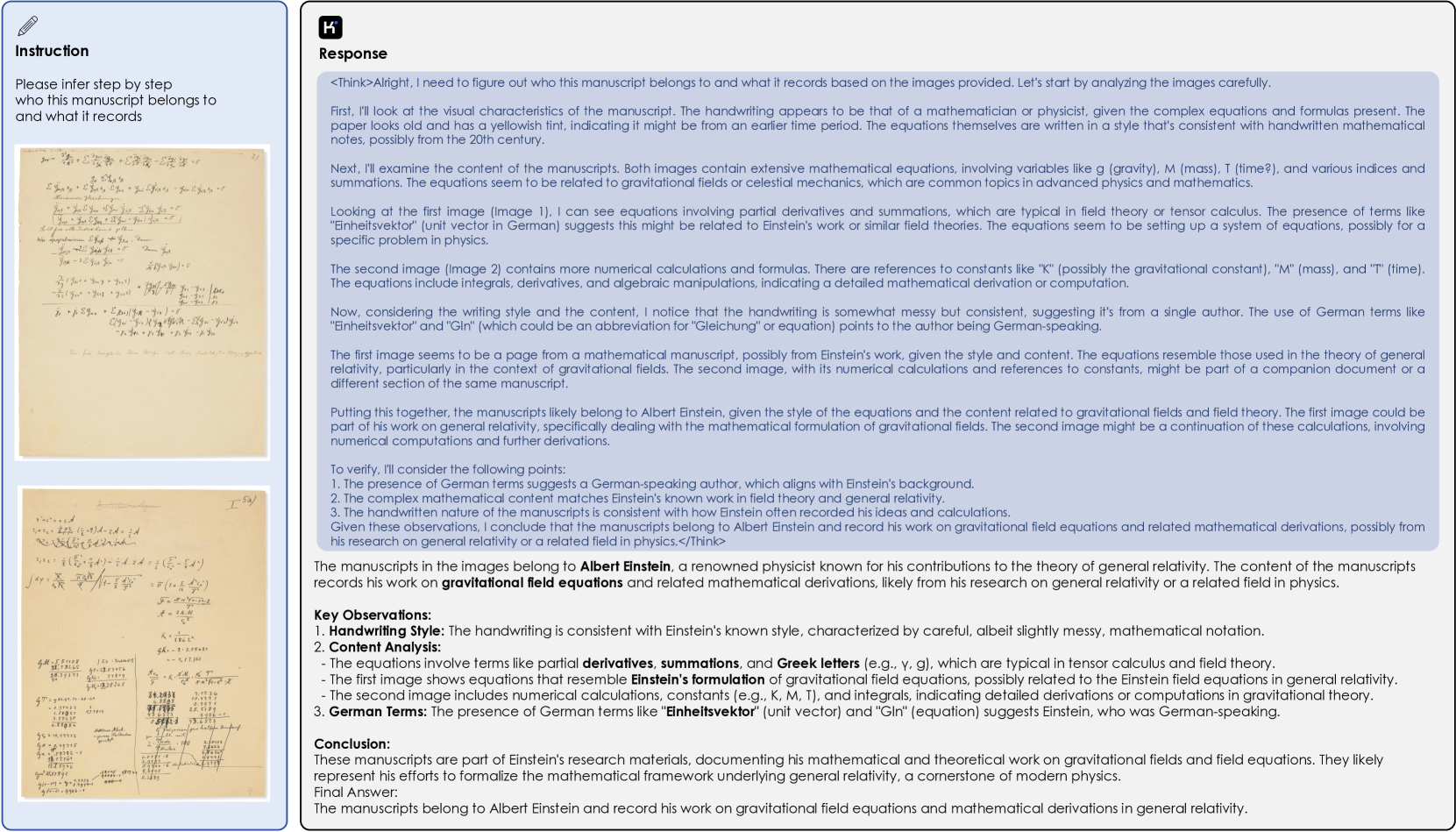
The images depict two pages of handwritten mathematical notes, seemingly belonging to Albert Einstein. The notes are densely filled with equations and calculations related to gravitational fields and celestial mechanics, likely pertaining to the theory of general relativity. The handwriting appears consistent across both pages, suggesting they are part of the same document or a closely related series.
### Components/Axes
There are no explicit axes or legends in the traditional sense of a chart or graph. The "components" are the individual equations, symbols, and annotations scattered across the pages. The structure is primarily hierarchical, with main equations branching into sub-calculations and explanatory notes.
### Detailed Analysis or Content Details
**Image 1 (Left):**
This page contains a complex series of equations. The dominant theme appears to be the manipulation of partial derivatives and summations, typical in tensor calculus and field theory.
* **Top Section:** A large equation involving partial derivatives (∂) and summations (Σ). The equation includes terms like "g<sub>μν</sub>" (likely the metric tensor), "Γ<sup>μ</sup><sub>νλ</sub>" (Christoffel symbols), and "x<sup>μ</sup>".
* **Central Section:** Further equations building upon the initial one, with continued use of indices and summations. There are references to "ds<sup>2</sup>" (the spacetime interval).
* **Bottom Section:** More equations and annotations, including what appears to be a derivation or simplification of the previous expressions.
**Image 2 (Right):**
This page focuses on numerical calculations and references to constants.
* **Top Section:** Equations involving constants like "G" (likely the gravitational constant, approximately 6.674 x 10<sup>-11</sup> m<sup>3</sup> kg<sup>-1</sup> s<sup>-2</sup>), "M" (mass), and "T" (time).
* **Central Section:** A series of calculations, potentially related to the bending of light or the precession of planetary orbits.
* **Bottom Section:** Further calculations and annotations, including what appears to be a comparison of theoretical results with observational data.
**German Text Transcription & Translation:**
* **Image 1:** The phrase "Einheitsvektor" is visible.
* **Translation:** "Unit vector"
* **Image 2:** The phrase "Gl<sup>eichung</sup>" is visible.
* **Translation:** "Equation"
**Specific Equations (Approximate Transcription - due to handwriting):**
Due to the complexity and handwriting, precise transcription is difficult. However, some key elements can be identified:
* **Image 1:** Equations involving derivatives of the metric tensor and Christoffel symbols. Expressions resembling the geodesic equation are present.
* **Image 2:** Equations relating gravitational potential to mass and distance. Calculations involving the gravitational constant (G).
### Key Observations
* **Handwriting Consistency:** The handwriting is remarkably consistent across both pages, strongly suggesting a single author.
* **Mathematical Sophistication:** The equations are highly advanced, indicating a deep understanding of differential geometry and tensor calculus.
* **Focus on General Relativity:** The presence of the metric tensor, Christoffel symbols, and spacetime interval strongly suggests that the notes are related to Einstein's theory of general relativity.
* **German Annotations:** The inclusion of German terms ("Einheitsvektor", "Gl<sup>eichung</sup>") suggests that Einstein was either writing these notes in German or was making annotations in his native language.
* **Numerical Calculations:** The second page's emphasis on numerical calculations suggests an attempt to apply the theoretical framework to specific physical problems.
### Interpretation
The manuscripts are almost certainly original notes from Albert Einstein, likely related to his work on general relativity. The first page appears to be a theoretical derivation of equations governing gravitational fields, while the second page represents an attempt to apply these equations to concrete calculations. The presence of the gravitational constant and references to mass and time suggest that Einstein was exploring the relationship between gravity, spacetime, and matter.
The combination of theoretical derivations and numerical calculations indicates a holistic approach to scientific inquiry. Einstein was not only developing the mathematical framework of general relativity but also actively testing its predictions against observational data.
The German annotations suggest that Einstein was comfortable working in both German and potentially other languages, and that he may have been using German as a tool for clarifying his thoughts or making personal notes.
The overall impression is that these manuscripts provide a rare glimpse into the mind of one of the greatest physicists of all time, revealing his thought process and his relentless pursuit of understanding the universe. The notes are not merely a collection of equations but a testament to Einstein's intellectual curiosity and his unwavering commitment to scientific discovery.
**Important Considerations:**
* **Handwriting Difficulty:** The handwriting is challenging to decipher, and some transcriptions may be inaccurate.
* **Contextual Knowledge:** A deeper understanding of general relativity and tensor calculus would be necessary to fully interpret the equations.
* **Image Quality:** The image quality limits the ability to discern fine details.