## Screenshot: Manuscript Analysis Response
### Overview
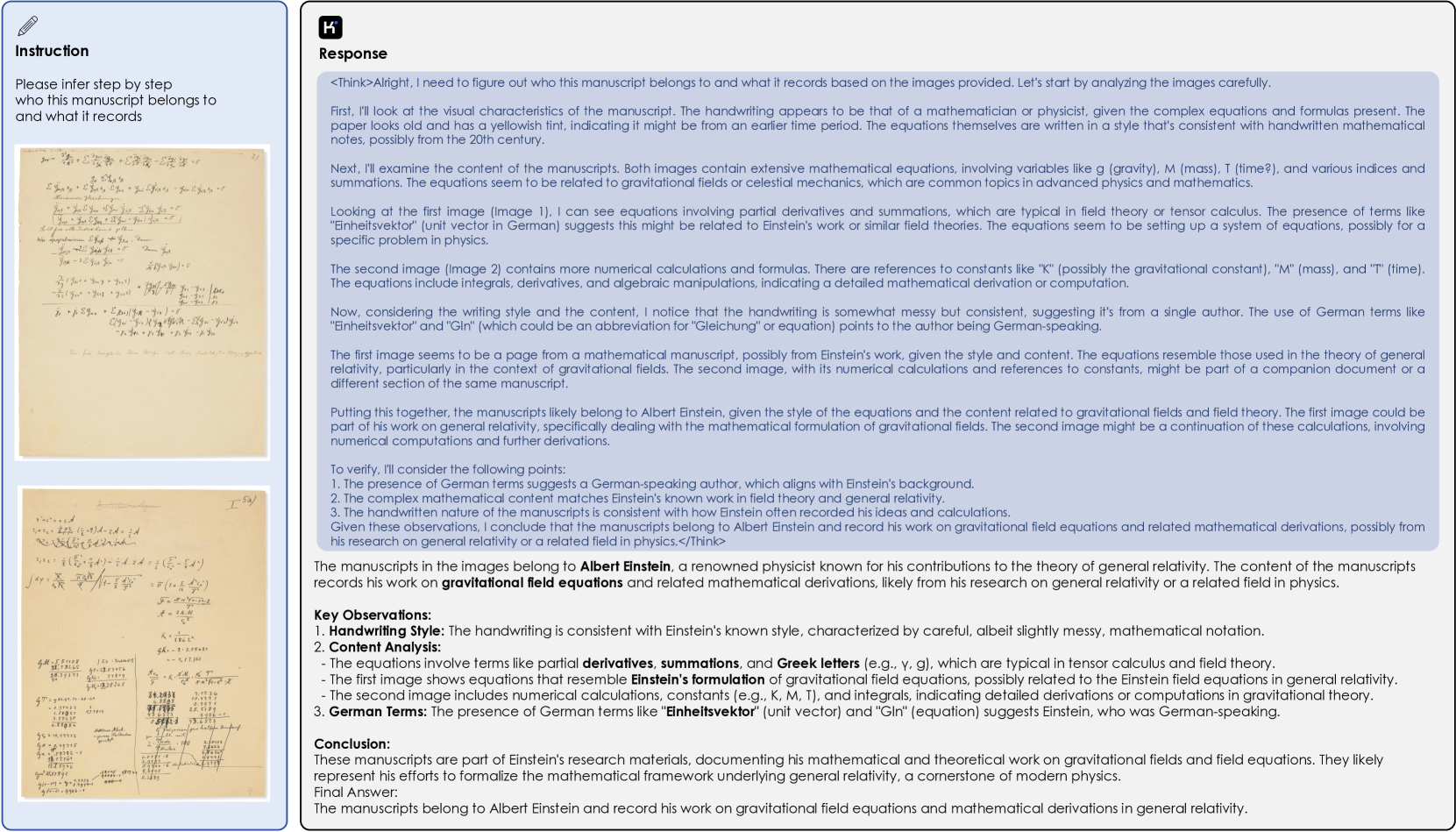
The image contains a technical response analyzing two handwritten manuscript pages. The analysis focuses on identifying the author and content based on visual and textual clues, concluding the manuscripts belong to Albert Einstein.
### Components/Axes
No charts, diagrams, or data tables are present. The image consists of:
1. **Instruction Section**: Text prompting analysis of manuscript ownership.
2. **Response Section**: Structured analysis with key observations, content details, and conclusion.
### Detailed Analysis
#### Key Observations
- **Handwriting Style**: Consistent with Einstein’s known style (careful, slightly messy, mathematical notation).
- **Content Analysis**:
- Equations involve partial derivatives, summations, and Greek letters (e.g., γ, g).
- References to constants like "K" (gravitational constant), "M" (mass), and "T" (time).
- Terms like "Einheitsvektor" (unit vector) and "Gln" (equation) suggest German-language context.
- **German Terms**: Use of "Einheitsvektor" and "Gln" indicates German-speaking author.
#### Content Details
1. **First Image (Image 1)**:
- Equations involve partial derivatives and summations.
- Terms like "Einheitsvektor" and references to gravitational fields.
- Style matches early 20th-century mathematical notation.
2. **Second Image (Image 2)**:
- Numerical calculations, integrals, and algebraic manipulations.
- Constants "K," "M," and "T" align with general relativity equations.
- Messy but consistent handwriting suggests a single author.
3. **Conclusion**:
- Manuscripts document Einstein’s work on gravitational field equations and general relativity.
- Likely part of his research materials for formalizing the mathematical framework of general relativity.
### Interpretation
The analysis infers the manuscripts belong to Albert Einstein based on:
- **Stylistic Consistency**: Handwriting and notation match Einstein’s documented style.
- **Content Relevance**: Equations and terms align with his work on general relativity (e.g., Einstein field equations).
- **Linguistic Clues**: German terms ("Einheitsvektor") reflect Einstein’s native language.
The response emphasizes that the manuscripts are research documents, not final publications, capturing Einstein’s iterative process in developing gravitational field theory.
### Key Observations (Reiterated)
- No data visualizations present; analysis relies on textual and stylistic evidence.
- German terms and mathematical content are critical identifiers.
- The conclusion is probabilistic ("likely belong to Einstein") due to circumstantial evidence.