## Diagram: System Interaction Flow with Global Pruning
### Overview
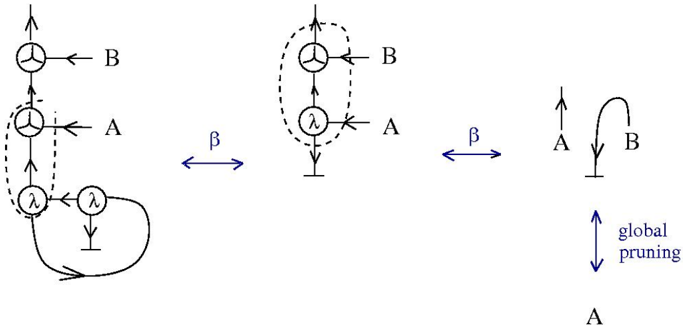
The diagram illustrates a three-stage system interaction process involving components labeled **A** and **B**, mediated by bidirectional relationships (β) and internal feedback loops (λ). The final stage introduces "global pruning" as a regulatory mechanism affecting the system's state.
---
### Components/Axes
1. **Stage 1 (Left Diagram)**:
- **A**: Central node with bidirectional arrows to **B** and internal feedback loops (λ).
- **B**: Connected to **A** via bidirectional arrows.
- **λ**: Self-loops on **A** and **B**, suggesting iterative processes or parameters.
- **β**: Arrows between diagrams indicate transitions between stages.
2. **Stage 2 (Middle Diagram)**:
- Simplified representation of **A** and **B** with dashed lines, implying abstraction or reduced complexity.
- **λ** remains as a self-loop on **A**.
3. **Stage 3 (Right Diagram)**:
- Minimalist depiction of **A** and **B** with a single bidirectional arrow (β).
- **Global pruning**: Vertical bidirectional arrows labeled "global pruning" between **A** and **B**, suggesting a system-wide optimization or constraint.
---
### Detailed Analysis
- **Stage 1**:
- **A** and **B** interact bidirectionally, with **A** having two feedback loops (λ). This suggests **A** undergoes iterative processing before influencing **B**.
- **B** receives input from **A** but lacks feedback loops, indicating a one-way dependency in this stage.
- **Stage 2**:
- Dashed lines between **A** and **B** imply a transitional or abstracted relationship. The removal of one **λ** loop on **B** may represent simplification or stabilization.
- **Stage 3**:
- The single bidirectional arrow (β) between **A** and **B** indicates a streamlined interaction.
- **Global pruning** introduces a regulatory layer, with arrows pointing both ways, suggesting mutual adjustment or balancing of **A** and **B** under external constraints.
---
### Key Observations
1. **Progressive Simplification**: The diagrams evolve from complex interactions (Stage 1) to abstracted (Stage 2) and minimalist (Stage 3) representations.
2. **Feedback Dynamics**: **λ** loops dominate **A**'s behavior, while **B** remains reactive until **global pruning** introduces bidirectional regulation.
3. **Pruning Mechanism**: "Global pruning" acts as a system-wide constraint, potentially optimizing or limiting interactions between **A** and **B**.
---
### Interpretation
This diagram likely models a computational or biological system where components **A** and **B** interact through iterative processes (λ) and transitional states (β). The introduction of "global pruning" in Stage 3 suggests a mechanism to prevent runaway feedback or stabilize the system. The progression from detailed to simplified diagrams may represent stages of system analysis, optimization, or abstraction. Notably, **A**'s self-loops (λ) imply it is a driver of internal dynamics, while **B**'s role shifts from reactive to regulated under pruning. The bidirectional β arrows emphasize mutual dependency, critical for maintaining system equilibrium.