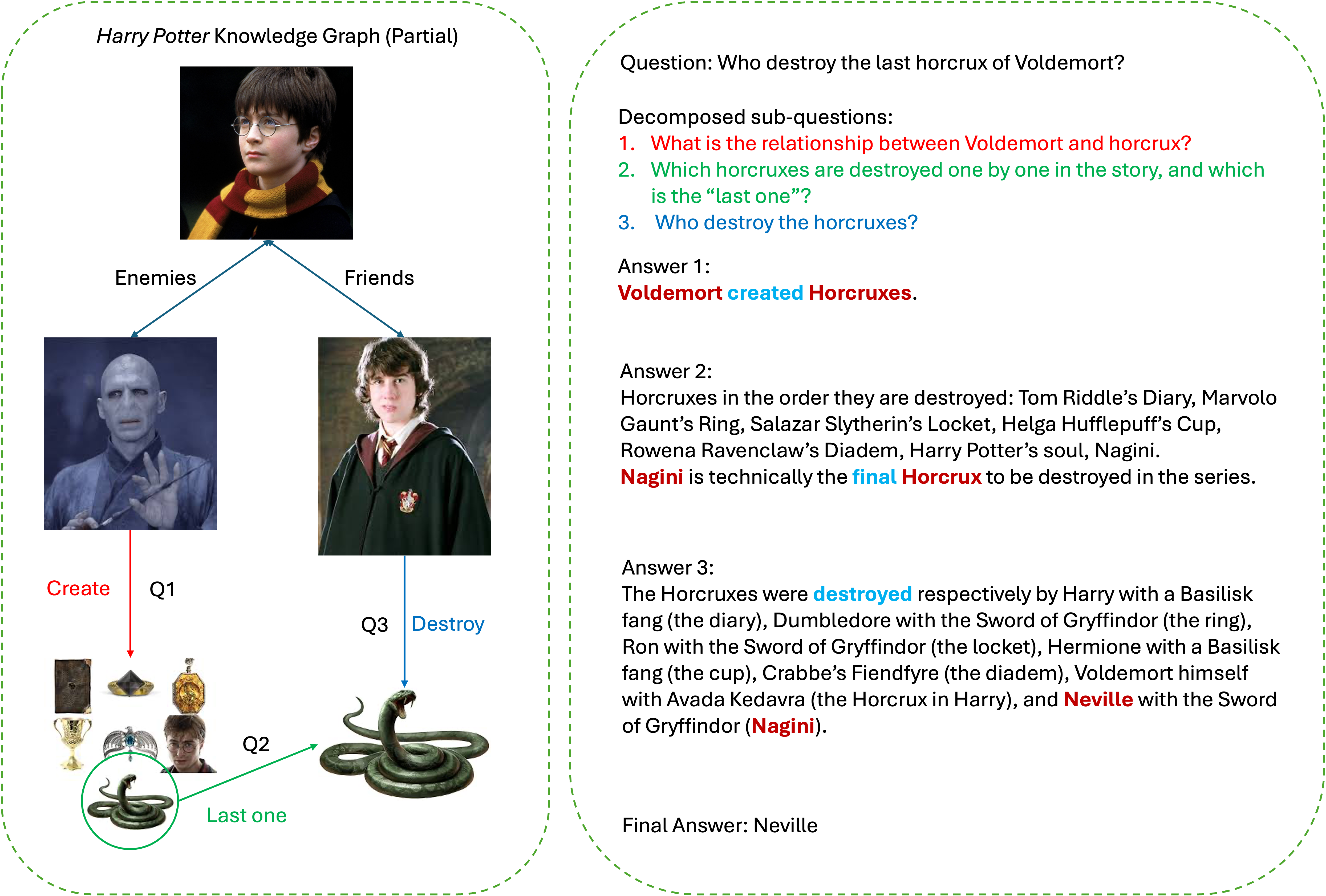
## Diagram: Harry Potter Knowledge Graph (Partial)
### Overview
The image presents a knowledge graph related to Harry Potter, specifically focusing on the relationship between characters and horcruxes. It includes images of Harry Potter, Voldemort, and Neville Longbottom, along with images representing the horcruxes. The diagram also includes a question and a series of answers related to the destruction of Voldemort's horcruxes.
### Components/Axes
* **Title:** Harry Potter Knowledge Graph (Partial)
* **Nodes:**
* Harry Potter (top center)
* Voldemort (bottom left)
* Neville Longbottom (bottom right)
* Horcruxes (bottom left, below Voldemort)
* Nagini (bottom left, circled)
* **Edges:**
* From Harry Potter to Voldemort, labeled "Enemies" (top left)
* From Harry Potter to Neville Longbottom, labeled "Friends" (top right)
* From Voldemort to Horcruxes, labeled "Create" (red arrow, left)
* From Voldemort to Horcruxes, labeled "Q1" (black, left)
* From Horcruxes to Nagini, labeled "Last one" (green arrow, bottom left)
* From Neville Longbottom to Nagini, labeled "Destroy" (blue arrow, right)
* From Neville Longbottom to Nagini, labeled "Q3" (black, right)
* From Horcruxes to Nagini, labeled "Q2" (black, bottom left)
* **Question:** Who destroy the last horcrux of Voldemort?
* **Decomposed sub-questions:**
1. What is the relationship between Voldemort and horcrux?
2. Which horcruxes are destroyed one by one in the story, and which is the "last one"?
3. Who destroy the horcruxes?
* **Answers:**
* Answer 1: Voldemort created Horcruxes.
* Answer 2: Horcruxes in the order they are destroyed: Tom Riddle's Diary, Marvolo Gaunt's Ring, Salazar Slytherin's Locket, Helga Hufflepuff's Cup, Rowena Ravenclaw's Diadem, Harry Potter's soul, Nagini. Nagini is technically the final Horcrux to be destroyed in the series.
* Answer 3: The Horcruxes were destroyed respectively by Harry with a Basilisk fang (the diary), Dumbledore with the Sword of Gryffindor (the ring), Ron with the Sword of Gryffindor (the locket), Hermione with a Basilisk fang (the cup), Crabbe's Fiendfyre (the diadem), Voldemort himself with Avada Kedavra (the Horcrux in Harry), and Neville with the Sword of Gryffindor (Nagini).
* Final Answer: Neville
### Detailed Analysis or ### Content Details
The diagram visually represents relationships between characters and objects in the Harry Potter universe. Harry Potter is positioned at the top, with arrows indicating relationships to Voldemort (Enemies) and Neville Longbottom (Friends). Voldemort is linked to the horcruxes via a "Create" relationship, indicating his role in their creation. The horcruxes are then linked to Nagini, the snake, with the label "Last one," indicating its significance as the final horcrux. Neville Longbottom is linked to Nagini via a "Destroy" relationship, highlighting his role in destroying the final horcrux.
The right side of the image presents a question about who destroyed the last horcrux of Voldemort, along with a series of decomposed sub-questions and answers. The answers provide context and details about the creation, destruction, and order of destruction of the horcruxes, ultimately leading to the final answer: Neville.
### Key Observations
* The diagram focuses on the relationship between characters and the creation/destruction of horcruxes.
* The "Last one" label emphasizes the importance of Nagini as the final horcrux.
* The question and answers provide a narrative context for the diagram, explaining the significance of the relationships depicted.
* The use of color-coded arrows (red for "Create," blue for "Destroy," green for "Last one") helps to visually distinguish the different relationships.
### Interpretation
The knowledge graph visually summarizes key relationships and events related to Voldemort's horcruxes in the Harry Potter series. It highlights the roles of Voldemort, Harry Potter, and Neville Longbottom in the creation and destruction of the horcruxes, with a particular emphasis on Nagini as the final horcrux and Neville's role in its destruction. The inclusion of the question and answers provides a narrative context, explaining the significance of these relationships and events within the broader story. The diagram effectively conveys complex information in a concise and visually appealing manner.