\n
## Diagram: Lambda Calculus Representations
### Overview
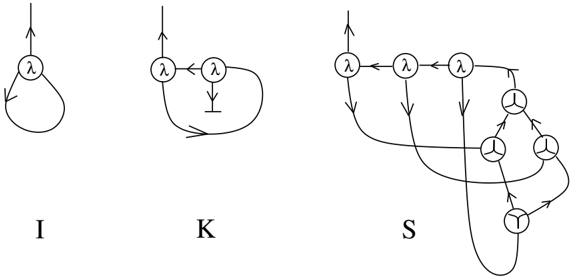
The image presents three diagrams representing different expressions within lambda calculus. Each diagram consists of nodes connected by directed edges, visually depicting function application and abstraction. The diagrams are labeled 'I', 'K', and 'S' at the bottom, likely representing identity, constant, and substitution combinators respectively.
### Components/Axes
The diagrams do not have traditional axes or scales. They are composed of:
* **Nodes:** Represented by circles, some containing the symbol 'λ' (lambda).
* **Directed Edges:** Arrows indicating the flow of function application.
* **Labels:** 'I', 'K', and 'S' identifying each diagram.
### Detailed Analysis or Content Details
**Diagram I (Identity Combinator):**
* A single circular node with a self-looping arrow.
* The arrow originates and terminates at the same node.
* This represents the identity function, which returns its input unchanged.
**Diagram K (Constant Combinator):**
* Two circular nodes, both labeled with 'λ'.
* An arrow points from the left 'λ' node to the right 'λ' node.
* An arrow loops back from the right 'λ' node to the left 'λ' node.
* A vertical line originates from the right 'λ' node, indicating an input.
* This represents a function that takes two arguments and returns the first argument, ignoring the second.
**Diagram S (Substitution Combinator):**
* Three 'λ' nodes in a horizontal sequence, with arrows connecting them from left to right.
* The leftmost 'λ' node has an arrow pointing downwards, representing an input.
* From the rightmost 'λ' node, three arrows diverge:
* One arrow points downwards, representing an output.
* Two arrows point to two 'Y'-shaped nodes.
* Each 'Y' node has two outgoing arrows, both pointing to the output node.
* A curved arrow connects the output node back to the leftmost 'λ' node.
* This represents a function that applies a function to an argument, substituting the argument into the function.
### Key Observations
* The diagrams visually represent the core concepts of lambda calculus: function abstraction (λ) and application (arrows).
* The complexity of the diagrams increases from 'I' to 'K' to 'S', reflecting the increasing complexity of the corresponding combinators.
* The 'S' combinator is significantly more complex, indicating its role as a fundamental building block for more complex functions.
### Interpretation
These diagrams are visual representations of fundamental combinators in lambda calculus. Lambda calculus is a formal system in mathematical logic and computer science for expressing computation based on function abstraction and application.
* **I (Identity):** The simplest combinator, it demonstrates the basic principle of returning an input value.
* **K (Constant):** This combinator highlights the ability to ignore an input and return a fixed value.
* **S (Substitution):** The most powerful of the three, 'S' demonstrates the core mechanism of function application and substitution, allowing for the construction of more complex functions from simpler ones.
The diagrams demonstrate how complex computational behavior can be built from a small set of primitive operations. The 'S' combinator, in particular, is crucial because it allows for the construction of any computable function using only itself and the 'K' and 'I' combinators. This illustrates the Church-Turing thesis, which states that any effectively calculable function can be expressed in lambda calculus. The diagrams are not providing numerical data, but rather a symbolic representation of computational logic. They are a visual aid for understanding the abstract concepts of lambda calculus.