## Diagram: Process Flow Representation
### Overview
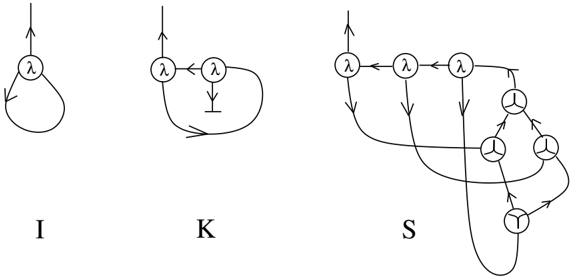
The image contains three labeled diagrams (I, K, S) depicting abstract process flows. Each diagram uses nodes (circles) with lambda (λ) symbols and directional arrows to represent relationships or transitions. Diagram S is the most complex, featuring additional Y-shaped nodes and multiple interconnections.
### Components/Axes
- **Labels**:
- Diagram I: Single-node loop with a lambda (λ) symbol.
- Diagram K: Two-node loop with a lambda (λ) symbol and a downward arrow between nodes.
- Diagram S: Multi-node system with lambda (λ) and Y-shaped nodes, interconnected via arrows.
- **Arrows**:
- Solid arrows indicate directional flow.
- Dashed arrows (in Diagram K) suggest feedback or secondary pathways.
- **Y-shaped nodes**: Present only in Diagram S, possibly representing decision points or divergent states.
### Detailed Analysis
1. **Diagram I**:
- A single lambda (λ) node forms a closed loop with an upward arrow.
- No additional nodes or branches.
2. **Diagram K**:
- Two lambda (λ) nodes connected in a loop.
- A downward arrow between nodes implies a feedback mechanism or hierarchical relationship.
3. **Diagram S**:
- Three lambda (λ) nodes in a linear chain (top-to-bottom).
- Branching pathways connect to Y-shaped nodes, which further interconnect.
- Arrows form a network with no clear termination, suggesting cyclical or recursive processes.
### Key Observations
- **Progression**: Diagrams increase in complexity from I → K → S.
- **Feedback**: Diagram K introduces feedback loops absent in Diagram I.
- **Y-shaped nodes**: Unique to Diagram S, potentially indicating decision-making or state transitions.
- **Cyclicality**: All diagrams feature closed loops, emphasizing recurring processes.
### Interpretation
The diagrams likely represent stages of a system or process:
- **Diagram I**: A foundational, self-sustaining loop (e.g., basic feedback mechanism).
- **Diagram K**: Adds complexity via bidirectional interaction between components.
- **Diagram S**: Represents a highly interconnected system with multiple pathways and decision points (Y nodes), suggesting adaptability or branching logic.
The lambda (λ) symbols may denote variables, functions, or states, while arrows indicate causality or influence. The absence of termination points in Diagram S implies an open-ended or recursive system.