## Diagram: Knot Theory Equivalence
### Overview
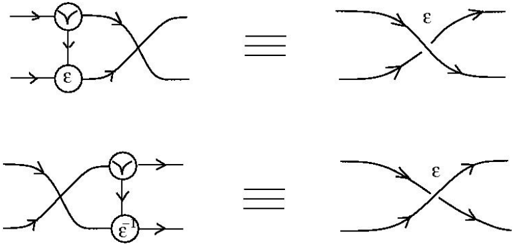
The image presents two diagrams illustrating equivalences in knot theory. Each diagram shows a transformation from a representation involving vertices and edges to a simplified crossing representation. Arrows indicate the direction of the strands.
### Components/Axes
* **Diagram 1 (Top Row):**
* Left Side: Two horizontal strands enter from the left. The top strand connects to a vertex labeled "Y" inside a circle. The bottom strand connects to a vertex labeled "ε" inside a circle. A vertical edge connects the "Y" vertex to the "ε" vertex, with an arrow pointing downwards. The strands exit to the right, with the top strand crossing over the bottom strand.
* Middle: "≡" symbol indicating equivalence.
* Right Side: Two strands cross each other. The top strand crosses over the bottom strand. The crossing is labeled "ε". Arrows indicate the direction of the strands.
* **Diagram 2 (Bottom Row):**
* Left Side: Two horizontal strands enter from the left. The top strand crosses over the bottom strand. The top strand connects to a vertex labeled "Y" inside a circle. The bottom strand connects to a vertex labeled "ε̄" inside a circle. A vertical edge connects the "Y" vertex to the "ε̄" vertex, with an arrow pointing downwards. The strands exit to the right.
* Middle: "≡" symbol indicating equivalence.
* Right Side: Two strands cross each other. The top strand crosses under the bottom strand. The crossing is labeled "ε". Arrows indicate the direction of the strands.
### Detailed Analysis
* **Diagram 1 (Top Row):**
* The left side shows a more complex representation with vertices and edges. The "Y" vertex likely represents a splitting or joining of strands, while the "ε" vertex represents a specific type of crossing.
* The right side shows the equivalent simplified crossing representation. The "ε" label indicates the type of crossing.
* **Diagram 2 (Bottom Row):**
* The left side again shows a complex representation with vertices and edges. The "ε̄" vertex likely represents the inverse of the "ε" crossing.
* The right side shows the equivalent simplified crossing representation. The "ε" label indicates the type of crossing.
### Key Observations
* The diagrams illustrate how complex representations of knots can be simplified to crossing representations.
* The "Y" vertex appears to be a standard component in these diagrams.
* The "ε" and "ε̄" labels likely represent different types of crossings or operations.
### Interpretation
The diagrams demonstrate equivalences between different representations of knots. The left side of each diagram shows a more complex representation involving vertices and edges, while the right side shows a simplified crossing representation. The "≡" symbol indicates that these two representations are equivalent. The "ε" and "ε̄" labels likely represent different types of crossings or operations, and the diagrams show how these operations can be simplified to basic crossings. The "Y" vertex likely represents a splitting or joining of strands, which is a common operation in knot theory. The diagrams suggest that complex knot diagrams can be simplified to a series of crossings, which is a fundamental concept in knot theory.