\n
## Diagram: Feynman Diagrams - Particle Interactions
### Overview
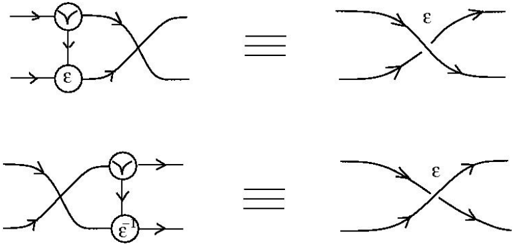
The image presents two pairs of Feynman diagrams illustrating particle interactions. Each pair shows a diagram in a more complex form on the left, and its simplified equivalent on the right. The diagrams depict interactions involving particles and their antiparticles, represented by lines with arrows indicating direction of propagation. The diagrams use specific symbols for vertices and internal lines.
### Components/Axes
The diagrams consist of the following components:
* **Lines with Arrows:** Represent particles and antiparticles. The direction of the arrow indicates the direction of propagation (forward in time).
* **Vertices:** Points where particles interact. These are represented by circles with symbols inside.
* **Internal Lines:** Lines connecting vertices, representing the exchange of virtual particles.
* **Symbol 'ε':** Appears on internal lines, likely representing a specific type of virtual particle (e.g., a photon).
* **Symbol 'Y':** Appears inside a vertex, likely representing a specific type of interaction.
* **Equal Sign (===):** Indicates equivalence between the complex and simplified diagrams.
### Detailed Analysis or Content Details
**Diagram 1 (Top Row):**
* **Left Side:** Two incoming lines converge at a vertex containing the 'Y' symbol. One line goes down, labeled with 'ε', and the other continues as an outgoing line. Two outgoing lines emerge from the bottom vertex, labeled with 'ε'.
* **Right Side:** Two lines cross, with an internal line labeled 'ε' connecting them. The lines are curved, indicating interaction.
**Diagram 2 (Bottom Row):**
* **Left Side:** Two incoming lines cross, with an internal line labeled 'ε' connecting them. The lines converge at a vertex containing the 'Y' symbol. One line goes down, labeled with 'ε', and the other continues as an outgoing line. Two outgoing lines emerge from the bottom vertex, labeled with 'ε'.
* **Right Side:** Two lines cross, with an internal line labeled 'ε' connecting them. The lines are curved, indicating interaction.
### Key Observations
* The diagrams demonstrate a simplification process in Feynman diagram representation. The complex diagrams on the left are equivalent to the simpler diagrams on the right.
* The 'ε' symbol consistently appears on internal lines, suggesting the exchange of a specific virtual particle.
* The 'Y' symbol appears at the vertices, indicating a specific type of interaction.
* The diagrams are symmetrical in their structure, with the simplified versions representing the core interaction.
### Interpretation
These diagrams likely represent a fundamental interaction in particle physics, such as an electromagnetic interaction. The 'ε' symbol likely represents a photon, the carrier of the electromagnetic force. The 'Y' symbol could represent a specific type of vertex, such as an electron-positron annihilation or creation. The simplification process demonstrates that complex interactions can be represented in a more concise and intuitive manner using Feynman diagrams. The diagrams illustrate the concept of virtual particles mediating interactions between real particles. The equivalence shown by the "===" sign suggests that the simplified diagram captures the essential physics of the more complex one, making calculations easier while preserving the underlying physical process. The diagrams are a visual representation of quantum electrodynamics (QED) or a similar quantum field theory.