\n
## Diagram: RAG Process Flow
### Overview
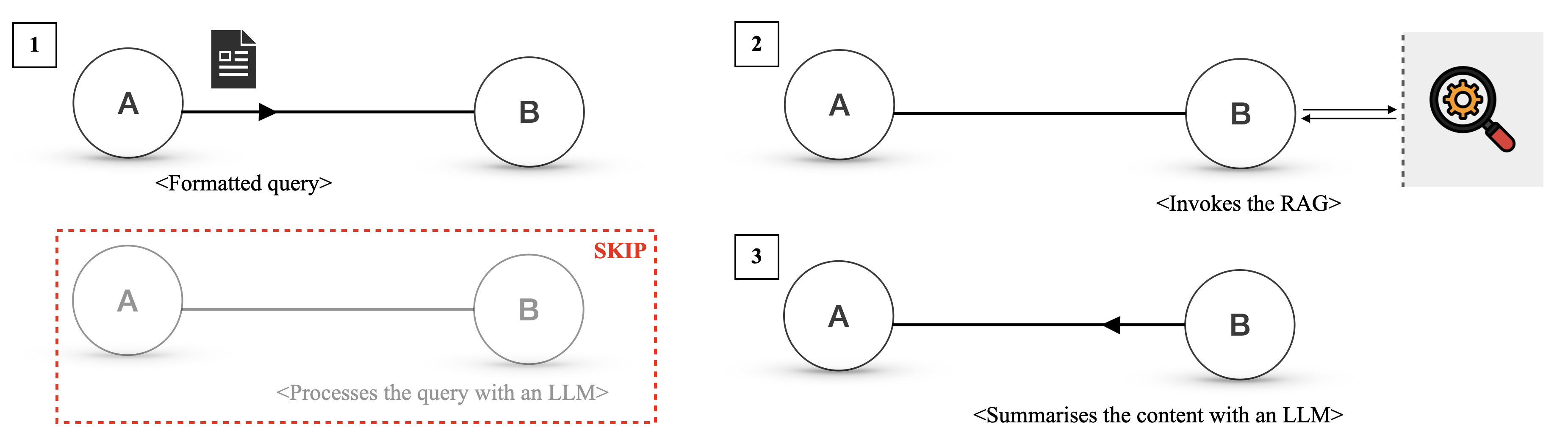
The image depicts a diagram illustrating a Retrieval-Augmented Generation (RAG) process flow, broken down into three sequential steps (labeled 1, 2, and 3). Each step shows a flow of information between two nodes labeled 'A' and 'B', with accompanying text descriptions of the process occurring at each stage. A dashed orange box surrounds step 3, indicating a potential skip or conditional execution.
### Components/Axes
The diagram consists of:
* **Nodes:** Two circular nodes labeled 'A' and 'B' in each step.
* **Arrows:** Arrows indicating the direction of information flow between nodes.
* **Text Descriptions:** Text labels below each arrow describing the process.
* **Icons:** A document icon in step 1 and a magnifying glass with gears in step 2.
* **Step Numbers:** Numbers 1, 2, and 3 indicating the sequence of steps.
* **Dashed Box:** An orange dashed box surrounding step 3, with the text "SKIP" inside.
### Detailed Analysis or Content Details
**Step 1:**
* Node A is connected to Node B via a solid arrow pointing from left to right.
* Text description: "<Formatted query>".
* A document icon is positioned between Node A and Node B, suggesting the query is related to document retrieval.
**Step 2:**
* Node A is connected to Node B via a solid arrow pointing from left to right.
* Node B is connected back to Node A via a bidirectional arrow.
* Text description: "<Invokes the RAG>".
* A magnifying glass icon with gears is positioned near Node B, indicating a search or retrieval process.
**Step 3:**
* Node A is connected to Node B via a solid arrow pointing from left to right.
* Text description: "<Processes the query with an LLM>".
* This step is enclosed in a dashed orange box with the text "SKIP" inside.
**Step 4:**
* Node A is connected to Node B via a solid arrow pointing from left to right.
* Text description: "<Summarises the content with an LLM>".
### Key Observations
* The diagram illustrates a sequential process with a potential skip in step 3.
* The process involves a formatted query, RAG invocation, and LLM processing/summarization.
* The bidirectional arrow in step 2 suggests a feedback loop or iterative process.
* The "SKIP" label indicates that step 3 might be bypassed under certain conditions.
### Interpretation
The diagram represents a simplified workflow of a Retrieval-Augmented Generation (RAG) system. The process begins with a formatted query (Step 1), which then invokes the RAG mechanism (Step 2). The RAG process likely retrieves relevant information, as indicated by the magnifying glass icon. Step 3, enclosed in a dashed box, suggests a conditional step where the query is processed by a Large Language Model (LLM). The "SKIP" label implies that this step might be omitted based on certain criteria. Finally, Step 4 indicates that the retrieved content is summarized using an LLM.
The bidirectional arrow in Step 2 suggests that the RAG process might involve iterative refinement of the query or retrieval results. The overall flow demonstrates how a RAG system combines information retrieval with LLM capabilities to generate more informed and contextually relevant responses. The diagram is a high-level overview and does not provide specific details about the implementation or the conditions for skipping Step 3.