# Technical Document Extraction: Pencil Distribution Problem Analysis
## Problem Statement
**Textual Content**:
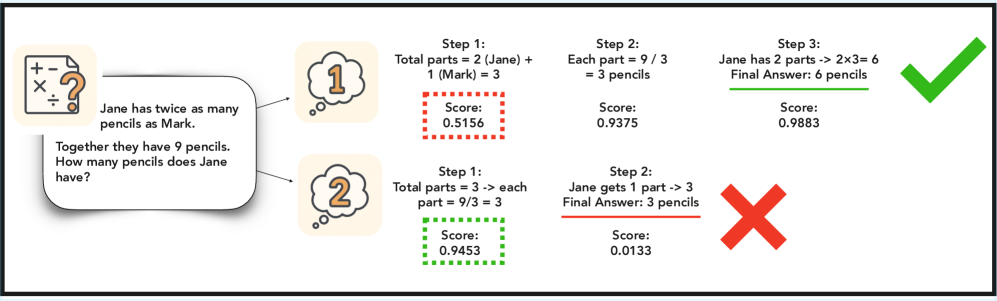
"Jane has twice as many pencils as Mark. Together they have 9 pencils. How many pencils does Jane have?"
## Diagram Components
### Header Section
- **Visual Elements**:
- Math symbols (`+`, `-`, `×`, `÷`) with a question mark icon
- Text box containing the problem statement
### Main Flowchart
#### Method 1 (Incorrect Approach)
1. **Step 1**:
- Text: "Total parts = 2 (Jane) + 1 (Mark) = 3"
- Score: `0.5156` (Red dashed box)
2. **Step 2**:
- Text: "Each part = 9 / 3 = 3 pencils"
- Score: `0.9375`
3. **Step 3**:
- Text: "Jane has 2 parts -> 2×3 = 6"
- Final Answer: "6 pencils"
- Score: `0.9883`
- Visual: Green checkmark
#### Method 2 (Incorrect Approach)
1. **Step 1**:
- Text: "Total parts = 3 -> each part = 9/3 = 3"
- Score: `0.9453` (Green dashed box)
2. **Step 2**:
- Text: "Jane gets 1 part -> 3"
- Final Answer: "3 pencils"
- Score: `0.0133`
- Visual: Red X
### Legend & Scoring
- **Color Coding**:
- Red: Incorrect methods (Steps 1 and 2 of Method 1, Step 2 of Method 2)
- Green: Correct method (Step 3 of Method 1)
- **Legend Placement**: Implied via color association with steps (no explicit legend box visible).
## Key Trends & Data Points
1. **Correct Method (Method 1)**:
- Logical progression: Total parts → per-part value → final answer.
- Highest score (`0.9883`) with green checkmark.
2. **Incorrect Methods**:
- Method 2 erroneously assigns Jane 1 part instead of 2.
- Low score (`0.0133`) with red X.
## Spatial Grounding
- **Legend**: No explicit legend box; colors are contextually tied to step validity.
- **Text Placement**:
- Problem statement: Top-left quadrant.
- Steps: Centered in sequential order.
- Scores: Adjacent to respective steps.
## Component Isolation
1. **Header**: Problem statement and math symbols.
2. **Main Chart**: Three methods with step-by-step calculations.
3. **Footer**: Scoring system and visual indicators (checkmark/X).
## Transcribed Text
- **Problem**:
"Jane has twice as many pencils as Mark. Together they have 9 pencils. How many pencils does Jane have?"
- **Method 1 Steps**:
- Step 1: "Total parts = 2 (Jane) + 1 (Mark) = 3"
- Step 2: "Each part = 9 / 3 = 3 pencils"
- Step 3: "Jane has 2 parts -> 2×3 = 6"
- **Method 2 Steps**:
- Step 1: "Total parts = 3 -> each part = 9/3 = 3"
- Step 2: "Jane gets 1 part -> 3"
## Language Notes
- **Primary Language**: English.
- **No Additional Languages Detected**.
## Final Answer Validation
- **Correct Answer**: Jane has **6 pencils** (Method 1, Step 3).
- **Incorrect Answer**: Jane has **3 pencils** (Method 2, Step 2).