## Diagram: Agent System Architectures
### Overview
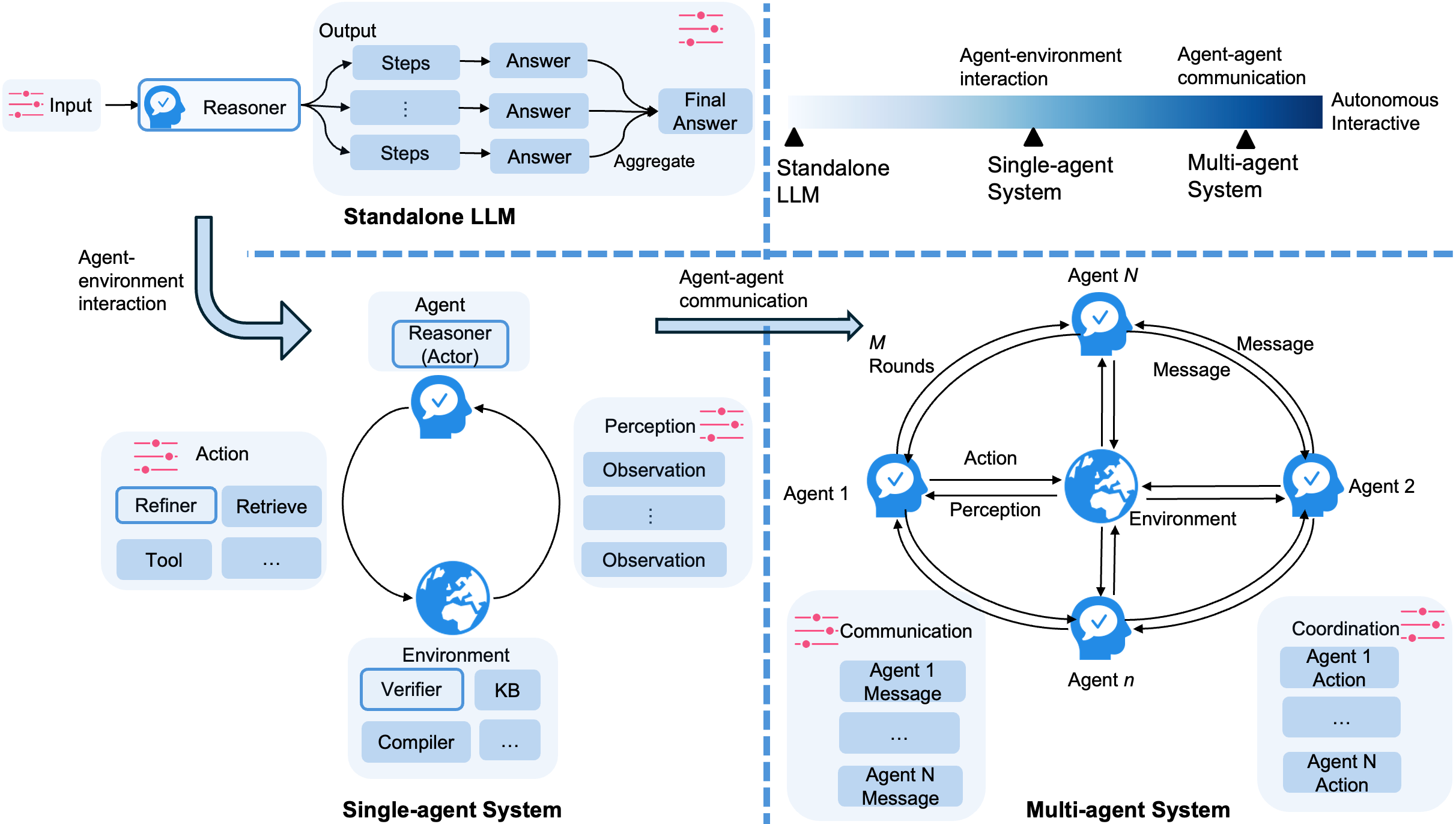
The image presents a diagram illustrating three different agent system architectures: Standalone LLM, Single-agent System, and Multi-agent System. It visualizes the flow of information and interactions between agents and their environment, highlighting the increasing complexity from standalone to multi-agent systems.
### Components/Axes
* **Title:** Agent System Architectures
* **Top-Left:** Standalone LLM
* Input: An input is fed into a Reasoner.
* Reasoner: Processes the input.
* Output: The Reasoner generates multiple "Steps" which lead to "Answer"s. These answers are then aggregated into a "Final Answer".
* **Left-Center:** Single-agent System
* Agent-environment interaction: An arrow indicates the flow from Standalone LLM to Single-agent System.
* Agent (Reasoner (Actor)): An agent that reasons and acts.
* Perception: The agent perceives the environment through "Observation".
* Action: The agent performs actions, including "Refiner", "Retrieve", "Tool", and others.
* Environment: The agent interacts with the environment, which includes "Verifier", "KB" (Knowledge Base), "Compiler", and others.
* **Right:** Multi-agent System
* Agent-agent communication: Agents communicate with each other.
* Agents: Multiple agents (Agent 1, Agent 2, ..., Agent N) interact with each other and the environment.
* Environment: The agents interact with the environment.
* Communication: Agents exchange messages (Agent 1 Message, ..., Agent N Message).
* Coordination: Agents coordinate their actions (Agent 1 Action, ..., Agent N Action).
* M Rounds: Indicates multiple rounds of interaction.
* **Top-Right:** Agent-environment interaction, Agent-agent communication, Autonomous Interactive. A gradient bar shows the transition from Standalone LLM to Single-agent System to Multi-agent System, indicating increasing agent-environment and agent-agent interaction, and a shift from autonomous to interactive behavior.
### Detailed Analysis or Content Details
* **Standalone LLM:**
* Input -> Reasoner -> Steps -> Answer -> Final Answer
* **Single-agent System:**
* Agent (Reasoner (Actor)) <-> Environment
* Agent -> Action -> Environment
* Environment -> Perception -> Agent
* **Multi-agent System:**
* Multiple Agents <-> Environment
* Agents communicate with each other via Messages.
* Agents coordinate their actions.
### Key Observations
* The diagram illustrates a progression from a simple Standalone LLM to more complex Single-agent and Multi-agent Systems.
* The Single-agent System introduces a feedback loop between the agent and the environment.
* The Multi-agent System involves communication and coordination between multiple agents.
### Interpretation
The diagram provides a high-level overview of different agent system architectures. It highlights the increasing complexity and interactivity as we move from a standalone LLM to a multi-agent system. The Standalone LLM represents a basic system where an input is processed to generate an output. The Single-agent System introduces interaction with an environment, allowing the agent to perceive and act. The Multi-agent System further expands on this by incorporating multiple agents that communicate and coordinate with each other, enabling more complex and collaborative behaviors. The gradient bar at the top-right visually represents this progression, showing the increasing levels of agent-environment and agent-agent interaction, and the shift from autonomous to interactive systems.