## Diagram: Agent System Architectures
### Overview
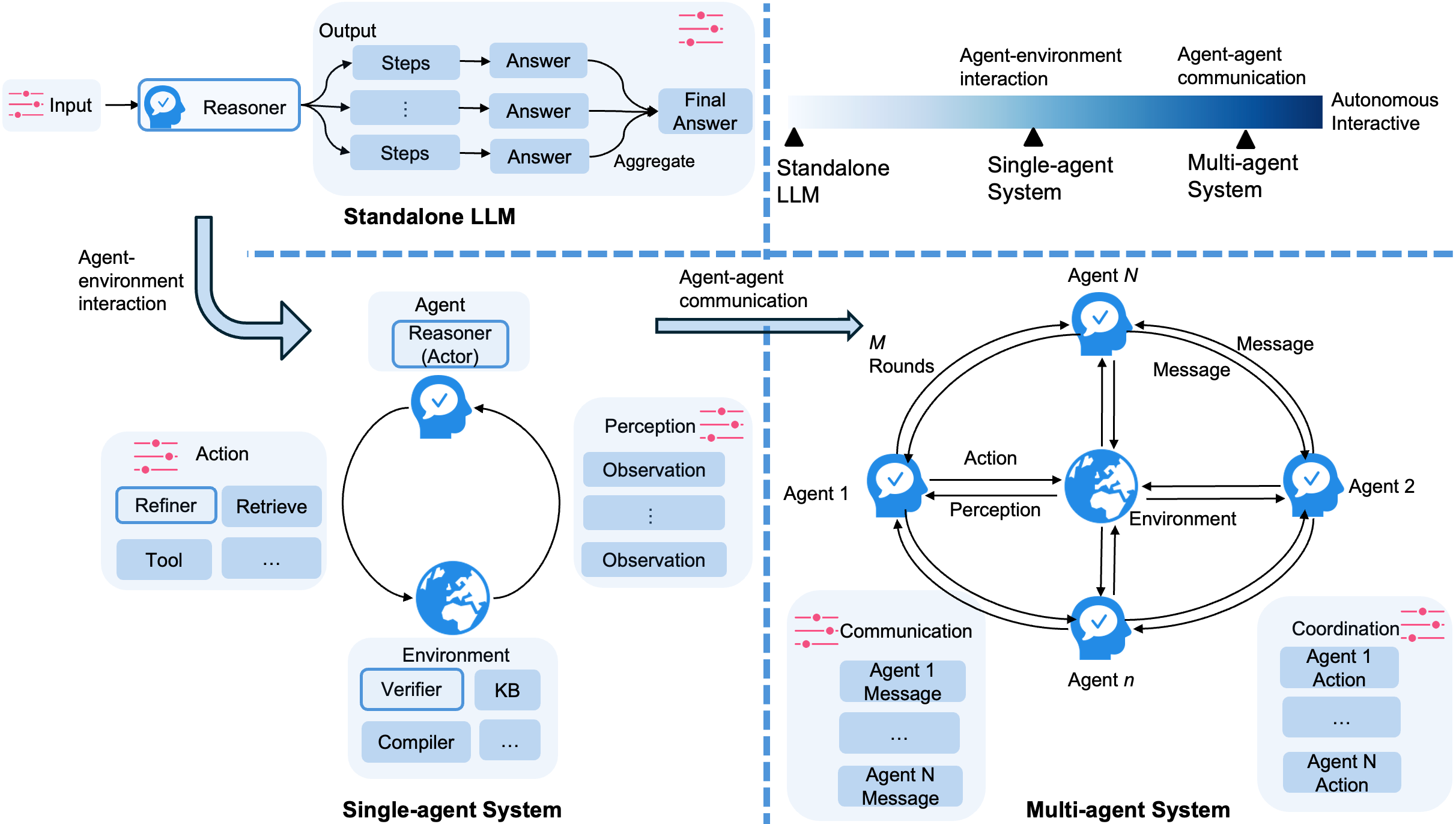
The image presents a diagram illustrating two agent system architectures: a standalone Large Language Model (LLM) system and a multi-agent system. It details the interaction between agents, the environment, and the flow of information within each system. The diagram uses a combination of boxes, circles, arrows, and labels to represent components and processes.
### Components/Axes
The diagram is divided into three main sections:
1. **Standalone LLM:** Located in the top-left, showing the process from input to output.
2. **Single-agent System:** Located in the bottom-left, detailing the interaction between an agent and the environment.
3. **Multi-agent System:** Located in the bottom-right, illustrating communication and coordination between multiple agents and the environment.
Key components and labels include:
* **Input:** Starting point for the standalone LLM.
* **Reasoner:** Processes the input in both standalone and single-agent systems.
* **Steps/Answer:** Intermediate outputs from the Reasoner.
* **Output:** Final result from the standalone LLM.
* **Final Answer/Aggregate:** Combined output in the standalone LLM.
* **Agent Reasoner (Actor):** The core of the single-agent system.
* **Action:** Output from the agent, influencing the environment.
* **Refiner/Retrieve/Tool:** Components used by the agent to refine actions.
* **Environment:** The external world the agent interacts with. Includes Verifier, KB (Knowledge Base), and Compiler.
* **Perception/Observation:** Input from the environment to the agents.
* **Agent 1, Agent N, Agent n:** Represent individual agents in the multi-agent system.
* **Message:** Communication between agents.
* **Coordination/Action:** Coordinated actions of multiple agents.
* **Agent-environment interaction:** A general label for the interaction between agents and the environment.
* **Agent-agent communication:** A general label for communication between agents.
* **Autonomous Interactive:** A label describing the multi-agent system.
* **Standalone LLM:** A label describing the standalone LLM system.
* **Single-agent System:** A label describing the single-agent system.
* **Multi-agent System:** A label describing the multi-agent system.
* **M Rounds:** Indicates iterative communication between agents.
The diagram uses different colored arrows to represent different types of interactions:
* **Red dashed arrows:** Represent actions.
* **Pink dotted arrows:** Represent communication.
* **Black solid arrows:** Represent the primary flow of information.
* **Grey solid arrows:** Represent secondary flow of information.
### Detailed Analysis or Content Details
**Standalone LLM:**
The process begins with an "Input" which is fed into a "Reasoner". The Reasoner generates "Steps" and "Answer" which are then aggregated into a "Final Answer" and "Output".
**Single-agent System:**
The "Agent Reasoner (Actor)" receives input and generates an "Action". This action interacts with the "Environment", which provides "Observation" back to the agent. The agent also utilizes "Refiner", "Retrieve", and "Tool" components. The environment contains "Verifier", "KB", and "Compiler".
**Multi-agent System:**
Multiple agents (Agent 1, Agent n, Agent N) communicate with each other via "Message" exchanges. Each agent perceives the "Environment" and takes "Action". The agents coordinate their actions, resulting in "Coordination" and further "Action". This process repeats for "M Rounds".
### Key Observations
* The diagram highlights the increasing complexity of agent systems, moving from a single LLM to a multi-agent setup.
* The multi-agent system emphasizes communication and coordination as key elements.
* The use of different arrow types clearly distinguishes between actions, communication, and information flow.
* The diagram illustrates a cyclical process of perception, action, and observation in both single and multi-agent systems.
* The standalone LLM is presented as a more direct, linear process compared to the iterative and interactive nature of the agent systems.
### Interpretation
The diagram demonstrates a progression in agent system design. The standalone LLM represents a basic form of AI processing, while the single and multi-agent systems introduce the concept of interaction with an environment and collaboration between multiple agents. The multi-agent system, in particular, suggests a move towards more complex, autonomous, and interactive AI systems. The "M Rounds" notation indicates the potential for iterative learning and adaptation within the multi-agent environment. The diagram is a conceptual overview, focusing on the architectural components and information flow rather than specific implementation details. It serves as a high-level blueprint for designing and understanding different types of agent systems. The diagram suggests that the complexity of the system increases with the number of agents and the level of interaction between them. The inclusion of components like "Verifier", "KB", and "Compiler" within the environment suggests the importance of knowledge management and validation in these systems.