TECHNICAL ASSET FINGERPRINT
0d6e61c158c0a0f22ff32bbb
Click to view fullscreen
Press ESC or click to close
FOUND IN PAPERS
EXPERT: healer-alpha-free VERSION 1
RUNTIME: free/openrouter/healer-alpha
INTEL_VERIFIED
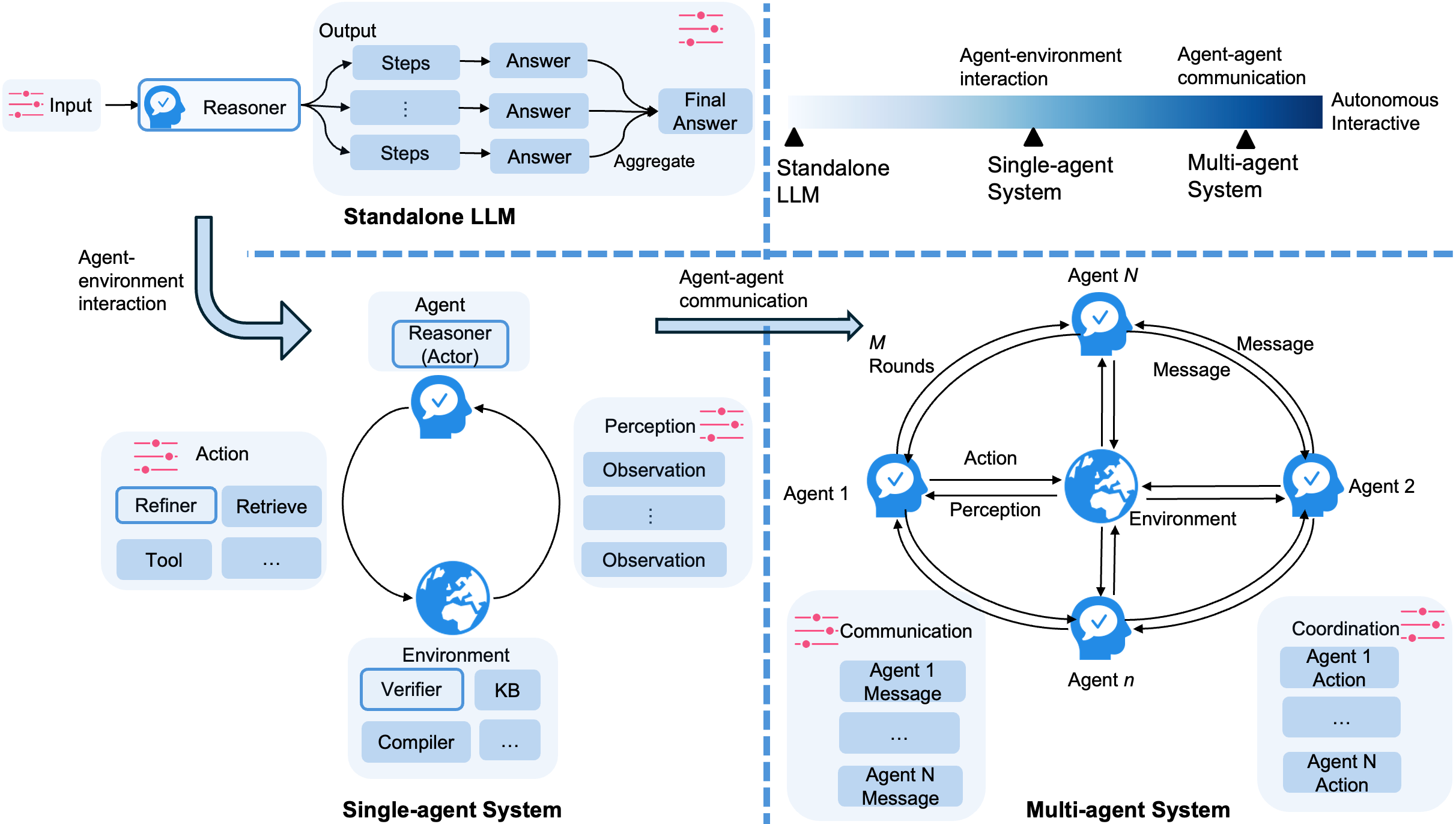
## Diagram: AI System Architectures - Standalone LLM, Single-agent, and Multi-agent Systems
### Overview
The image is a technical diagram illustrating three progressive architectures for AI systems: a **Standalone LLM**, a **Single-agent System**, and a **Multi-agent System**. It visually explains the increasing complexity and interaction capabilities as systems move from a simple language model to autonomous agents that interact with environments and each other. The diagram is divided into three main sections, with a gradient bar at the top right providing a conceptual spectrum.
### Components/Axes
**Top-Right Gradient Bar (Spectrum):**
* **Position:** Top-right corner.
* **Labels (Left to Right):** "Standalone LLM", "Single-agent System", "Multi-agent System".
* **Axis Titles (Above Bar):** "Agent-environment interaction" (left side), "Agent-agent communication" (right side).
* **Axis End Label:** "Autonomous Interactive" (far right).
* **Purpose:** This bar establishes a conceptual axis showing increasing levels of interaction and autonomy from left to right.
**Main Diagram Sections:**
1. **Top-Left: Standalone LLM**
* **Input:** A pink icon labeled "Input" feeds into a blue "Reasoner" icon (a head with a checkmark).
* **Process:** The "Reasoner" outputs multiple parallel paths, each labeled "Steps" leading to an "Answer".
* **Output:** All "Answer" boxes converge via an "Aggregate" arrow into a single "Final Answer" box.
* **Label:** "Standalone LLM" is written below this section.
2. **Bottom-Left: Single-agent System**
* **Core Loop:** A circular flow between an "Agent" (blue head icon, labeled "Reasoner (Actor)") and an "Environment" (blue globe icon).
* **Agent Side (Top of Loop):**
* **Action Box:** Contains sub-components: "Refiner", "Retrieve", "Tool", and "...".
* **Environment Side (Bottom of Loop):**
* **Perception Box:** Contains sub-components: "Observation", "...", "Observation".
* **Environment Box:** Contains sub-components: "Verifier", "KB", "Compiler", and "...".
* **Flow:** Arrows show a cycle: Agent -> Action -> Environment -> Perception -> Agent.
* **Label:** "Single-agent System" is written below this section.
* **Connection:** A large, curved arrow labeled "Agent-environment interaction" points from the "Standalone LLM" section to this "Single-agent System" section.
3. **Right: Multi-agent System**
* **Core Structure:** A central "Environment" (globe icon) surrounded by multiple agents ("Agent 1", "Agent 2", "Agent n", "Agent N") arranged in a circle.
* **Agent-Environment Interaction:** Arrows labeled "Action" point from each agent to the Environment. Arrows labeled "Perception" point from the Environment back to each agent.
* **Agent-Agent Communication:** Curved arrows labeled "Message" connect the agents directly to each other in a network. A label "M Rounds" indicates this communication can happen over multiple rounds.
* **Supporting Boxes:**
* **Communication Box (Bottom Left):** Lists "Agent 1 Message", "...", "Agent N Message".
* **Coordination Box (Bottom Right):** Lists "Agent 1 Action", "...", "Agent N Action".
* **Label:** "Multi-agent System" is written below this section.
* **Connection:** A large, straight arrow labeled "Agent-agent communication" points from the "Single-agent System" section to this "Multi-agent System" section.
### Detailed Analysis
**Standalone LLM Flow:**
1. Input is processed by a single Reasoner.
2. The Reasoner generates multiple reasoning paths ("Steps") in parallel.
3. Each path produces an intermediate "Answer".
4. These answers are aggregated to produce a single "Final Answer".
* **Trend:** This is a linear, one-shot processing model with internal parallelism for reasoning, but no external interaction.
**Single-agent System Flow:**
1. An Agent (Reasoner/Actor) exists in a continuous loop with an Environment.
2. The Agent performs an **Action** (using tools like a Refiner, Retriever, or other Tools).
3. The Environment processes the action and returns **Perception** data (Observations).
4. The Agent uses these observations to inform its next action.
* **Trend:** This introduces a closed-loop, interactive cycle. The agent is no longer just reasoning; it is acting and perceiving, enabling iterative problem-solving within a defined environment.
**Multi-agent System Flow:**
1. Multiple agents (1, 2, ..., n, N) coexist.
2. Each agent interacts with a shared **Environment** via Actions and Perceptions.
3. Crucially, agents also engage in direct **Agent-agent communication**, sending Messages to each other.
4. This communication can occur over "M Rounds".
5. **Communication** and **Coordination** boxes suggest mechanisms for managing messages and synchronizing actions across the agent collective.
* **Trend:** This represents the highest complexity, adding a social/communicative layer on top of environmental interaction. The system's capability emerges from the coordination and communication between multiple autonomous entities.
### Key Observations
1. **Progressive Complexity:** The diagram clearly shows an evolutionary path: from internal reasoning (Standalone), to environmental interaction (Single-agent), to social interaction plus environmental interaction (Multi-agent).
2. **Component Reuse:** The "Reasoner" icon from the Standalone LLM becomes the core "Agent (Reasoner/Actor)" in the Single-agent System, showing a foundational relationship.
3. **Interaction Types:** The top gradient bar explicitly names the two key interaction types that differentiate the systems: "Agent-environment" and "Agent-agent".
4. **Scalability Notation:** The use of "n" and "N" for agents, and "M Rounds" for communication, indicates the model is designed to be scalable to an arbitrary number of agents and interaction cycles.
5. **Functional Decomposition:** Each system breaks down its functions into labeled sub-components (e.g., Action: Refiner, Retrieve, Tool; Environment: Verifier, KB, Compiler), suggesting a modular design philosophy.
### Interpretation
This diagram serves as a conceptual framework for understanding the architecture of modern AI systems, particularly those built around Large Language Models (LLMs). It argues that moving beyond a standalone LLM requires endowing the model with **agency**—the ability to take actions and perceive outcomes (Single-agent). The next leap in capability comes from enabling **collaboration or competition** between multiple such agents (Multi-agent).
The progression implies that complex tasks requiring iterative refinement, tool use, external knowledge, or diverse expertise are better suited to agent-based architectures. The Multi-agent system, with its communication and coordination layers, is presented as the most "Autonomous Interactive" paradigm, capable of tackling problems that are too dynamic, multifaceted, or large-scale for a single agent. The diagram is less about specific algorithms and more about the structural relationships between intelligence, action, environment, and communication.
DECODING INTELLIGENCE...