## Diagram: Agent System Architecture Overview
### Overview
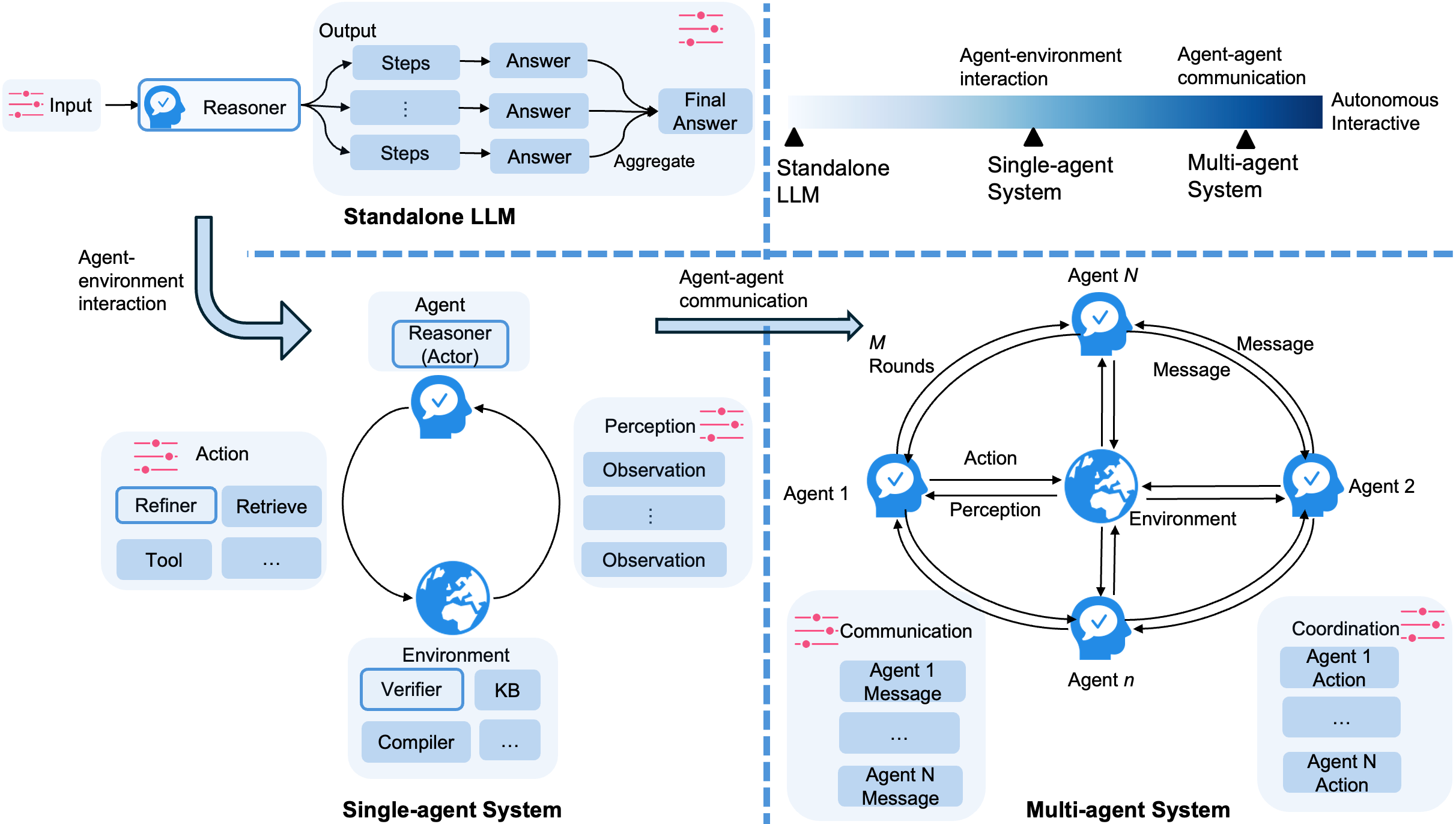
The diagram illustrates the evolution of agent-based systems from standalone language models (LLMs) to multi-agent systems, emphasizing interactions between agents, environments, and communication protocols. It contrasts three system types: Standalone LLM, Single-agent System, and Multi-agent System, with clear distinctions in complexity and interaction mechanisms.
---
### Components/Axes
#### Standalone LLM Section
- **Input**: Labeled with pink dots (→ Reasoner)
- **Reasoner**: Processes input into:
- **Steps** (→ Answer)
- **Final Answer** (Aggregation of steps)
- **Agent-environment interaction**: Arrows connect to:
- **Action** (Refiner, Retrieve, Tool)
- **Environment** (Verifier, KB, Compiler)
#### Single-agent System Section
- **Agent (Actor)**: Circular flow with:
- **Perception** (Observations)
- **Action** (Refiner, Retrieve, Tool)
- **Environment** (Verifier, KB, Compiler)
- Arrows indicate cyclical interaction between Agent, Perception, and Environment.
#### Multi-agent System Section
- **Agents 1 to N**: Arranged in a circular topology with:
- **Perception** (Observations)
- **Action** (Coordinated outputs)
- **Communication**: Messages exchanged between agents (Agent 1 → Agent N)
- **Environment**: Central node connecting all agents
- **Rounds**: Labeled "M Rounds" for communication cycles
---
### Detailed Analysis
#### Standalone LLM
- **Flow**: Input → Reasoner → Steps/Answers → Final Answer
- **Key Components**:
- **Reasoner**: Core processing unit
- **Aggregation**: Combines intermediate steps into a final output
#### Single-agent System
- **Cyclical Process**:
1. Agent perceives environment (Observations)
2. Takes action (Refiner/Retrieve/Tool)
3. Environment responds via Verifier/KB/Compiler
4. Perception updates observations
#### Multi-agent System
- **Communication Protocol**:
- **Message Passing**: Agents exchange messages in M rounds
- **Coordination**: Final actions aggregated from all agents
- **Scalability**: N agents enable distributed task handling
---
### Key Observations
1. **Progression of Complexity**:
- Standalone LLM → Single-agent → Multi-agent systems show increasing sophistication
2. **Communication Overhead**:
- Multi-agent systems introduce message-passing latency (M rounds)
3. **Environment Integration**:
- All systems rely on environmental verification (Verifier) and knowledge bases (KB)
4. **Action Diversity**:
- Tools/Refiners appear in both single and multi-agent systems but scale differently
---
### Interpretation
This diagram demonstrates the architectural progression from isolated reasoning systems to collaborative agent networks. The Standalone LLM represents basic reasoning capabilities, while the Single-agent System adds environmental interaction. The Multi-agent System introduces critical elements for complex tasks:
- **Distributed Cognition**: Agents specialize in sub-tasks (Agent 1 to N)
- **Temporal Coordination**: M rounds of communication enable iterative refinement
- **Scalability Tradeoff**: Increased agents improve capability but add communication overhead
The circular topology in multi-agent systems suggests fault tolerance and load balancing capabilities. The absence of explicit error-handling mechanisms in the diagram implies these would be implementation-specific additions. The progression from linear (Standalone) to cyclical (Single-agent) to networked (Multi-agent) flows reflects increasing system autonomy and adaptability.