# Technical Document Extraction: Topology Building Blocks and MASS-optimized Topology
This document provides a detailed technical extraction of the provided diagram, which illustrates modular components for agentic workflows and their specific configurations (topologies) optimized for various benchmarks.
## 1. Header Section: Topology Building Blocks
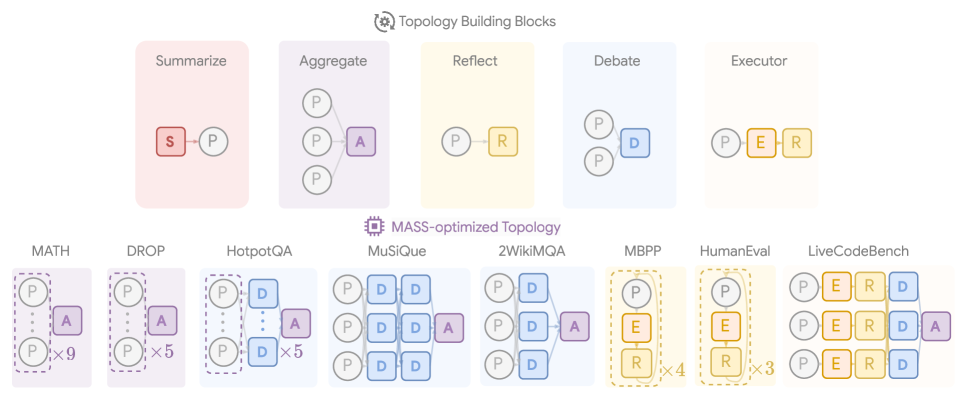
The top section defines five fundamental "Building Blocks" used to construct complex agent topologies. Each block is represented by a colored card containing a flow diagram of nodes.
| Block Name | Color Theme | Component Flow | Description |
| :--- | :--- | :--- | :--- |
| **Summarize** | Red/Pink | `[S] -> (P)` | A square node 'S' (Summarize) outputs to a circular node 'P' (Prompt/Process). |
| **Aggregate** | Purple | `(P), (P), (P) -> [A]` | Three circular 'P' nodes converge into a single square 'A' (Aggregate) node. |
| **Reflect** | Yellow | `(P) -> [R]` | A circular 'P' node feeds into a square 'R' (Reflect) node. |
| **Debate** | Blue | `(P), (P) -> [D]` | Two circular 'P' nodes feed into a single square 'D' (Debate) node. |
| **Executor** | Gold/Yellow | `(P) -> [E] -> [R]` | A circular 'P' node feeds into a square 'E' (Executor) node, which then feeds into a square 'R' (Reflect) node. |
---
## 2. Main Section: MASS-optimized Topology
The bottom section displays eight specific topologies optimized for different datasets/benchmarks. These topologies are constructed using the building blocks defined above.
### A. Mathematical & Reasoning Benchmarks (Purple/Aggregate Focus)
These topologies utilize a parallel processing structure followed by an aggregation step.
* **MATH**:
* **Structure**: A vertical stack of circular 'P' nodes enclosed in a dashed purple border.
* **Quantity**: Indicated as `x9`.
* **Flow**: The stack of 9 'P' nodes feeds into a single square 'A' node.
* **DROP**:
* **Structure**: A vertical stack of circular 'P' nodes enclosed in a dashed purple border.
* **Quantity**: Indicated as `x5`.
* **Flow**: The stack of 5 'P' nodes feeds into a single square 'A' node.
* **HotpotQA**:
* **Structure**: A vertical stack of circular 'P' nodes (dashed border) feeding into a vertical stack of square 'D' (Debate) nodes.
* **Quantity**: Indicated as `x5`.
* **Flow**: The 5 'D' nodes then converge into a single square 'A' node.
### B. Multi-hop Reasoning Benchmarks (Blue/Debate Focus)
These topologies feature multi-layered debate structures.
* **MuSiQue**:
* **Structure**: Three parallel tracks. Each track consists of `(P) -> [D] -> [D]`.
* **Flow**: All three final '[D]' nodes converge into a single square 'A' node.
* **2WikiMQA**:
* **Structure**: Three parallel tracks. Each track consists of `(P) -> [D]`.
* **Flow**: All three '[D]' nodes converge into a single square 'A' node.
### C. Coding Benchmarks (Gold/Executor Focus)
These topologies utilize the Executor/Reflect pattern, often in iterative loops.
* **MBPP**:
* **Structure**: A vertical stack containing `(P)`, `[E]`, and `[R]`.
* **Loop**: Enclosed in a dashed gold border with a circular arrow indicating iteration.
* **Quantity**: Indicated as `x4`.
* **HumanEval**:
* **Structure**: A vertical stack containing `(P)`, `[E]`, and `[R]`.
* **Loop**: Enclosed in a dashed gold border with a circular arrow indicating iteration.
* **Quantity**: Indicated as `x3`.
### D. Complex Integrated Benchmark
* **LiveCodeBench**:
* **Structure**: Three parallel horizontal tracks.
* **Track Flow**: Each track follows the sequence `(P) -> [E] -> [R] -> [D]`.
* **Final Flow**: The three final '[D]' nodes converge into a single square 'A' node.
---
## 3. Key Symbols and Notation Summary
* **Circular Node (P)**: Likely represents a "Prompt" or "Base Processor" step.
* **Square Nodes (S, A, R, D, E)**: Represent specialized functional agents (Summarize, Aggregate, Reflect, Debate, Executor).
* **Dashed Enclosures**: Grouping of nodes for repetition or iterative loops.
* **Multiplier (xN)**: Indicates the number of parallel instances or iterative cycles.
* **Arrows**: Indicate the direction of data flow between components.