TECHNICAL ASSET FINGERPRINT
0da9627184b21bdf4aa15a35
Click to view fullscreen
Press ESC or click to close
FOUND IN PAPERS
EXPERT: gemini-2.0-flash VERSION 1
RUNTIME: nugit/gemini/gemini-2.0-flash
INTEL_VERIFIED
## Flow Diagram: Agent Evaluation Process
### Overview
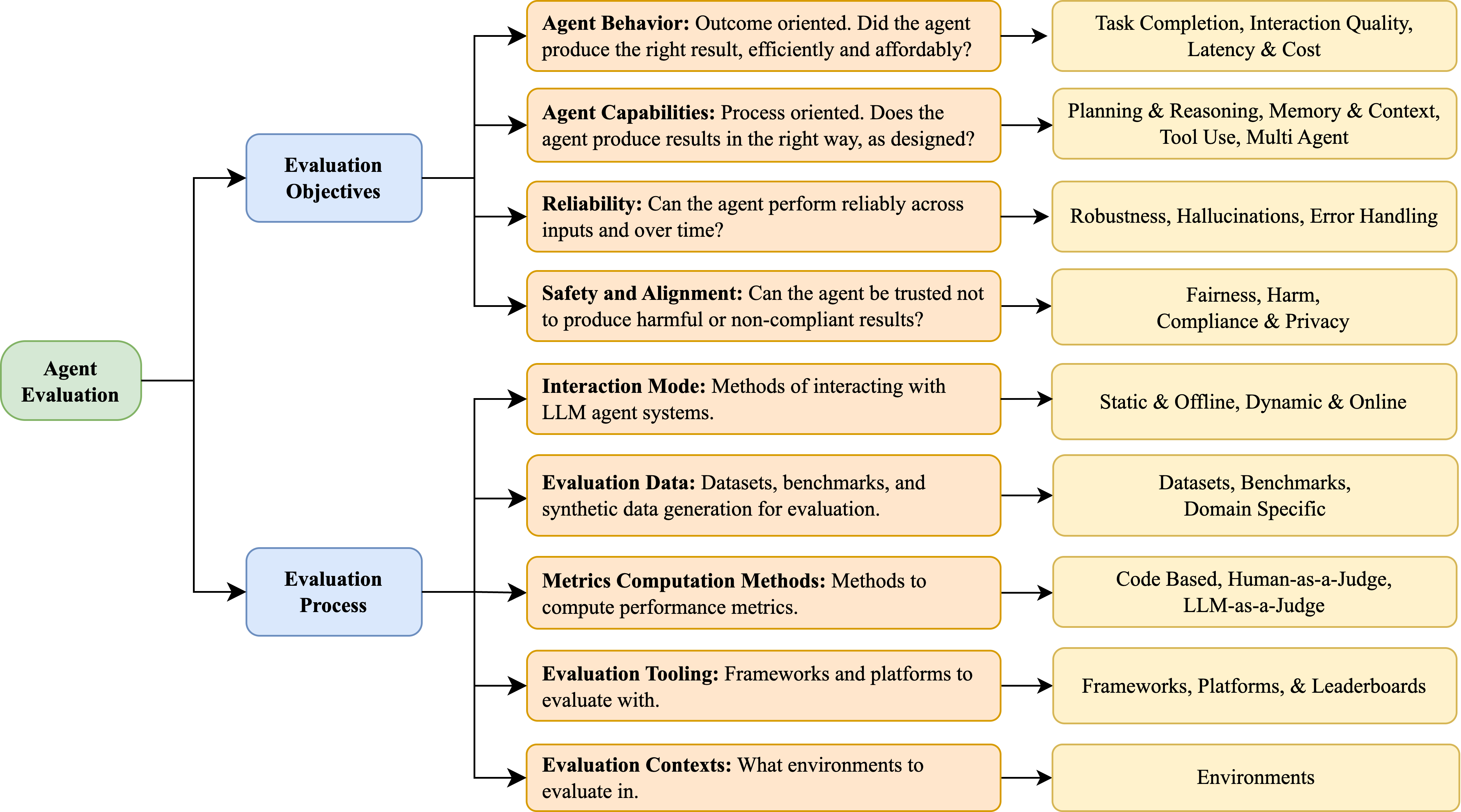
The image is a flow diagram illustrating the agent evaluation process. It starts with "Agent Evaluation" and branches into "Evaluation Objectives" and "Evaluation Process." Each of these branches further expands into specific aspects and considerations for evaluating agents.
### Components/Axes
* **Root Node:** "Agent Evaluation" (green rounded rectangle, left side)
* **Primary Branches:**
* "Evaluation Objectives" (blue rounded rectangle, top-center)
* "Evaluation Process" (blue rounded rectangle, bottom-center)
* **Secondary Branches (from Evaluation Objectives):**
* "Agent Behavior: Outcome oriented. Did the agent produce the right result, efficiently and affordably?" (tan rounded rectangle, top-right)
* "Agent Capabilities: Process oriented. Does the agent produce results in the right way, as designed?" (tan rounded rectangle, mid-top-right)
* "Reliability: Can the agent perform reliably across inputs and over time?" (tan rounded rectangle, mid-right)
* "Safety and Alignment: Can the agent be trusted not to produce harmful or non-compliant results?" (tan rounded rectangle, mid-bottom-right)
* "Interaction Mode: Methods of interacting with LLM agent systems." (tan rounded rectangle, bottom-right)
* **Secondary Branches (from Evaluation Process):**
* "Evaluation Data: Datasets, benchmarks, and synthetic data generation for evaluation." (tan rounded rectangle, mid-top-left)
* "Metrics Computation Methods: Methods to compute performance metrics." (tan rounded rectangle, mid-left)
* "Evaluation Tooling: Frameworks and platforms to evaluate with." (tan rounded rectangle, mid-bottom-left)
* "Evaluation Contexts: What environments to evaluate in." (tan rounded rectangle, bottom-left)
* **Tertiary Branches (from Agent Behavior):**
* "Task Completion, Interaction Quality, Latency & Cost" (tan rounded rectangle, far-right, top)
* **Tertiary Branches (from Agent Capabilities):**
* "Planning & Reasoning, Memory & Context, Tool Use, Multi Agent" (tan rounded rectangle, far-right, second from top)
* **Tertiary Branches (from Reliability):**
* "Robustness, Hallucinations, Error Handling" (tan rounded rectangle, far-right, middle)
* **Tertiary Branches (from Safety and Alignment):**
* "Fairness, Harm, Compliance & Privacy" (tan rounded rectangle, far-right, second from bottom)
* **Tertiary Branches (from Interaction Mode):**
* "Static & Offline, Dynamic & Online" (tan rounded rectangle, far-right, bottom)
* **Tertiary Branches (from Evaluation Data):**
* "Datasets, Benchmarks, Domain Specific" (tan rounded rectangle, far-right, second from top)
* **Tertiary Branches (from Metrics Computation Methods):**
* "Code Based, Human-as-a-Judge, LLM-as-a-Judge" (tan rounded rectangle, far-right, middle)
* **Tertiary Branches (from Evaluation Tooling):**
* "Frameworks, Platforms, & Leaderboards" (tan rounded rectangle, far-right, second from bottom)
* **Tertiary Branches (from Evaluation Contexts):**
* "Environments" (tan rounded rectangle, far-right, bottom)
### Detailed Analysis or ### Content Details
The diagram outlines a hierarchical structure for agent evaluation. The process begins with a general "Agent Evaluation" node, which then splits into two main categories: "Evaluation Objectives" and "Evaluation Process."
* **Evaluation Objectives:** This branch focuses on *what* aspects of the agent's performance are being evaluated. It includes:
* **Agent Behavior:** Assessing the outcome of the agent's actions (e.g., task completion, efficiency, cost).
* Metrics: Task Completion, Interaction Quality, Latency & Cost
* **Agent Capabilities:** Evaluating the agent's process and design (e.g., planning, reasoning, tool use).
* Metrics: Planning & Reasoning, Memory & Context, Tool Use, Multi Agent
* **Reliability:** Determining the agent's consistency and robustness over time and across different inputs.
* Metrics: Robustness, Hallucinations, Error Handling
* **Safety and Alignment:** Ensuring the agent's actions are safe, ethical, and compliant.
* Metrics: Fairness, Harm, Compliance & Privacy
* **Interaction Mode:** Considering the methods of interaction with LLM agent systems.
* Metrics: Static & Offline, Dynamic & Online
* **Evaluation Process:** This branch focuses on *how* the agent is being evaluated. It includes:
* **Evaluation Data:** Specifying the datasets, benchmarks, and synthetic data used for evaluation.
* Data Types: Datasets, Benchmarks, Domain Specific
* **Metrics Computation Methods:** Defining the methods used to compute performance metrics.
* Methods: Code Based, Human-as-a-Judge, LLM-as-a-Judge
* **Evaluation Tooling:** Identifying the frameworks and platforms used for evaluation.
* Tools: Frameworks, Platforms, & Leaderboards
* **Evaluation Contexts:** Defining the environments in which the agent is evaluated.
* Contexts: Environments
### Key Observations
* The diagram provides a structured overview of the key considerations in agent evaluation.
* It highlights the importance of both *what* is being evaluated (objectives) and *how* it is being evaluated (process).
* The diagram covers a wide range of evaluation aspects, including behavior, capabilities, reliability, safety, interaction mode, data, metrics, tooling, and contexts.
### Interpretation
The diagram serves as a useful framework for designing and conducting agent evaluations. It emphasizes the need to consider both the objectives of the evaluation and the process used to achieve those objectives. By systematically addressing each of the aspects outlined in the diagram, evaluators can gain a comprehensive understanding of an agent's performance and capabilities. The diagram also highlights the importance of considering ethical and safety concerns in agent evaluation, as well as the need to use appropriate data, metrics, and tools.
DECODING INTELLIGENCE...
EXPERT: gemini-3.1-flash-lite-preview-free VERSION 1
RUNTIME: google-free/gemini-3.1-flash-lite-preview
INTEL_VERIFIED
## Hierarchical Diagram: Taxonomy of Agent Evaluation
### Overview
This diagram presents a structured taxonomy for the evaluation of AI agents. It is organized as a left-to-right flow chart, originating from a central root node ("Agent Evaluation") and branching into two primary pillars: "Evaluation Objectives" and "Evaluation Process." Each pillar further expands into specific categories and their corresponding components. The diagram uses color-coding to denote hierarchy: Green for the root, Blue for primary categories, Tan for sub-categories, and Yellow for specific components/examples.
### Components/Axes
* **Root Node (Green):** Agent Evaluation.
* **Primary Nodes (Blue):** Evaluation Objectives, Evaluation Process.
* **Sub-Category Nodes (Tan):** These define the specific areas of focus within the primary nodes.
* **Component Nodes (Yellow):** These list the specific metrics, methods, or examples associated with the sub-categories.
* **Flow:** The diagram flows from left to right, with arrows indicating the hierarchical relationship between the root, primary, sub-categories, and components.
### Detailed Analysis
#### Branch 1: Evaluation Objectives
This branch focuses on *what* is being evaluated.
1. **Agent Behavior** (Outcome oriented. Did the agent produce the right result, efficiently and affordably?)
* *Components:* Task Completion, Interaction Quality, Latency & Cost.
2. **Agent Capabilities** (Process oriented. Does the agent produce results in the right way, as designed?)
* *Components:* Planning & Reasoning, Memory & Context, Tool Use, Multi Agent.
3. **Reliability** (Can the agent perform reliably across inputs and over time?)
* *Components:* Robustness, Hallucinations, Error Handling.
4. **Safety and Alignment** (Can the agent be trusted not to produce harmful or non-compliant results?)
* *Components:* Fairness, Harm, Compliance & Privacy.
#### Branch 2: Evaluation Process
This branch focuses on *how* the evaluation is conducted.
1. **Interaction Mode** (Methods of interacting with LLM agent systems.)
* *Components:* Static & Offline, Dynamic & Online.
2. **Evaluation Data** (Datasets, benchmarks, and synthetic data generation for evaluation.)
* *Components:* Datasets, Benchmarks, Domain Specific.
3. **Metrics Computation Methods** (Methods to compute performance metrics.)
* *Components:* Code Based, Human-as-a-Judge, LLM-as-a-Judge.
4. **Evaluation Tooling** (Frameworks and platforms to evaluate with.)
* *Components:* Frameworks, Platforms, & Leaderboards.
5. **Evaluation Contexts** (What environments to evaluate in.)
* *Components:* Environments.
### Key Observations
* **Conceptual Split:** The diagram makes a clear distinction between "Outcome oriented" (Behavior) and "Process oriented" (Capabilities) evaluation, which is a critical distinction in modern AI agent development.
* **Methodological Breadth:** The "Evaluation Process" branch highlights the shift from traditional static benchmarking to more complex, dynamic evaluation methods (e.g., "LLM-as-a-Judge" and "Dynamic & Online" interaction modes).
* **Hierarchy Balance:** The "Evaluation Objectives" branch contains 4 sub-categories, while the "Evaluation Process" branch contains 5, suggesting that the *process* of evaluation is currently as complex, if not more so, than the *objectives* themselves.
### Interpretation
This diagram serves as a comprehensive framework for the current state of AI Agent evaluation. It demonstrates that evaluating an agent is significantly more complex than evaluating a standard Large Language Model (LLM).
* **Shift in Focus:** By including "Tool Use," "Multi Agent," and "Planning & Reasoning," the diagram acknowledges that agents are not just text generators but active systems that interact with the world.
* **The "Judge" Paradigm:** The inclusion of "Human-as-a-Judge" and "LLM-as-a-Judge" under "Metrics Computation Methods" highlights the industry's reliance on model-based evaluation to scale the assessment of complex, open-ended agent behaviors where traditional code-based metrics (like exact match or BLEU scores) are insufficient.
* **Operational Reality:** The "Evaluation Process" branch emphasizes that evaluation is not just about the model, but about the *environment* (Evaluation Contexts) and the *interaction mode* (Static vs. Dynamic), reflecting the need to test agents in real-world, non-deterministic scenarios.
DECODING INTELLIGENCE...
EXPERT: nemotron-free VERSION 1
RUNTIME: free/nvidia/nemotron-nano-12b-v2-vl:free
INTEL_VERIFIED
## Flowchart: Agent Evaluation Framework
### Overview
The image depicts a hierarchical flowchart outlining an **Agent Evaluation Framework** for Large Language Model (LLM) systems. It branches into two primary categories: **Evaluation Objectives** (left) and **Evaluation Process** (right), each subdivided into detailed criteria. Arrows indicate relationships between components, emphasizing a structured approach to assessing agent performance.
### Components/Axes
#### Evaluation Objectives (Left Branch)
1. **Agent Behavior**
- Sub-components: Task Completion, Interaction Quality, Latency & Cost
- Question: "Did the agent produce the right result, efficiently and affordably?"
2. **Agent Capabilities**
- Sub-components: Planning & Reasoning, Memory & Context, Tool Use, Multi-Agent
- Question: "Does the agent produce results in the right way, as designed?"
3. **Reliability**
- Sub-components: Robustness, Hallucinations, Error Handling
- Question: "Can the agent perform reliably across inputs and over time?"
4. **Safety and Alignment**
- Sub-components: Fairness, Harm, Compliance & Privacy
- Question: "Can the agent be trusted not to produce harmful or non-compliant results?"
5. **Interaction Mode**
- Sub-components: Static & Offline, Dynamic & Online
- Question: "Methods of interacting with LLM agent systems."
6. **Evaluation Data**
- Sub-components: Datasets, Benchmarks, Domain-Specific
- Description: "Datasets, benchmarks, and synthetic data generation for evaluation."
#### Evaluation Process (Right Branch)
1. **Metrics Computation Methods**
- Sub-components: Code-Based, Human-as-a-Judge, LLM-as-a-Judge
- Description: "Methods to compute performance metrics."
2. **Evaluation Tooling**
- Sub-components: Frameworks, Platforms, & Leaderboards
- Description: "Frameworks and platforms to evaluate with."
3. **Evaluation Contexts**
- Sub-components: Environments
- Description: "What environments to evaluate in."
### Detailed Analysis
- **Agent Behavior** focuses on outcome-oriented metrics (e.g., task completion efficiency).
- **Agent Capabilities** emphasizes process-oriented design adherence (e.g., reasoning, tool use).
- **Reliability** addresses consistency across inputs and time, including error handling.
- **Safety and Alignment** ensures ethical and compliant outputs (e.g., fairness, privacy).
- **Interaction Mode** distinguishes between static/offline and dynamic/online interactions.
- **Evaluation Data** highlights the importance of domain-specific benchmarks.
- **Metrics Computation Methods** include hybrid approaches (human/LLM judges).
- **Evaluation Tooling** and **Contexts** stress the need for scalable frameworks and realistic environments.
### Key Observations
- The framework balances **outcome** (e.g., task completion) and **process** (e.g., reasoning) evaluations.
- **Safety and Alignment** is a standalone pillar, reflecting its criticality in trustworthy AI.
- **Evaluation Data** and **Tooling** components suggest a focus on reproducibility and scalability.
- Arrows indicate a top-down flow: objectives → process → implementation.
### Interpretation
This framework provides a **comprehensive, multi-dimensional evaluation strategy** for LLM agents. By separating objectives (what to measure) from processes (how to measure), it ensures both **effectiveness** (did the agent succeed?) and **reliability** (can it be trusted?). The inclusion of **human/LLM judges** and **domain-specific data** acknowledges the complexity of real-world applications. The emphasis on **safety** and **interaction modes** aligns with ethical AI development trends. Overall, the flowchart advocates for a holistic approach to agent evaluation, critical for deploying robust and responsible LLM systems.
DECODING INTELLIGENCE...