## Hierarchical Diagram: Taxonomy of Agent Evaluation
### Overview
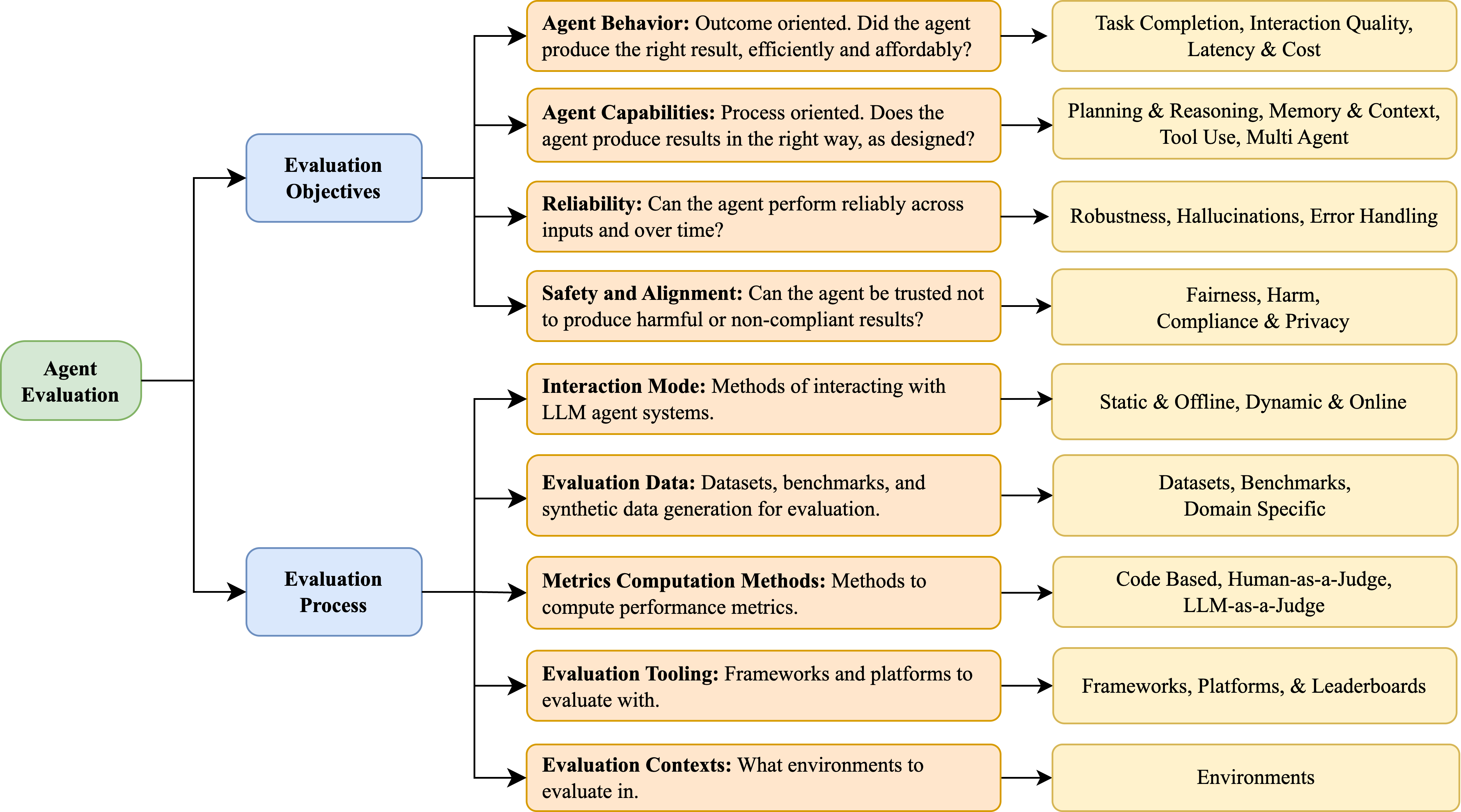
This diagram presents a structured taxonomy for the evaluation of AI agents. It is organized as a left-to-right flow chart, originating from a central root node ("Agent Evaluation") and branching into two primary pillars: "Evaluation Objectives" and "Evaluation Process." Each pillar further expands into specific categories and their corresponding components. The diagram uses color-coding to denote hierarchy: Green for the root, Blue for primary categories, Tan for sub-categories, and Yellow for specific components/examples.
### Components/Axes
* **Root Node (Green):** Agent Evaluation.
* **Primary Nodes (Blue):** Evaluation Objectives, Evaluation Process.
* **Sub-Category Nodes (Tan):** These define the specific areas of focus within the primary nodes.
* **Component Nodes (Yellow):** These list the specific metrics, methods, or examples associated with the sub-categories.
* **Flow:** The diagram flows from left to right, with arrows indicating the hierarchical relationship between the root, primary, sub-categories, and components.
### Detailed Analysis
#### Branch 1: Evaluation Objectives
This branch focuses on *what* is being evaluated.
1. **Agent Behavior** (Outcome oriented. Did the agent produce the right result, efficiently and affordably?)
* *Components:* Task Completion, Interaction Quality, Latency & Cost.
2. **Agent Capabilities** (Process oriented. Does the agent produce results in the right way, as designed?)
* *Components:* Planning & Reasoning, Memory & Context, Tool Use, Multi Agent.
3. **Reliability** (Can the agent perform reliably across inputs and over time?)
* *Components:* Robustness, Hallucinations, Error Handling.
4. **Safety and Alignment** (Can the agent be trusted not to produce harmful or non-compliant results?)
* *Components:* Fairness, Harm, Compliance & Privacy.
#### Branch 2: Evaluation Process
This branch focuses on *how* the evaluation is conducted.
1. **Interaction Mode** (Methods of interacting with LLM agent systems.)
* *Components:* Static & Offline, Dynamic & Online.
2. **Evaluation Data** (Datasets, benchmarks, and synthetic data generation for evaluation.)
* *Components:* Datasets, Benchmarks, Domain Specific.
3. **Metrics Computation Methods** (Methods to compute performance metrics.)
* *Components:* Code Based, Human-as-a-Judge, LLM-as-a-Judge.
4. **Evaluation Tooling** (Frameworks and platforms to evaluate with.)
* *Components:* Frameworks, Platforms, & Leaderboards.
5. **Evaluation Contexts** (What environments to evaluate in.)
* *Components:* Environments.
### Key Observations
* **Conceptual Split:** The diagram makes a clear distinction between "Outcome oriented" (Behavior) and "Process oriented" (Capabilities) evaluation, which is a critical distinction in modern AI agent development.
* **Methodological Breadth:** The "Evaluation Process" branch highlights the shift from traditional static benchmarking to more complex, dynamic evaluation methods (e.g., "LLM-as-a-Judge" and "Dynamic & Online" interaction modes).
* **Hierarchy Balance:** The "Evaluation Objectives" branch contains 4 sub-categories, while the "Evaluation Process" branch contains 5, suggesting that the *process* of evaluation is currently as complex, if not more so, than the *objectives* themselves.
### Interpretation
This diagram serves as a comprehensive framework for the current state of AI Agent evaluation. It demonstrates that evaluating an agent is significantly more complex than evaluating a standard Large Language Model (LLM).
* **Shift in Focus:** By including "Tool Use," "Multi Agent," and "Planning & Reasoning," the diagram acknowledges that agents are not just text generators but active systems that interact with the world.
* **The "Judge" Paradigm:** The inclusion of "Human-as-a-Judge" and "LLM-as-a-Judge" under "Metrics Computation Methods" highlights the industry's reliance on model-based evaluation to scale the assessment of complex, open-ended agent behaviors where traditional code-based metrics (like exact match or BLEU scores) are insufficient.
* **Operational Reality:** The "Evaluation Process" branch emphasizes that evaluation is not just about the model, but about the *environment* (Evaluation Contexts) and the *interaction mode* (Static vs. Dynamic), reflecting the need to test agents in real-world, non-deterministic scenarios.