## Diagram: Process Flow with Node Attributes
### Overview
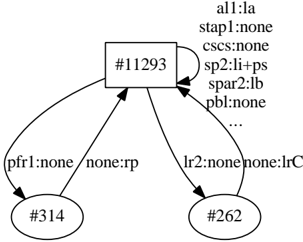
The diagram depicts a hierarchical process flow originating from a central node (#11293) branching into two downstream nodes (#314 and #262). Each node contains labeled attributes, and directional arrows indicate relationships or transitions between nodes. The structure suggests a decision-making or state-transition system with conditional logic.
### Components/Axes
- **Central Node (#11293)**: Contains seven attributes:
- `all1:la`
- `stap1:none`
- `cscs:none`
- `sp2:li+ps`
- `spar2:lb`
- `pbl:none`
- `...` (implied continuation)
- **Downstream Node #314**: Contains two attributes:
- `pfr1:none`
- `none:rp`
- **Downstream Node #262**: Contains two attributes:
- `lr2:none`
- `none:lrC`
- **Arrows**: Labeled with directional relationships (e.g., `none:rp`, `none:lrC`).
### Detailed Analysis
- **Node #11293**: Attributes include mixed states (e.g., `sp2:li+ps` suggests a combined condition, while `stap1:none` indicates absence). The ellipsis (`...`) implies additional attributes not fully visible.
- **Node #314**: The attribute `none:rp` may represent a transition from an undefined state (`none`) to a resolved state (`rp`).
- **Node #262**: The attribute `none:lrC` mirrors the structure of #314, suggesting parallel logic paths.
- **Arrows**: All arrows originate from #11293, indicating it as the root node. Labels like `pfr1:none` and `lr2:none` on arrows may denote conditional triggers or absence of specific actions.
### Key Observations
1. **Symmetry in Downstream Nodes**: Both #314 and #262 share a similar structure (`none:<state>`), implying mirrored decision paths.
2. **Ambiguous Continuation**: The ellipsis (`...`) in #11293 suggests incomplete data or additional attributes not shown.
3. **Directional Flow**: All transitions originate from #11293, establishing it as the primary decision point.
### Interpretation
This diagram likely represents a workflow or state machine where #11293 acts as a central hub evaluating conditions (`all1:la`, `sp2:li+ps`, etc.) before branching into two distinct paths. The attributes on downstream nodes (#314, #262) suggest resolution states (`rp`, `lrC`), possibly indicating outcomes of conditional checks. The use of `none` as a prefix in arrow labels (e.g., `none:rp`) implies transitions from an undefined or default state to a resolved one. The ellipsis in #11293 raises questions about missing data or unmodeled variables, which could impact the system's completeness. The symmetry between #314 and #262 hints at parallel processing or redundancy in the workflow.