## Flow Diagram: Neural Architecture Search
### Overview
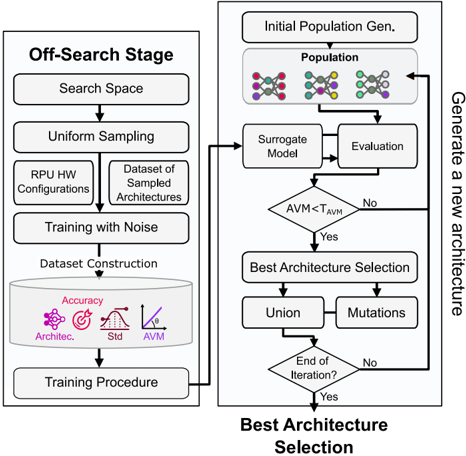
The image presents a flow diagram illustrating a neural architecture search process. It consists of two main stages: an "Off-Search Stage" and a "Best Architecture Selection" stage. The diagram outlines the steps involved in generating and evaluating neural network architectures, ultimately selecting the best one based on certain criteria.
### Components/Axes
**Off-Search Stage (Left Side):**
* **Search Space:** The initial stage where the possible architectures are defined.
* **Uniform Sampling:** A method for selecting architectures from the search space.
* **RPU HW Configurations:** Hardware configurations for the architectures.
* **Dataset of Sampled Architectures:** A collection of architectures sampled from the search space.
* **Training with Noise:** Training the architectures with added noise.
* **Dataset Construction:** Building a dataset from the trained architectures.
* **Accuracy Metrics:**
* **Architec.:** Represents the architecture itself (depicted as a network diagram).
* **Std:** Standard deviation of performance (depicted as a bell curve).
* **AVM:** Average value metric (depicted as an angle).
* **Training Procedure:** The process of training the architectures.
**Best Architecture Selection (Right Side):**
* **Initial Population Gen.:** Generating an initial population of architectures.
* **Population:** A set of architectures (depicted as network diagrams with different colored nodes).
* **Surrogate Model:** A model used to approximate the performance of architectures.
* **Evaluation:** Evaluating the performance of the architectures.
* **AVM < T<sub>AVM</sub>?:** A decision point comparing the average value metric (AVM) to a threshold (T<sub>AVM</sub>).
* **Yes:** If AVM is less than T<sub>AVM</sub>, proceed to "Best Architecture Selection."
* **No:** If AVM is not less than T<sub>AVM</sub>, loop back to "Population" to generate a new architecture.
* **Best Architecture Selection:** Selecting the best architecture from the population.
* **Union:** Combining architectures.
* **Mutations:** Introducing changes to the architectures.
* **End of Iteration?:** A decision point to determine if the iteration is complete.
* **Yes:** If the iteration is complete, end the process.
* **No:** If the iteration is not complete, loop back to "Surrogate Model."
* **Generate a new architecture:** Text on the right side of the diagram, indicating the iterative nature of the process.
### Detailed Analysis
The diagram illustrates a two-stage process for neural architecture search. The "Off-Search Stage" focuses on generating a diverse dataset of architectures and training them with noise. This stage involves uniform sampling from the search space, training the sampled architectures, and constructing a dataset with accuracy metrics. The "Best Architecture Selection" stage iteratively refines the architecture by generating an initial population, evaluating their performance using a surrogate model, and selecting the best architectures based on the AVM metric. The process continues with union and mutation operations until the end of the iteration is reached.
### Key Observations
* The diagram highlights the iterative nature of the architecture search process.
* The use of a surrogate model suggests an attempt to reduce the computational cost of evaluating architectures.
* The AVM metric plays a crucial role in selecting the best architectures.
* The "Off-Search Stage" appears to be a preliminary step to generate a diverse dataset for the subsequent optimization process.
### Interpretation
The flow diagram represents a neural architecture search algorithm that combines an initial exploration phase ("Off-Search Stage") with an iterative optimization phase ("Best Architecture Selection"). The "Off-Search Stage" aims to create a diverse dataset of architectures and their performance characteristics, which can then be used to train a surrogate model. The surrogate model is used to efficiently evaluate the performance of new architectures in the "Best Architecture Selection" stage. The algorithm iteratively refines the architecture by generating new populations, evaluating them using the surrogate model, and selecting the best architectures based on the AVM metric. The union and mutation operations introduce diversity and exploration into the search process. The comparison of AVM to T<sub>AVM</sub> acts as a convergence criterion, determining when the algorithm has found a satisfactory architecture. The overall process aims to automate the design of neural network architectures, potentially leading to improved performance and efficiency compared to manually designed architectures.