## Diagram: Solar System vs. Rutherford Atom
### Overview
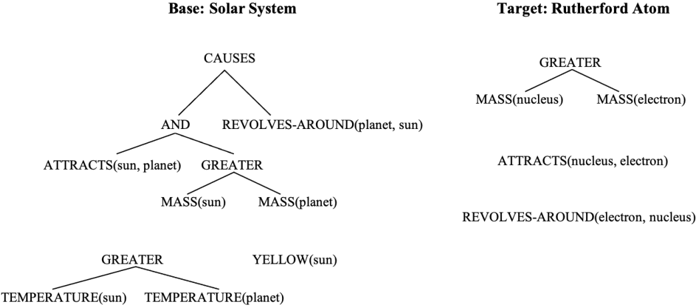
The image presents two diagrams side-by-side, illustrating analogies between the Solar System and the Rutherford model of the atom. The left diagram, labeled "Base: Solar System," breaks down the causes and properties of the solar system. The right diagram, labeled "Target: Rutherford Atom," similarly breaks down the properties of the Rutherford atom. Both diagrams use a tree-like structure to represent relationships and properties.
### Components/Axes
**Left Diagram (Base: Solar System):**
* **Title:** Base: Solar System
* **Top Node:** CAUSES
* **Second Level:** AND, REVOLVES-AROUND(planet, sun)
* **Third Level:** ATTRACTS(sun, planet), GREATER
* **Fourth Level:** MASS(sun), MASS(planet)
* **Bottom Level:** GREATER, YELLOW(sun)
* **Bottom Level:** TEMPERATURE(sun), TEMPERATURE(planet)
**Right Diagram (Target: Rutherford Atom):**
* **Title:** Target: Rutherford Atom
* **Top Node:** GREATER
* **Second Level:** MASS(nucleus), MASS(electron)
* **Third Level:** ATTRACTS(nucleus, electron)
* **Fourth Level:** REVOLVES-AROUND(electron, nucleus)
### Detailed Analysis
**Left Diagram (Base: Solar System):**
* The diagram starts with "CAUSES" at the top.
* "CAUSES" branches into "AND" and "REVOLVES-AROUND(planet, sun)". This suggests that the solar system exists because of some combination of factors, and that planets revolve around the sun.
* "AND" branches into "ATTRACTS(sun, planet)" and "GREATER". This suggests that the attraction between the sun and planets is a factor, and that something is "GREATER" than something else.
* "GREATER" branches into "MASS(sun)" and "MASS(planet)". This indicates that the mass of the sun is greater than the mass of the planet.
* The diagram also includes "GREATER" branching into "TEMPERATURE(sun)" and "TEMPERATURE(planet)", indicating the temperature of the sun is greater than the temperature of the planet.
* Finally, "YELLOW(sun)" is present, indicating the sun is yellow.
**Right Diagram (Target: Rutherford Atom):**
* The diagram starts with "GREATER" at the top.
* "GREATER" branches into "MASS(nucleus)" and "MASS(electron)". This indicates that the mass of the nucleus is greater than the mass of the electron.
* The diagram then states "ATTRACTS(nucleus, electron)", indicating the nucleus attracts the electron.
* Finally, "REVOLVES-AROUND(electron, nucleus)" is present, indicating the electron revolves around the nucleus.
### Key Observations
* Both diagrams use a hierarchical structure to represent relationships.
* The diagrams highlight the similarities between the solar system and the Rutherford atom model, specifically in terms of mass relationships, attraction, and revolution.
* The left diagram includes the property "YELLOW(sun)", which is a specific characteristic of the solar system not directly analogous to the Rutherford atom.
### Interpretation
The diagrams illustrate an analogy between the structure of the solar system and the Rutherford model of the atom. The solar system, with planets revolving around a massive sun due to gravitational attraction, is presented as analogous to the Rutherford atom, with electrons revolving around a massive nucleus due to electromagnetic attraction. The diagrams emphasize the relationships between mass, attraction, and revolution in both systems. The inclusion of "YELLOW(sun)" in the solar system diagram suggests a specific, non-analogous property. The diagrams likely serve to explain the Rutherford model by relating it to a more familiar concept, the solar system.