\n
## Diagram: Analogical Mapping - Solar System to Rutherford Atom
### Overview
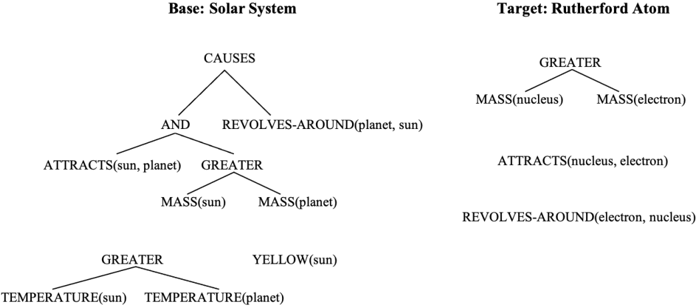
The image presents a diagram illustrating an analogical mapping between the Solar System and the Rutherford Atom model. It uses a tree-like structure to show relationships and correspondences between elements of the two systems. The diagram is split into two main sections, labeled "Base: Solar System" on the left and "Target: Rutherford Atom" on the right. Each section has a hierarchical structure, branching out from a central concept.
### Components/Axes
The diagram doesn't have traditional axes. Instead, it uses a branching tree structure. The key components are:
* **Base (Solar System):**
* Root: "CAUSES"
* Branches: "AND", "REVOLVES-AROUND(planet, sun)"
* Sub-branches: "ATTRACTS(sun, planet)", "GREATER", "MASS(sun)", "MASS(planet)"
* Further sub-branches: "GREATER", "TEMPERATURE(sun)", "TEMPERATURE(planet)", "YELLOW(sun)"
* **Target (Rutherford Atom):**
* Root: "GREATER"
* Branches: "MASS(nucleus)", "MASS(electron)"
* Sub-branches: "ATTRACTS(nucleus, electron)"
* Further sub-branches: "REVOLVES-AROUND(electron, nucleus)"
### Detailed Analysis or Content Details
**Solar System (Base):**
* "CAUSES" branches into "AND" and "REVOLVES-AROUND(planet, sun)".
* "AND" branches into "ATTRACTS(sun, planet)" and "GREATER".
* "GREATER" branches into "MASS(sun)" and "MASS(planet)".
* "MASS(sun)" branches into "GREATER", "TEMPERATURE(sun)", and "TEMPERATURE(planet)".
* "GREATER" branches into "TEMPERATURE(sun)" and "TEMPERATURE(planet)".
* "MASS(planet)" branches into "YELLOW(sun)".
**Rutherford Atom (Target):**
* "GREATER" branches into "MASS(nucleus)" and "MASS(electron)".
* "MASS(nucleus)" branches into "ATTRACTS(nucleus, electron)".
* "ATTRACTS(nucleus, electron)" branches into "REVOLVES-AROUND(electron, nucleus)".
### Key Observations
The diagram establishes an analogy where:
* The Sun in the Solar System corresponds to the Nucleus in the Rutherford Atom.
* Planets in the Solar System correspond to Electrons in the Rutherford Atom.
* Gravitational attraction between the Sun and planets corresponds to the electrostatic attraction between the nucleus and electrons.
* The concept of "greater" is used to relate mass and temperature in the Solar System, and mass in the Rutherford Atom.
* The color yellow is associated with the sun.
* The diagram uses functional notation (e.g., ATTRACTS(x, y), REVOLVES-AROUND(x, y)) to represent relationships.
### Interpretation
This diagram illustrates a conceptual analogy used to understand the structure of the Rutherford Atom. The Solar System, a familiar system, serves as a base for understanding the less intuitive structure of the atom. The analogy highlights the key relationships: a central massive body attracting orbiting smaller bodies. The use of "GREATER" suggests a hierarchical relationship based on size or influence. The diagram is a visual representation of a cognitive tool used to map knowledge from one domain (astronomy) to another (atomic physics). The inclusion of "YELLOW(sun)" is a less critical detail, perhaps intended to add a concrete element to the analogy. The diagram doesn't present quantitative data, but rather a qualitative mapping of concepts. It's a pedagogical tool for conceptual understanding, not a precise scientific model. The diagram suggests that the atom's structure is understood by drawing parallels to the solar system, where a central mass attracts orbiting objects.