## Conceptual Diagram: Analogy Between Solar System and Rutherford Atom
### Overview
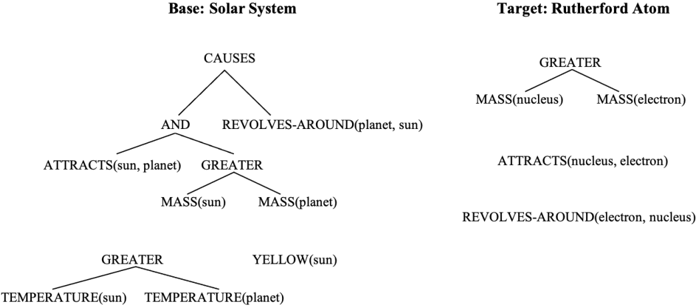
The image displays two side-by-side hierarchical tree diagrams. The left diagram is titled "Base: Solar System" and the right is titled "Target: Rutherford Atom." The diagrams are structured to show an analogy, mapping the relational and causal properties of the solar system onto the structure of the Rutherford atomic model. The diagrams use black text and lines on a plain white background.
### Components/Axes
There are no traditional chart axes or legends. The components are text nodes connected by lines in a top-down tree structure.
**Left Diagram: "Base: Solar System"**
* **Root Node (Top Center):** "CAUSES"
* **First-Level Branches (from "CAUSES"):**
* Left branch leads to node: "AND"
* Right branch leads to node: "REVOLVES-AROUND(planet, sun)"
* **Second-Level Branches (from "AND"):**
* Left branch leads to node: "ATTRACTS(sun, planet)"
* Right branch leads to node: "GREATER"
* **Third-Level Branches (from "GREATER"):**
* Left branch leads to node: "MASS(sun)"
* Right branch leads to node: "MASS(planet)"
* **Additional, Separate Tree (Bottom Left):**
* Root Node: "GREATER"
* Left branch leads to node: "TEMPERATURE(sun)"
* Right branch leads to node: "TEMPERATURE(planet)"
* **Isolated Node (Bottom Center-Right):** "YELLOW(sun)"
**Right Diagram: "Target: Rutherford Atom"**
* **Root Node (Top Center):** "GREATER"
* **First-Level Branches (from "GREATER"):**
* Left branch leads to node: "MASS(nucleus)"
* Right branch leads to node: "MASS(electron)"
* **Isolated Node (Middle Left):** "ATTRACTS(nucleus, electron)"
* **Isolated Node (Bottom Center):** "REVOLVES-AROUND(electron, nucleus)"
### Detailed Analysis
The diagrams are not data charts but conceptual maps. The text within the nodes represents predicates or properties.
**Solar System Diagram Structure:**
The primary tree asserts that "CAUSES" is the root concept. One cause is the conjunction ("AND") of two facts: 1) The sun attracts the planet ("ATTRACTS(sun, planet)"), and 2) The mass of the sun is greater than the mass of the planet ("GREATER" -> "MASS(sun)", "MASS(planet)"). The other direct effect or component of "CAUSES" is the fact that the planet revolves around the sun ("REVOLVES-AROUND(planet, sun)").
A separate, smaller tree at the bottom left states that the temperature of the sun is greater than the temperature of the planet. An independent node states the sun is yellow.
**Rutherford Atom Diagram Structure:**
The diagram is simpler and more fragmented. The main tree states that the mass of the nucleus is greater than the mass of the electron ("GREATER" -> "MASS(nucleus)", "MASS(electron)"). Two other key relationships are presented as standalone statements: the nucleus attracts the electron ("ATTRACTS(nucleus, electron)"), and the electron revolves around the nucleus ("REVOLVES-AROUND(electron, nucleus)").
### Key Observations
1. **Structural Analogy:** The diagrams explicitly draw a parallel between the solar system and the Rutherford atom. The predicates "ATTRACTS," "REVOLVES-AROUND," and "GREATER" (for mass) are used in both, with the roles of celestial bodies mapped to subatomic particles (sun -> nucleus, planet -> electron).
2. **Complexity Difference:** The "Base" (Solar System) diagram is more complex, with a deeper hierarchical tree and additional properties (temperature, color). The "Target" (Atom) diagram is a flattened, simplified version containing only the core relational predicates needed for the analogy.
3. **Missing Causal Link:** The "CAUSES" node is present only in the Solar System diagram. The Atom diagram does not have an explicit causal root; it presents the relationships as facts.
4. **Spatial Layout:** The Solar System diagram occupies the left two-thirds of the image. The Atom diagram is on the right third. The separate "GREATER" tree for temperature and the "YELLOW(sun)" node are positioned in the lower-left quadrant, below the main Solar System tree.
### Interpretation
This image is a pedagogical or conceptual tool illustrating analogical reasoning. It deconstructs a familiar system (the solar system) into a set of relational predicates and hierarchical causes. It then shows how the same set of core predicates (mass comparison, attraction, orbital revolution) can be applied to describe a less familiar system (the Rutherford atom), thereby making the atomic model more understandable.
The diagrams suggest that the strength of the analogy lies in the shared relational structure: a larger, central mass (sun/nucleus) attracts a smaller mass (planet/electron), causing it to revolve around it. The additional details in the solar system diagram (temperature, color) are not part of the core structural analogy and are therefore omitted from the atom diagram. The absence of the "CAUSES" node in the atom diagram may imply that the relationships are presented as observed facts rather than a deduced causal chain, or it may simply be a simplification for the sake of the analogy. The exercise demonstrates how complex systems can be modeled and understood by mapping their abstract relationships onto other domains.