## Diagram: Conceptual Comparison of Solar System and Rutherford Atom
### Overview
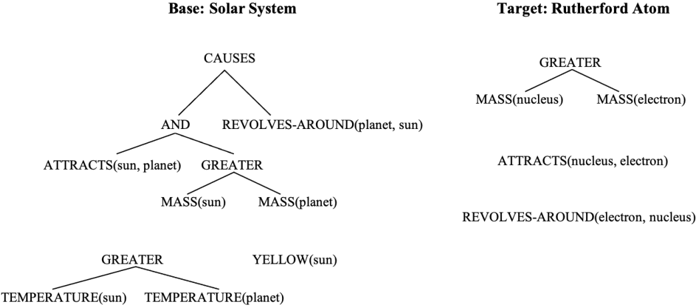
The image presents a hierarchical diagram comparing two systems: the **Solar System** (left) and the **Rutherford Atom** (right). Both systems are structured with nodes connected by labeled arrows, illustrating relationships such as causation, attraction, and comparative magnitude. The Solar System diagram emphasizes mass, temperature, and orbital dynamics, while the Rutherford Atom focuses on mass and subatomic interactions.
---
### Components/Axes
#### Solar System Section
- **Root Node**: `CAUSES`
- Branches into:
- `AND`
- `ATTRACTS(sun, planet)`
- `MASS(sun)`
- `MASS(planet)`
- `GREATER`
- `MASS(sun)`
- `MASS(planet)`
- `REVOLVES-AROUND(planet, sun)`
- `TEMPERATURE(planet)`
- `YELLOW(sun)`
- Additional node: `GREATER`
- `TEMPERATURE(sun)`
- `TEMPERATURE(planet)`
#### Rutherford Atom Section
- **Root Node**: `GREATER`
- Branches into:
- `MASS(nucleus)`
- `MASS(electron)`
- Additional nodes:
- `ATTRACTS(nucleus, electron)`
- `REVOLVES-AROUND(electron, nucleus)`
---
### Detailed Analysis
#### Solar System Hierarchy
1. **Causation and Attraction**:
- The root `CAUSES` node splits into `AND` (logical conjunction) and `REVOLVES-AROUND`.
- `AND` governs two sub-relationships:
- `ATTRACTS(sun, planet)`: Governs gravitational interaction, with mass attributes for both sun and planet.
- `GREATER`: Compares mass values (`MASS(sun)` > `MASS(planet)`).
- `REVOLVES-AROUND(planet, sun)` links orbital motion to temperature attributes (`TEMPERATURE(planet)` and `YELLOW(sun)`).
2. **Temperature Dynamics**:
- A standalone `GREATER` node compares `TEMPERATURE(sun)` and `TEMPERATURE(planet)`, though no explicit hierarchy is defined.
#### Rutherford Atom Hierarchy
1. **Mass and Attraction**:
- The root `GREATER` node compares `MASS(nucleus)` and `MASS(electron)`, implying the nucleus is significantly more massive.
- `ATTRACTS(nucleus, electron)` defines electrostatic interaction.
- `REVOLVES-AROUND(electron, nucleus)` mirrors planetary orbits but at the subatomic scale.
---
### Key Observations
1. **Structural Parallels**:
- Both systems use `GREATER` to compare mass, but the Solar System includes temperature comparisons absent in the atom.
- `REVOLVES-AROUND` appears in both, but the Solar System ties it to temperature, while the atom focuses purely on orbital mechanics.
2. **Divergent Attributes**:
- The Solar System introduces `YELLOW(sun)`, likely referencing stellar classification, which has no atomic counterpart.
- The Rutherford Atom lacks temperature attributes, focusing solely on mass and electrostatic forces.
3. **Logical Flow**:
- In the Solar System, causation (`CAUSES`) drives attraction and orbital dynamics, whereas the atom’s structure is defined by inherent mass differences and attraction.
---
### Interpretation
The diagram draws an analogy between celestial and subatomic systems, emphasizing shared principles of mass-driven attraction and orbital motion. However, critical differences emerge:
- **Scale and Complexity**: The Solar System incorporates temperature and stellar properties (e.g., `YELLOW(sun)`), reflecting macroscopic thermodynamic processes absent in atomic models.
- **Simplification**: The Rutherford Atom omits quantum mechanical nuances (e.g., electron probability clouds), focusing instead on classical orbital mechanics.
- **Causal Hierarchy**: The Solar System’s `CAUSES` node suggests a top-down causal chain (mass → attraction → orbit), while the atom’s structure is static, defined by fixed mass ratios and forces.
This comparison highlights how foundational physical principles (e.g., gravity, electromagnetism) manifest across vastly different scales, though each system operates under distinct governing laws.