## Diagram: Research Process Flowchart
### Overview
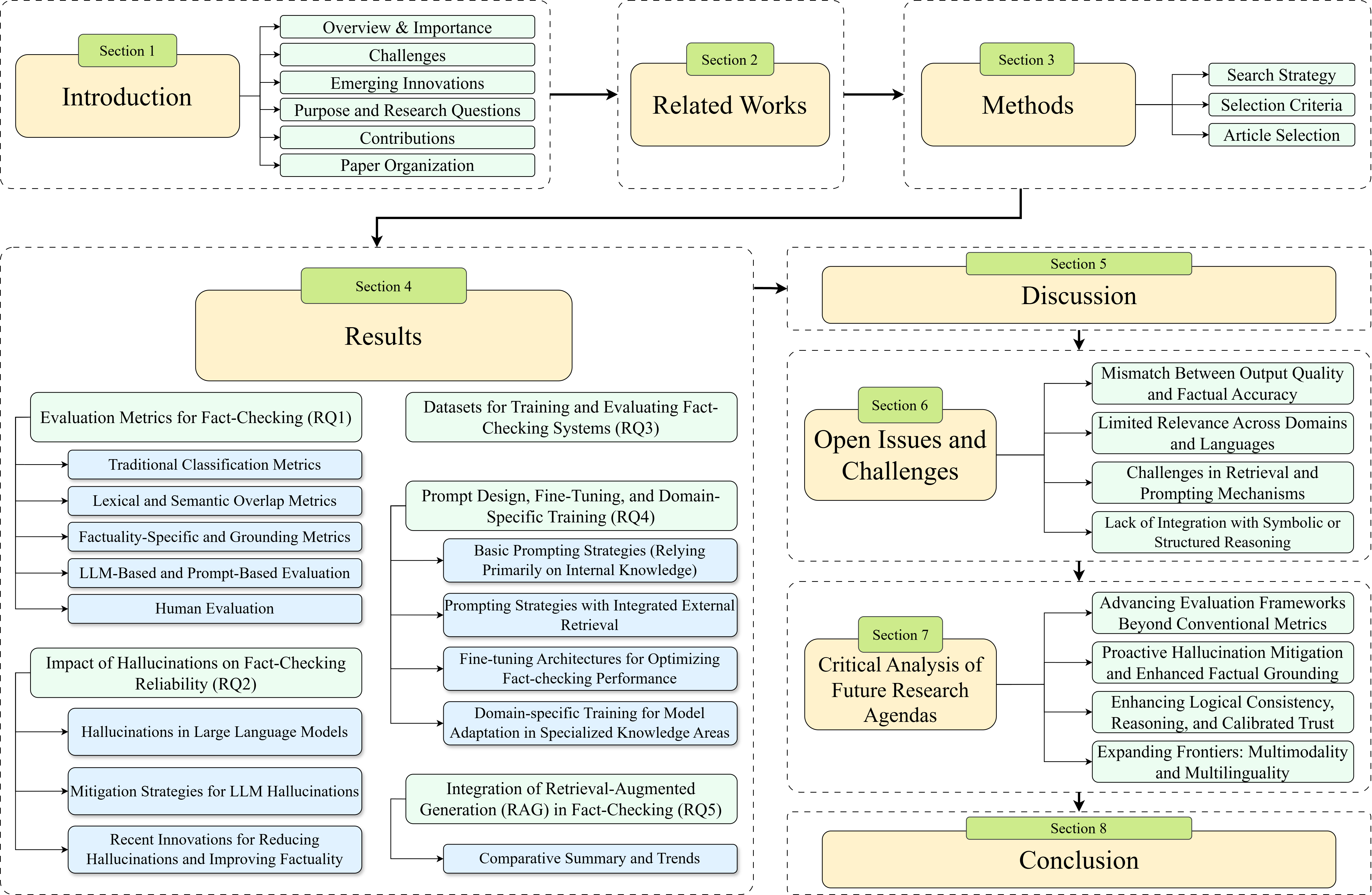
The image presents a flowchart illustrating a research process, likely for a paper or study focused on fact-checking using Large Language Models (LLMs). The diagram outlines the key sections of the research, their relationships, and sub-topics within each section. The flowchart is visually structured with rectangular boxes representing sections and arrows indicating the flow of the research.
### Components/Axes
The diagram is divided into eight sections, numbered 1 through 8, arranged in a generally linear flow with branching paths. The sections are:
1. Introduction
2. Related Works
3. Methods
4. Results
5. Discussion
6. Open Issues and Challenges
7. Critical Analysis of Future Research Agendas
8. Conclusion
Each section contains several sub-topics, listed within the corresponding box. The flowchart uses arrows to show the progression from Introduction to Results, and then branches out to Discussion, Open Issues, and Future Research, ultimately converging at the Conclusion.
### Detailed Analysis or Content Details
**Section 1: Introduction**
* Overview & Importance
* Challenges
* Emerging Innovations
* Purpose and Research Questions
* Contributions
* Paper Organization
**Section 2: Related Works**
* No sub-topics listed.
**Section 3: Methods**
* Search Strategy
* Selection Criteria
* Article Selection
**Section 4: Results**
* Evaluation Metrics for Fact-Checking (RQ1)
* Traditional Classification Metrics
* Lexical and Semantic Overlap Metrics
* Factuality-Specific and Grounding Metrics
* LLM-Based and Prompt-Based Evaluation
* Human Evaluation
* Impact of Hallucinations on Fact-Checking Reliability (RQ2)
* Hallucinations in Large Language Models
* Mitigation Strategies for LLM Hallucinations
* Recent Innovations for Reducing Hallucinations and Improving Factuality
**Section 5: Discussion**
* Mismatch Between Output Quality and Factual Accuracy
* Limited Relevance Across Domains and Languages
* Challenges in Retrieval and Prompting Mechanisms
* Lack of Integration with Symbolic or Structured Reasoning
**Section 6: Open Issues and Challenges**
* Datasets for Training and Evaluating Fact-Checking Systems (RQ3)
* Prompt Design, Fine-Tuning, and Domain-Specific Training (RQ4)
* Basic Prompting Strategies (Relying Primarily on Internal Knowledge)
* Prompting Strategies with Integrated External Retrieval
* Fine-tuning Architectures for Optimizing Fact-Checking Performance
* Domain-specific Training for Model Adaptation in Specialized Knowledge Areas
* Integration of Retrieval-Augmented Generation (RAG) in Fact-Checking (RQ5)
* Comparative Summary and Trends
**Section 7: Critical Analysis of Future Research Agendas**
* Advancing Evaluation Frameworks Beyond Conventional Metrics
* Proactive Hallucination Mitigation and Enhanced Factual Grounding
* Enhancing Logical Consistency, Reasoning, and Calibrated Trust
* Expanding Frontiers: Multimodality and Multilinguality
**Section 8: Conclusion**
* No sub-topics listed.
The arrows indicate the following flow:
* Introduction leads to Results.
* Results branches into Discussion, Open Issues and Challenges, and Future Research Agendas.
* All three branches converge into the Conclusion.
### Key Observations
The diagram emphasizes the iterative nature of research, with the Results section branching out into multiple areas of analysis. The inclusion of "Research Questions" (RQ1-RQ5) suggests a structured investigation with specific goals. The focus on "Hallucinations" and "Factuality" highlights a key concern in the application of LLMs to fact-checking. The diagram is well-organized and visually clear, effectively communicating the research process.
### Interpretation
This diagram represents a systematic approach to researching fact-checking methodologies using LLMs. The flow suggests a process of defining the problem (Introduction), reviewing existing work (Related Works), outlining the methods (Methods), presenting findings (Results), interpreting those findings (Discussion), identifying remaining challenges (Open Issues), and proposing future directions (Future Research). The emphasis on hallucinations and factual accuracy indicates a critical awareness of the limitations of current LLM technology. The branching from Results to multiple areas of analysis suggests a comprehensive investigation, exploring both the successes and failures of the proposed methods. The diagram serves as a roadmap for the research, outlining the key steps and considerations involved in addressing the challenges of automated fact-checking. The inclusion of RQs suggests a hypothesis-driven approach. The diagram is a high-level overview and does not contain specific data points or numerical values. It is a conceptual representation of a research process.