TECHNICAL ASSET FINGERPRINT
0e90e7baba62095cc1a00f6f
Click to view fullscreen
Press ESC or click to close
FOUND IN PAPERS
EXPERT: healer-alpha-free VERSION 1
RUNTIME: free/openrouter/healer-alpha
INTEL_VERIFIED
## Diagram: Research Paper Structure Flowchart
### Overview
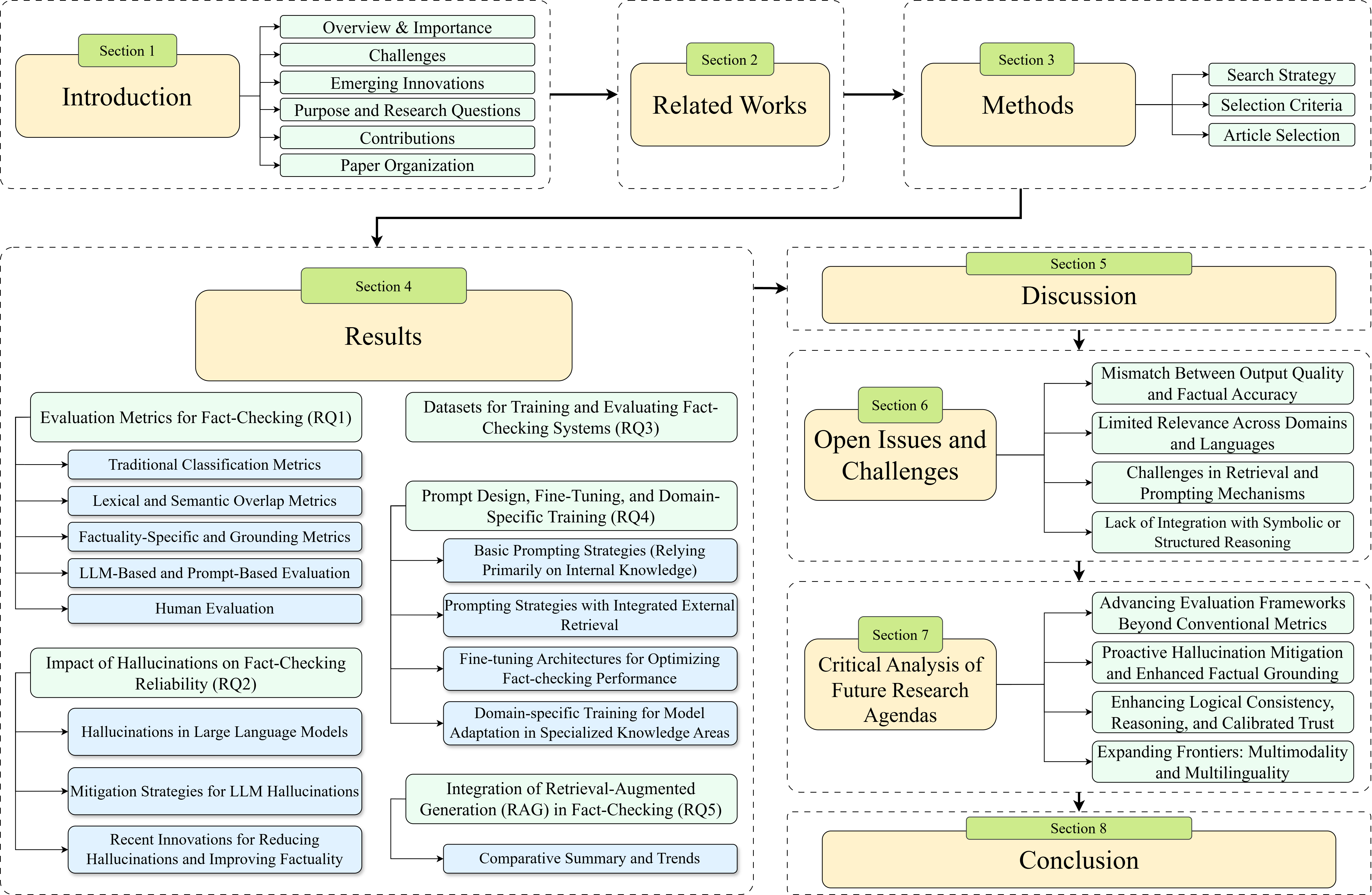
This image is a detailed flowchart illustrating the organizational structure and content flow of a research paper or review article, likely focused on fact-checking systems using Large Language Models (LLMs). The diagram uses a top-down, left-to-right flow with numbered sections, each containing main topics and sub-topics. The primary language is English.
### Components/Axes
The diagram is organized into two main horizontal rows, with sections connected by directional arrows indicating the paper's logical progression.
**Top Row (Sections 1-3):**
* **Section 1: Introduction** (Top-left, yellow box). It branches into six sub-topics (light blue boxes):
* Overview & Importance
* Challenges
* Emerging Innovations
* Purpose and Research Questions
* Contributions
* Paper Organization
* **Section 2: Related Works** (Top-center, yellow box). An arrow points from Section 1 to Section 2.
* **Section 3: Methods** (Top-right, yellow box). An arrow points from Section 2 to Section 3. It branches into three sub-topics (light blue boxes):
* Search Strategy
* Selection Criteria
* Article Selection
**Bottom Row (Sections 4-8):**
* **Section 4: Results** (Center-left, large yellow box). An arrow points from the "Methods" section (Section 3) down to the "Results" section. This is the most complex section, containing multiple research questions (RQs) and their associated topics.
* **Section 5: Discussion** (Center-right, yellow box). An arrow points from "Results" (Section 4) to "Discussion" (Section 5).
* **Section 6: Open Issues and Challenges** (Right, yellow box). An arrow points from "Discussion" (Section 5) down to this section. It branches into four sub-topics (light blue boxes).
* **Section 7: Critical Analysis of Future Research Agendas** (Right, below Section 6, yellow box). An arrow points from "Open Issues and Challenges" (Section 6) down to this section. It branches into four sub-topics (light blue boxes).
* **Section 8: Conclusion** (Bottom-right, yellow box). An arrow points from "Critical Analysis..." (Section 7) down to this final section.
### Detailed Analysis
**Section 4: Results - Detailed Breakdown**
This section is organized around five Research Questions (RQs), each with its own set of sub-topics.
1. **Evaluation Metrics for Fact-Checking (RQ1)** (Left column, light blue box). Branches into five sub-topics (smaller light blue boxes):
* Traditional Classification Metrics
* Lexical and Semantic Overlap Metrics
* Factuality-Specific and Grounding Metrics
* LLM-Based and Prompt-Based Evaluation
* Human Evaluation
2. **Impact of Hallucinations on Fact-Checking Reliability (RQ2)** (Left column, below RQ1, light blue box). Branches into three sub-topics:
* Hallucinations in Large Language Models
* Mitigation Strategies for LLM Hallucinations
* Recent Innovations for Reducing Hallucinations and Improving Factuality
3. **Datasets for Training and Evaluating Fact-Checking Systems (RQ3)** (Center column, top, light blue box). No further sub-branches shown.
4. **Prompt Design, Fine-Tuning, and Domain-Specific Training (RQ4)** (Center column, middle, light blue box). Branches into four sub-topics:
* Basic Prompting Strategies (Relying Primarily on Internal Knowledge)
* Prompting Strategies with Integrated External Retrieval
* Fine-tuning Architectures for Optimizing Fact-checking Performance
* Domain-specific Training for Model Adaptation in Specialized Knowledge Areas
5. **Integration of Retrieval-Augmented Generation (RAG) in Fact-Checking (RQ5)** (Center column, bottom, light blue box). Branches into one sub-topic:
* Comparative Summary and Trends
**Section 6: Open Issues and Challenges - Sub-topics**
* Mismatch Between Output Quality and Factual Accuracy
* Limited Relevance Across Domains and Languages
* Challenges in Retrieval and Prompting Mechanisms
* Lack of Integration with Symbolic or Structured Reasoning
**Section 7: Critical Analysis of Future Research Agendas - Sub-topics**
* Advancing Evaluation Frameworks Beyond Conventional Metrics
* Proactive Hallucination Mitigation and Enhanced Factual Grounding
* Enhancing Logical Consistency, Reasoning, and Calibrated Trust
* Expanding Frontiers: Multimodality and Multilinguality
### Key Observations
* **Hierarchical Structure:** The diagram clearly shows a hierarchical organization, with main sections (yellow) containing grouped sub-topics (light blue).
* **Research-Centric Flow:** The core of the paper (Sections 4-7) is structured around answering specific Research Questions (RQ1-RQ5) and then discussing their implications and future directions.
* **Focus on LLM Challenges:** A significant portion of the content (RQ2, Section 6) is dedicated to the problem of hallucinations in LLMs and their impact on fact-checking reliability.
* **Methodological Emphasis:** The "Methods" section (Section 3) is concise, focusing on the article selection process for the review, while the "Results" section (Section 4) is extensive, detailing the findings across multiple dimensions.
* **Forward-Looking Conclusion:** The paper structure moves from analysis (Results, Discussion) to identifying gaps (Open Issues) and finally proposing future research paths (Critical Analysis), culminating in a Conclusion.
### Interpretation
This flowchart represents the architecture of a comprehensive survey or review paper on the state of fact-checking in the era of Large Language Models. The structure suggests a systematic investigation that:
1. **Establishes Context:** The Introduction sets the stage by outlining the importance, challenges, and purpose of the study.
2. **Synthesizes Existing Knowledge:** The "Related Works" and "Methods" sections show the paper is grounded in prior literature and a defined selection process.
3. **Presents a Multi-Faceted Analysis:** The "Results" section is the heart of the paper, deconstructing the field into critical components: how to measure performance (RQ1), the core problem of hallucinations (RQ2), the data used (RQ3), the techniques for model adaptation (RQ4), and advanced integration methods like RAG (RQ5).
4. **Critiques and Projects Forward:** The subsequent sections (Discussion, Open Issues, Future Agendas) indicate the paper does not just summarize but critically evaluates the field's shortcomings and actively charts a course for future research, emphasizing needs like better evaluation, hallucination mitigation, improved reasoning, and multimodal/multilingual expansion.
The diagram itself is a meta-representation of the paper's logic, designed to give a reader a complete, at-a-glance understanding of the paper's scope, depth, and narrative flow before delving into the textual content. It highlights that the research is concerned not just with *what has been done*, but with *what is lacking* and *what should be done next*.
DECODING INTELLIGENCE...