## Flowchart: Research Paper Structure Diagram
### Overview
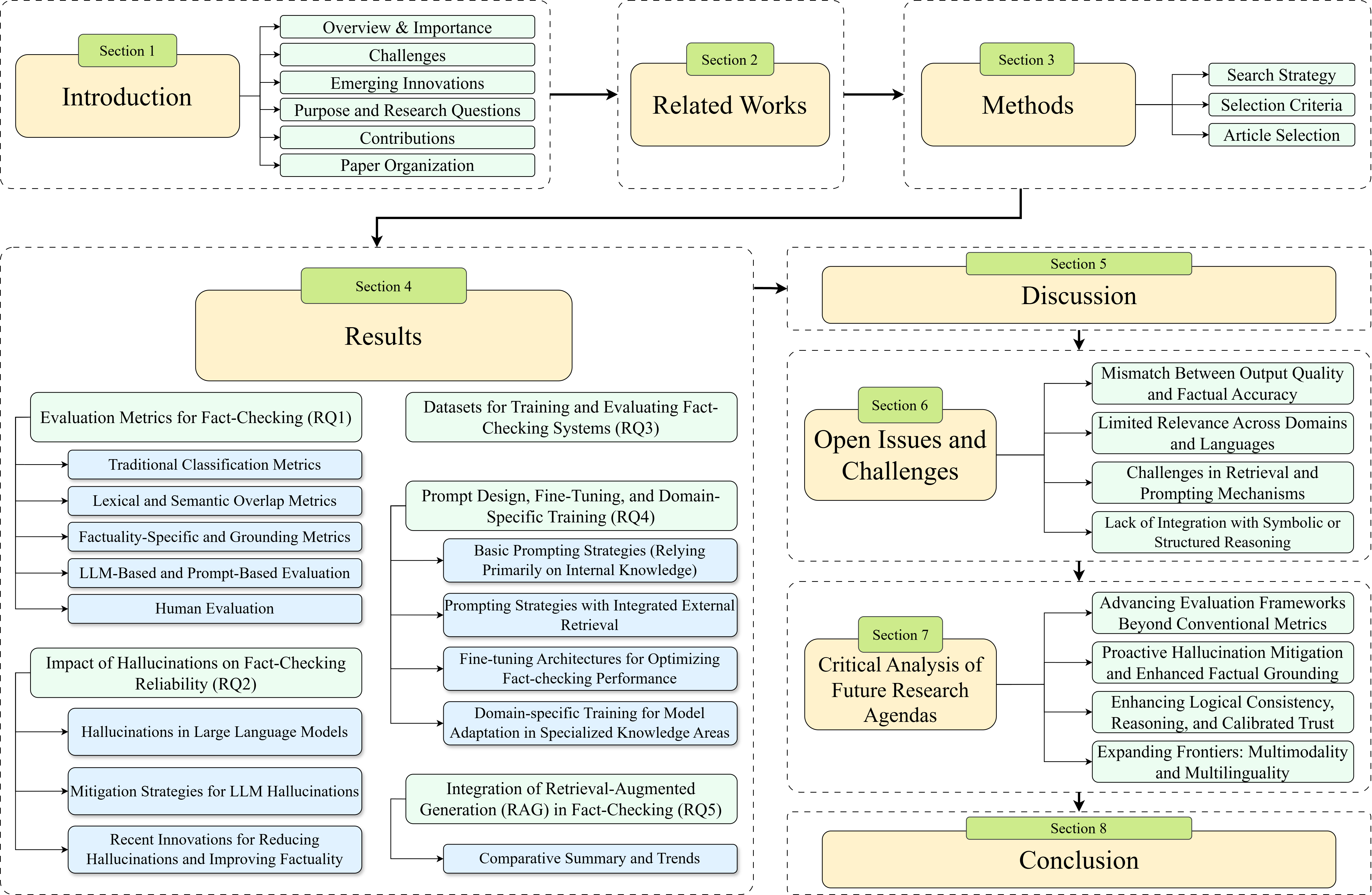
The image depicts a hierarchical flowchart outlining the structure of a research paper, divided into eight sections with subcomponents. The flow progresses from left to right, with branching elements in Sections 4 (Results) and 5 (Discussion).
### Components/Axes
- **Main Sections**:
- Section 1: Introduction
- Section 2: Related Works
- Section 3: Methods
- Section 4: Results
- Section 5: Discussion
- Section 6: Open Issues and Challenges
- Section 7: Critical Analysis of Future Research Agendas
- Section 8: Conclusion
- **Subcomponents**:
- **Section 1 (Introduction)**:
- Overview & Importance
- Challenges
- Emerging Innovations
- Purpose and Research Questions
- Contributions
- Paper Organization
- **Section 2 (Related Works)**:
- No subcomponents listed.
- **Section 3 (Methods)**:
- Search Strategy
- Selection Criteria
- Article Selection
- **Section 4 (Results)**:
- **Evaluation Metrics for Fact-Checking (RQ1)**:
- Traditional Classification Metrics
- Lexical and Semantic Overlap Metrics
- Factuality-Specific and Grounding Metrics
- LLM-Based and Prompt-Based Evaluation
- Human Evaluation
- **Impact of Hallucinations on Fact-Checking Reliability (RQ2)**:
- Hallucinations in Large Language Models
- Mitigation Strategies for LLM Hallucinations
- Recent Innovations for Reducing Hallucinations and Improving Factuality
- **Datasets for Training and Evaluating Fact-Checking Systems (RQ3)**:
- Prompt Design, Fine-Tuning, and Domain-Specific Training (RQ4)
- Basic Prompting Strategies (Relying Primarily on Internal Knowledge)
- Prompting Strategies with Integrated External Retrieval
- Fine-tuning Architectures for Optimizing Fact-checking Performance
- Domain-specific Training for Model Adaptation in Specialized Knowledge Areas
- **Integration of Retrieval-Augmented Generation (RAG) in Fact-Checking (RQ5)**:
- Comparative Summary and Trends
- **Section 5 (Discussion)**:
- Mismatch Between Output Quality and Factual Accuracy
- Limited Relevance Across Domains and Languages
- Challenges in Retrievals and Prompting Mechanisms
- Lack of Integration with Symbolic or Structured Reasoning
- Advancing Evaluation Frameworks Beyond Conventional Metrics
- Proactive Hallucination Mitigation and Enhanced Factual Grounding
- Enhancing Logical Consistency, Reasoning, and Calibrated Trust
- Expanding Frontiers: Multimodality and Multilinguality
- **Section 6 (Open Issues and Challenges)**:
- No subcomponents listed.
- **Section 7 (Critical Analysis of Future Research Agendas)**:
- No subcomponents listed.
- **Section 8 (Conclusion)**:
- No subcomponents listed.
### Key Observations
1. **Hierarchical Structure**: The diagram emphasizes a logical progression from foundational research (Introduction) to synthesis (Conclusion), with Results and Discussion containing the most granular subcomponents.
2. **Focus on Fact-Checking**: Sections 4 and 5 highlight technical challenges in evaluating and improving fact-checking systems, including hallucination mitigation and dataset design.
3. **Open Issues**: Section 6 and 7 suggest unresolved challenges in retrieval mechanisms, reasoning integration, and evaluation frameworks.
### Interpretation
The flowchart represents a comprehensive framework for structuring research on fact-checking systems, particularly in the context of large language models (LLMs). Key insights include:
- **Methodological Rigor**: The detailed subcomponents in Results (e.g., RQ1–RQ5) indicate a focus on empirical evaluation metrics and dataset design, critical for validating fact-checking performance.
- **Hallucination Mitigation**: The emphasis on RQ2 and RQ5 underscores the importance of addressing LLM hallucinations through mitigation strategies and retrieval-augmented approaches.
- **Future Directions**: Sections 6 and 7 highlight gaps in cross-domain relevance, symbolic reasoning integration, and multimodal evaluation, pointing to areas for future research.
- **Flow of Knowledge**: The left-to-right progression mirrors the scientific method, moving from problem definition (Introduction) to synthesis (Conclusion), with Results and Discussion serving as the core analytical phases.
This structure provides a roadmap for researchers to systematically address fact-checking challenges while identifying critical gaps in current methodologies.