\n
## Diagram: Iterative Image Generation Process
### Overview
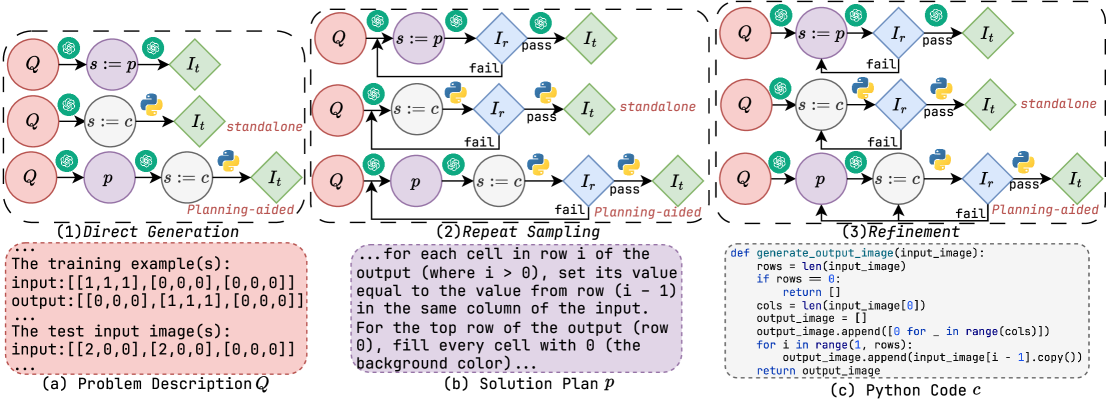
The image depicts a diagram illustrating an iterative process for image generation, broken down into three stages: Direct Generation, Repeat Sampling, and Refinement. Each stage is represented by a flow diagram and accompanied by textual descriptions of the problem, solution, and corresponding Python code. The diagrams use state transitions and feedback loops to show the process flow.
### Components/Axes
The diagram consists of three main sections, labeled (1) Direct Generation, (2) Repeat Sampling, and (3) Refinement, arranged horizontally. Each section contains a flow diagram and a text block.
* **Flow Diagrams:** Each diagram uses circles to represent states (labeled Q, p, c), arrows to indicate transitions, and labels on the arrows to describe the conditions or actions causing the transitions (e.g., "s := p", "fail", "pass"). The diagrams also include labels indicating the type of process: "standalone" and "Planning-aided".
* **Text Blocks:**
* **(a) Problem Description Q:** Contains example input and output image data.
* **(b) Solution Plan P:** Describes the algorithm for generating the output image.
* **(c) Python Code C:** Provides the Python code implementation of the algorithm.
### Detailed Analysis or Content Details
**Section 1: Direct Generation**
* The diagram shows a series of states 'Q' transitioning based on the condition "s := p" (where 's' is assigned the value of 'p').
* The output 'I<sub>t</sub>' is labeled as either "pass" or "fail".
* The process is labeled "Planning-aided".
* **Problem Description Q:**
* "The training example(s):"
* input: `[[1,1],[1,0],[0,0],[0,0]]`
* output: `[[0,0],[1,1],[1,1],[0,0]]`
* "The test input image(s):"
* input: `[[2,0],[2,0],[0,0],[0,0]]`
**Section 2: Repeat Sampling**
* The diagram shows states 'Q' transitioning based on "s := c".
* The output 'I<sub>t</sub>' is labeled as either "pass" or "fail".
* The process is labeled as both "standalone" and "Planning-aided".
* **Solution Plan P:**
* "...for each cell in row i of the output (where i > 0), set its value equal to the value from row (i - 1) in the same column of the input."
* "For the top row of the output (row 0), fill every cell with 0 (the background color)..."
**Section 3: Refinement**
* The diagram shows states 'Q' transitioning based on "s := c".
* The output 'I<sub>t</sub>' is labeled as either "pass" or "fail".
* The process is labeled "Planning-aided".
* **Python Code C:**
```python
def generate_output_image(input_image):
rows = len(input_image)
if rows == 0:
return []
cols = len(input_image[0])
output_image = []
output_image.append([0 for _ in range(cols)])
for i in range(1, rows):
output_image.append(input_image[i-1].copy())
return output_image
```
### Key Observations
* The diagrams in all three sections share a similar structure, suggesting a consistent underlying process with iterative refinement.
* The "fail" transitions indicate potential areas for improvement or further iteration.
* The Python code in Section 3 directly implements the algorithm described in the Solution Plan in Section 2.
* The input/output examples in Section 1 provide concrete instances for understanding the problem and solution.
### Interpretation
The diagram illustrates a method for image generation that starts with a direct generation step, then iteratively refines the output through repeat sampling and a final refinement stage. The process appears to be based on copying rows from the input image to the output image, with an initial row filled with a background color (0). The "pass" and "fail" labels suggest a validation or evaluation step at each iteration. The use of "Planning-aided" indicates that some form of planning or guidance is involved in the process. The Python code provides a clear and concise implementation of the algorithm, demonstrating how the iterative process can be automated. The examples provided show a simple case of copying rows, but the overall framework could be extended to more complex image generation tasks. The iterative nature of the process suggests a potential for learning and improvement over time. The diagram highlights the interplay between problem definition, solution design, and code implementation in the context of image generation.