TECHNICAL ASSET FINGERPRINT
0eadfef9e7f78411a1cc1c1a
Click to view fullscreen
Press ESC or click to close
FOUND IN PAPERS
EXPERT: healer-alpha-free VERSION 1
RUNTIME: free/openrouter/healer-alpha
INTEL_VERIFIED
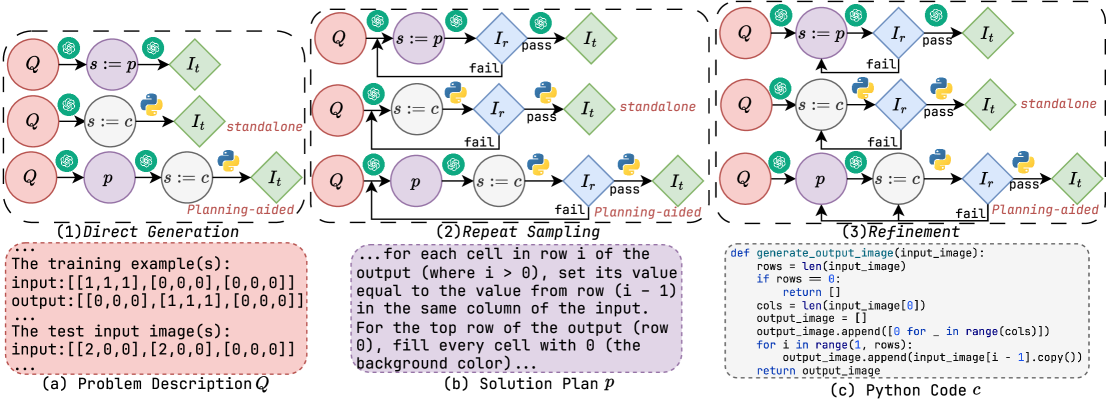
## Diagram: Comparison of Three Code Generation/Refinement Methods
### Overview
The image is a technical diagram comparing three distinct methods for generating and refining code or solutions, likely in the context of program synthesis or AI-assisted programming. The three methods are labeled (1) Direct Generation, (2) Repeat Sampling, and (3) Refinement. Each method is depicted as a flowchart with nodes representing different states or actions, connected by arrows indicating process flow. Below the main flowcharts are three explanatory boxes providing concrete examples of the components referenced in the diagrams.
### Components/Axes
The diagram is organized into three main vertical sections, each representing a method. Within each method, the flow is generally from left to right.
**Common Symbols & Legend (Present in each method's top-right corner):**
* **Gear Icon:** Represents a "planning" or "reasoning" step.
* **Python Logo:** Represents the generation or execution of Python code.
* **Pink Circle (Q):** Represents the initial problem or query.
* **Purple Circle (s := p / s := c):** Represents a state assignment. `s := p` means the state is set based on a plan. `s := c` means the state is set based on code.
* **Green Diamond (It):** Represents the final output or test result.
* **Blue Diamond (Ir):** Present in methods (2) and (3). Represents an intermediate result or evaluation step, with "pass" and "fail" outcomes.
* **Arrows:** Indicate the flow of the process. Dashed lines with arrows indicate loops or retries.
**Section (1) Direct Generation:**
* **Structure:** Three parallel, independent pathways.
* **Pathway 1 (Top):** `Q` -> (Gear) `s := p` -> `It`. Labeled "standalone".
* **Pathway 2 (Middle):** `Q` -> (Gear) `s := c` -> (Python Logo) `It`. Labeled "standalone".
* **Pathway 3 (Bottom):** `Q` -> `p` -> (Gear) `s := c` -> (Python Logo) `It`. Labeled "Planning-aided".
**Section (2) Repeat Sampling:**
* **Structure:** Three parallel pathways, each containing a potential loop.
* **Pathway 1 (Top):** `Q` -> (Gear) `s := p` -> `Ir`. If `Ir` results in "pass", proceed to `It`. If "fail", loop back to the `s := p` step. Labeled "standalone".
* **Pathway 2 (Middle):** `Q` -> (Gear) `s := c` -> (Python Logo) `Ir`. If "pass", proceed to `It`. If "fail", loop back to the `s := c` step. Labeled "standalone".
* **Pathway 3 (Bottom):** `Q` -> `p` -> (Gear) `s := c` -> (Python Logo) `Ir`. If "pass", proceed to `It`. If "fail", loop back to the `s := c` step. Labeled "Planning-aided".
**Section (3) Refinement:**
* **Structure:** A more integrated process with a central loop and multiple feedback paths.
* **Main Flow:** `Q` -> (Gear) `s := p` -> `Ir`. If "pass", proceed to `It`.
* **Refinement Loop:** If `Ir` results in "fail", the process enters a loop:
1. The flow goes to a node `s := c` (with a Python Logo).
2. From there, it goes to another `Ir` evaluation.
3. If this second `Ir` "passes", it proceeds to `It`.
4. If it "fails", it loops back to the initial `s := p` step.
* **Alternate Input:** There is also a direct path from `Q` to a node `p`, which then feeds into the `s := c` node within the refinement loop.
**Explanatory Boxes (Bottom):**
* **(a) Problem Description Q:** A pink box containing text.
* **Content:**
```
The training example(s):
input:[[1,1,1],[0,0,0],[0,0,0]]
output:[[0,0,0],[1,1,1],[0,0,0]]
The test input image(s):
input:[[2,0,0],[2,0,0],[0,0,0]]
```
* **(b) Solution Plan p:** A purple box containing text.
* **Content:** `...for each cell in row i of the output (where i > 0), set its value equal to the value from row (i - 1) in the same column of the input. For the top row of the output (row 0), fill every cell with 0 (the background color)....`
* **(c) Python Code c:** A light blue box containing Python code.
* **Content:**
```python
def generate_output_image(input_image):
rows = len(input_image)
if rows == 0:
return []
cols = len(input_image[0])
output_image = []
output_image.append([0 for _ in range(cols)])
for i in range(1, rows):
output_image.append(input_image[i - 1].copy())
return output_image
```
### Detailed Analysis
The diagram contrasts three strategies for solving a problem (Q), which is exemplified in box (a) as a grid transformation task.
1. **Direct Generation (1):** This is the simplest approach. It attempts to generate a solution in one shot. The "standalone" methods generate either a plan (`p`) or code (`c`) directly from the problem. The "Planning-aided" method first generates a plan (`p`) and then uses that plan to generate code (`c`). There is no mechanism for checking or correcting the output.
2. **Repeat Sampling (2):** This method introduces an evaluation step (`Ir`) after generating a plan or code. If the evaluation fails, the system retries the generation step (`s:=p` or `s:=c`) for that specific pathway. This is a local retry loop confined to each generation strategy.
3. **Refinement (3):** This is the most complex method. It starts by generating a plan (`s:=p`) and evaluating it (`Ir`). If it fails, it doesn't simply retry the plan. Instead, it enters a refinement cycle: it generates code (`s:=c`) based on the failed plan, evaluates that code (`Ir`), and if that also fails, it loops all the way back to re-generate the plan. This creates a tighter coupling between planning and coding, where failures in one stage inform the other.
The explanatory boxes (a, b, c) provide a concrete instance of the abstract symbols: `Q` is the grid problem, `p` is the natural language solution plan, and `c` is the Python implementation of that plan.
### Key Observations
* **Increasing Complexity:** The methods progress from open-loop generation (1) to closed-loop with local retries (2) to a closed-loop with cross-stage refinement (3).
* **Symbol Consistency:** The same symbols (Q, p, c, It, Ir) are used across all three diagrams, allowing for direct comparison of the process flows.
* **Role of Evaluation:** The blue diamond `Ir` is the critical component that enables iterative improvement. Its absence in method (1) is the key differentiator.
* **Planning vs. Code:** The diagram explicitly separates high-level planning (`p`, gear icon) from code implementation (`c`, Python logo), showing they can be generated independently or sequentially.
### Interpretation
This diagram illustrates a conceptual framework for improving the reliability of AI code generation systems. The core idea is that **direct, one-pass generation is insufficient for complex tasks**. The progression shows that incorporating an **evaluation step (`Ir`)** and **feedback loops** is essential for robustness.
* **Method (1)** represents a baseline, akin to a standard language model generating a single response.
* **Method (2)** adds a basic self-correction mechanism, similar to generating multiple samples and picking the best one, or using unit tests to retry generation.
* **Method (3)** proposes a more sophisticated, **integrated debugging process**. A failure doesn't just trigger a retry; it triggers a shift in strategy—from planning to coding—and creates a loop where plan and code are refined together until a valid solution is found. This mimics a human programmer's workflow: write a plan, try to code it, if the code fails, revisit and revise the plan.
The concrete example in the boxes grounds this abstract framework. It shows a simple image transformation problem (`Q`), a human-readable plan to solve it (`p`), and the corresponding code (`c`). The diagram's value is in showing the different *processes* by which an AI system might arrive at that code `c` from the problem `Q`, highlighting the trade-off between simplicity (Method 1) and robustness through iterative refinement (Method 3).
DECODING INTELLIGENCE...