## Conceptual Diagram: Existential Import in Syllogistic Logic
### Overview
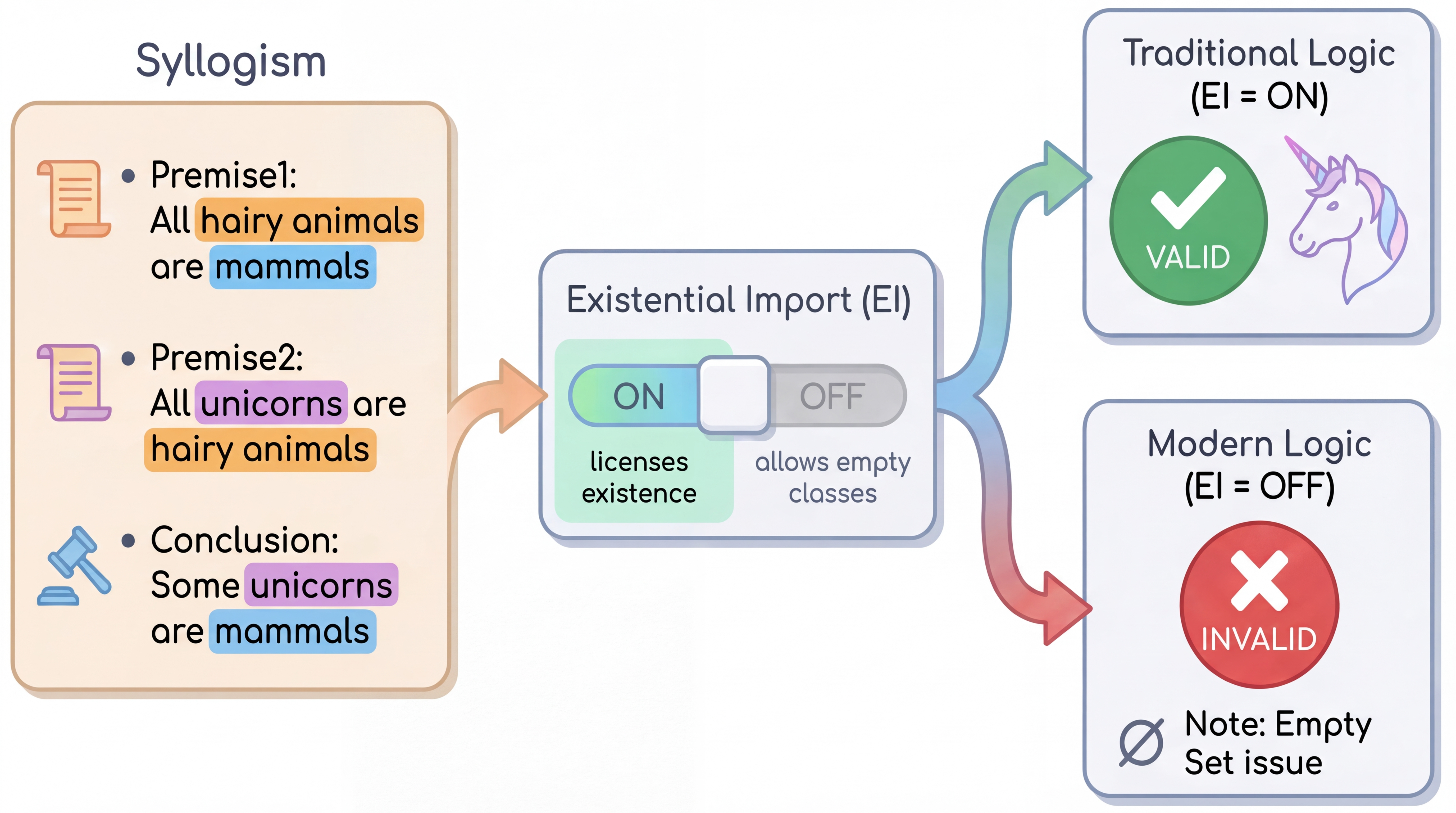
The image is a conceptual flowchart illustrating how the philosophical concept of "Existential Import" (EI) determines the validity of a classic syllogism. It contrasts two logical systems—Traditional Logic and Modern Logic—based on whether they assume terms in a proposition refer to existing things. The diagram uses a syllogism about unicorns as a test case.
### Components/Axes
The diagram is organized into three main regions, flowing from left to right:
1. **Left Region (Syllogism Box):** A beige, rounded rectangle titled "Syllogism". It contains the logical argument.
2. **Center Region (EI Toggle):** A light blue, rounded rectangle titled "Existential Import (EI)". It features a central toggle switch.
3. **Right Region (Logic Outcomes):** Two stacked, light blue, rounded rectangles representing the two logical systems.
* **Top Box:** "Traditional Logic (EI = ON)"
* **Bottom Box:** "Modern Logic (EI = OFF)"
**Flow Arrows:**
* A thick, orange arrow points from the Syllogism box to the EI Toggle box.
* From the EI Toggle, two arrows branch out:
* A green arrow curves upward to the "Traditional Logic" box.
* A red arrow curves downward to the "Modern Logic" box.
### Detailed Analysis
**1. Syllogism Box (Left):**
* **Title:** "Syllogism"
* **Content:** A standard categorical syllogism with color-coded terms.
* **Premise 1:** "All **hairy animals** are **mammals**"
* "hairy animals" is highlighted in orange.
* "mammals" is highlighted in blue.
* **Premise 2:** "All **unicorns** are **hairy animals**"
* "unicorns" is highlighted in purple.
* "hairy animals" is highlighted in orange.
* **Conclusion:** "Some **unicorns** are **mammals**"
* "unicorns" is highlighted in purple.
* "mammals" is highlighted in blue.
* **Icons:** Each line is preceded by a small icon: a scroll for premises, a gavel for the conclusion.
**2. Existential Import (EI) Toggle (Center):**
* **Title:** "Existential Import (EI)"
* **Toggle Switch:** A horizontal slider with two states.
* **Left (ON) State:** Green background. Label: "licenses existence".
* **Right (OFF) State:** Grey background. Label: "allows empty classes".
* **Function:** This switch represents the core philosophical choice. Setting EI to "ON" means universal statements ("All A are B") imply that the subject class (A) has members. Setting it to "OFF" means such statements can be true even if the subject class is empty.
**3. Logic Outcome Boxes (Right):**
* **Traditional Logic (Top Box):**
* **Title:** "Traditional Logic (EI = ON)"
* **Visual Outcome:** A large green circle with a white checkmark and the word "VALID".
* **Icon:** A stylized unicorn head (purple mane, blue horn) is shown to the right of the checkmark.
* **Interpretation:** When EI is ON, the syllogism is valid. The premises imply unicorns exist (as hairy animals), so the conclusion "Some unicorns are mammals" follows.
* **Modern Logic (Bottom Box):**
* **Title:** "Modern Logic (EI = OFF)"
* **Visual Outcome:** A large red circle with a white "X" and the word "INVALID".
* **Note:** Below the circle, text reads: "Ø Note: Empty Set issue". The "Ø" symbol represents the empty set.
* **Interpretation:** When EI is OFF, the syllogism is invalid. The premises can be true even if the class of unicorns is empty. Therefore, you cannot validly conclude that *some* unicorns exist and are mammals.
### Key Observations
1. **Color Consistency:** The diagram uses color consistently to track terms: orange for "hairy animals," blue for "mammals," and purple for "unicorns." This aids in following the logical flow.
2. **Visual Metaphor:** The toggle switch is a powerful metaphor for a binary philosophical assumption. The green/red and checkmark/X iconography clearly contrasts the two outcomes.
3. **The Unicorn Example:** The choice of "unicorns" is deliberate. It is a universally recognized example of a non-existent (empty) class, making it the perfect test case for the problem of existential import.
4. **Spatial Grounding:** The flow is strictly left-to-right, with the central EI toggle acting as a decision point that branches into two distinct, vertically separated outcomes (Traditional above, Modern below).
### Interpretation
This diagram elegantly explains a fundamental schism in the history of logic. It demonstrates that the validity of a seemingly straightforward syllogism depends entirely on a hidden assumption about existence.
* **Traditional Logic (Aristotelian):** Assumes that the subject of a universal proposition ("All unicorns...") must have members. This makes the syllogism valid but commits to the existence of things like unicorns when reasoning about them.
* **Modern Logic (Boolean):** Rejects this assumption. Universal statements are interpreted as conditional ("If something is a unicorn, then it is a hairy animal"). This allows logic to handle empty classes without contradiction, making it more suitable for mathematics and abstract reasoning, but rendering the classic syllogism invalid.
The "Empty Set issue" note highlights the core problem: Modern logic treats classes as potentially empty, which breaks the traditional syllogistic form known as *Darapti* (the form used in the example). The diagram thus serves as a concise lesson on how foundational assumptions shape logical systems and their conclusions. It shows that logic is not just about form, but also about the metaphysical commitments embedded within that form.