\n
## Meeting Documentation: Focus Group Transcript
### Overview
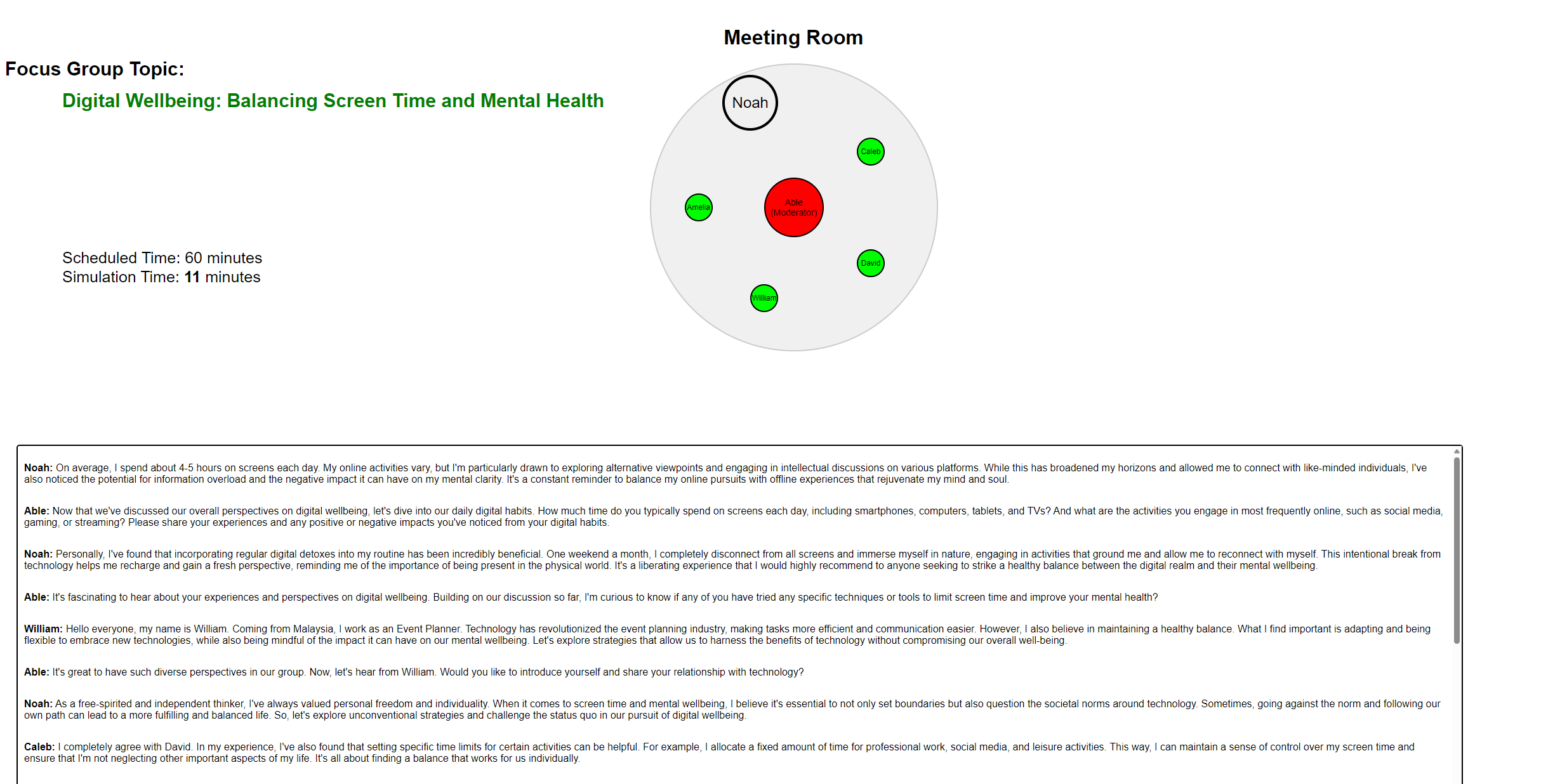
The image presents a transcript of a focus group discussion centered around "Digital Wellbeing: Balancing Screen Time and Mental Health." The transcript captures the dialogue between participants named Noah, Able, William, and David, facilitated by a moderator (presumably Able). The setting is a "Meeting Room" with a scheduled time of 60 minutes. A visual element depicts a group of people around a table, likely representing the focus group participants.
### Components/Axes
The image consists of:
* **Header:** "Meeting Room" title, "Focus Group Topic: Digital Wellbeing: Balancing Screen Time and Mental Health", "Scheduled Time: 60 minutes", "Simulation Time: 11 minutes".
* **Visual Element:** A cartoon-style illustration of four people seated around a table. The people are labeled "Noah", "Able", "William", and "David". There are also icons representing "Ideas", "Moderator", and "Planning".
* **Transcript:** A block of text containing the dialogue from the focus group participants.
### Detailed Analysis or Content Details
The transcript is as follows:
**Noah:** "On average, I spend about 4-5 hours on screens each day. My online activities vary but I’m particularly drawn to exploring alternative viewpoints and engaging in intellectual discussions on various platforms. While this has broadened my horizons and allowed me to connect with like-minded individuals, I’ve also noticed the potential for information overload and the negative impact it can have on my mental clarity. It’s a constant reminder to balance my online pursuits with offline experiences that rejuvenate my mind and soul."
**Able:** "Now that we’ve discussed our overall perspectives on digital wellbeing, let’s dive into our digital habits. How much time do you typically spend on screens each day, including smartphones, tablets, and TVs? And what are the activities you engage in most frequently online, such as social media, gaming, or streaming? Please share your experiences and any positive or negative impacts you’ve noticed from your digital habits."
**Noah:** "Personally, I’ve found that incorporating regular digital detoxes into my routine has been incredibly beneficial. One weekend a month, I completely disconnect from all screens and immerse myself in nature, engaging in activities that ground me and allow me to reconnect with myself. This intentional break from technology helps me recharge and gain a fresh perspective, reminding me of the importance of being present in the physical world. It’s a liberating experience that I would highly recommend to anyone seeking to strike a healthy balance between the digital realm and their mental wellbeing."
**Able:** "Is everyone to share about your experiences and perspectives on digital wellbeing. Building on your discussion so far, is it curious to know if any of you have tried any specific techniques or tools to limit screen time and improve your mental health?"
**William:** "Greetings from William in Malaysia. Coming from work as an Event Planner. Technology has revolutionized the event planning industry, making tasks more efficient and communication easier. However, I also believe in maintaining a healthy balance. What I find important is adapting and being flexible to embrace new technologies, while being also mindful of the impact it can have on our mental wellbeing. Let’s explore strategies that allow us to harness the benefits of technology without compromising our overall wellbeing."
**Able:** "It’s great to have such diverse perspectives in our group. Now, let’s hear from William. Would you like to introduce yourself and share your relationship with technology?"
**Noah:** "As a free-spirited and independent thinker, I’ve always valued personal freedom and individuality. When it comes to screen time and mental wellbeing, I believe it’s essential to set not only boundaries but also question the societal norms around technology. Sometimes going against the norm and following our own path can lead to a more fulfilling and balanced life. So, let’s explore unconventional strategies and challenge the status quo to pursue digital wellbeing."
**David:** "I completely agree with David. In my experience, there’s also a soothing habit to be found in our daily activities which can be helpful. For example, I like to allocate about an hour of time for professional work, then connect to social media for about 10 minutes. I can maintain a sense of control over my screen time and it’s a way to stay connected with friends and family."
### Key Observations
* The discussion revolves around the balance between the benefits and drawbacks of digital technology on mental wellbeing.
* Participants share personal experiences with screen time, digital detoxes, and strategies for maintaining a healthy relationship with technology.
* There's a recurring theme of intentionality and mindful usage of technology.
* The participants come from diverse backgrounds (Event Planner, Independent Thinker) and locations (Malaysia).
### Interpretation
The focus group transcript reveals a nuanced understanding of the impact of digital technology on mental health. Participants acknowledge the benefits of connectivity and access to information but also recognize the potential for overload and negative consequences. The emphasis on digital detoxes, mindful usage, and setting boundaries suggests a growing awareness of the need for a balanced approach. The diverse perspectives highlight the subjective nature of digital wellbeing and the importance of finding strategies that work for individual needs and lifestyles. The transcript demonstrates a desire to move beyond simply limiting screen time and towards a more holistic approach that integrates technology into a fulfilling and balanced life. The visual element reinforces the collaborative nature of the discussion, depicting participants engaged in a shared exploration of these complex issues.