## Screenshot: Focus Group Discussion on Digital Wellbeing
### Overview
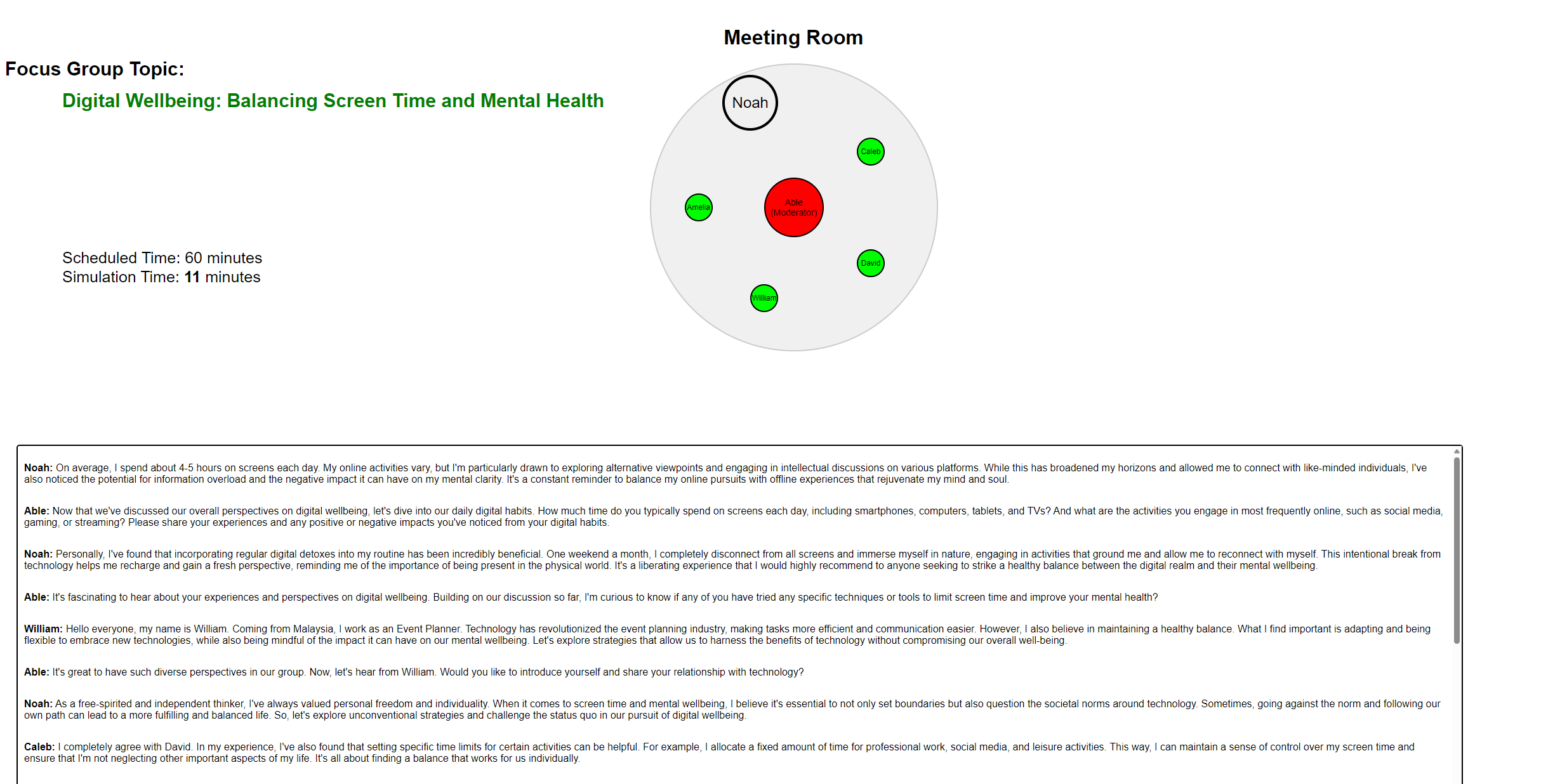
The image depicts a structured focus group discussion interface titled **"Digital Wellbeing: Balancing Screen Time and Mental Health"**. It includes a meeting room diagram, participant roles, and a transcript of dialogue. The session is scheduled for 60 minutes, with a simulation time of 11 minutes. The discussion revolves around screen time habits, mental health impacts, and strategies for balance.
---
### Components/Axes
1. **Header Section**:
- **Focus Group Topic**: "Digital Wellbeing: Balancing Screen Time and Mental Health" (green text).
- **Scheduled Time**: 60 minutes.
- **Simulation Time**: 11 minutes.
2. **Meeting Room Diagram**:
- **Central Red Circle**: Labeled "Able (Moderator)".
- **Five Green Circles**: Representing participants:
- Top: Noah
- Left: Amelia
- Bottom: William
- Right: Caleb
- Bottom-Right: David
- **Layout**: Participants are evenly spaced around the moderator in a circular arrangement.
3. **Transcript Section**:
- Dialogue between participants and the moderator (Able), structured as a conversation. Names are bolded, followed by their contributions.
---
### Detailed Analysis
#### Header Section
- **Focus Group Topic**: Explicitly states the theme of the discussion.
- **Time Allocation**:
- Scheduled Time: 60 minutes (total session duration).
- Simulation Time: 11 minutes (likely the time allocated for the simulated discussion in the interface).
#### Meeting Room Diagram
- **Color Coding**:
- **Red**: Moderator (Able).
- **Green**: Participants (Noah, Amelia, William, Caleb, David).
- **Spatial Arrangement**:
- Participants are positioned around the moderator in a circular pattern, suggesting equal participation and visibility.
#### Transcript Section
- **Dialogue Flow**:
1. **Noah**: Shares screen time habits (4–5 hours/day) and concerns about information overload.
2. **Able**: Moderates the discussion, prompting participants to share experiences and impacts of digital habits.
3. **William**: Introduces himself (from Malaysia, event planner) and emphasizes balancing technology use.
4. **Noah**: Discusses digital detoxes (weekly screen-free weekends) for mental rejuvenation.
5. **Able**: Encourages sharing of techniques/tools for limiting screen time.
6. **Caleb**: Agrees with David on setting time limits for activities (work, social media, leisure).
7. **David**: Advocates for personal freedom and challenging societal norms around technology use.
---
### Key Observations
1. **Participant Roles**:
- Able (Moderator) guides the conversation, ensuring all voices are heard.
- Participants share personal experiences, strategies, and perspectives on digital wellbeing.
2. **Themes**:
- **Screen Time Management**: Discussions around time limits, digital detoxes, and balancing online/offline activities.
- **Mental Health**: Concerns about information overload, the need for mindfulness, and reconnecting with the physical world.
- **Societal Norms**: Challenging conventional expectations around technology use.
3. **Dialogue Structure**:
- The conversation alternates between participants and the moderator, maintaining a structured yet open format.
---
### Interpretation
The focus group aims to explore how individuals navigate digital technology's impact on mental health. Key insights include:
- **Personal Strategies**: Participants employ techniques like digital detoxes and time allocation to maintain balance.
- **Moderator's Role**: Able facilitates a collaborative discussion, ensuring diverse perspectives (e.g., William's professional background in event planning) are integrated.
- **Societal Critique**: David and Caleb highlight the tension between societal norms and individual choices, suggesting a need for redefining "healthy" technology use.
The discussion underscores the importance of intentional boundaries and adaptability in leveraging technology without compromising well-being. The circular diagram symbolizes interconnectedness among participants, reflecting the collaborative nature of the dialogue.