## Grouped Bar Chart: The Accuracy of Different Operation Sets
### Overview
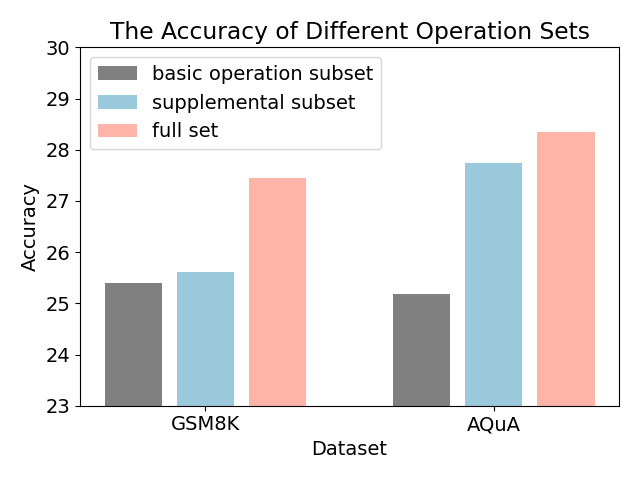
The image displays a grouped bar chart comparing the accuracy of three different operation subsets ("basic operation subset," "supplemental subset," and "full set") across two distinct datasets ("GSM8K" and "AQuA"). The chart is designed to show how the inclusion of more operations impacts model accuracy on these two benchmarks.
### Components/Axes
* **Chart Title:** "The Accuracy of Different Operation Sets" (centered at the top).
* **Y-Axis:**
* **Label:** "Accuracy" (rotated vertically on the left side).
* **Scale:** Linear scale ranging from 23 to 30, with major tick marks at every integer value (23, 24, 25, 26, 27, 28, 29, 30).
* **X-Axis:**
* **Label:** "Dataset" (centered at the bottom).
* **Categories:** Two primary categories are labeled: "GSM8K" (left group) and "AQuA" (right group).
* **Legend:**
* **Position:** Top-left corner of the chart area.
* **Items:**
1. A gray square labeled "basic operation subset".
2. A light blue square labeled "supplemental subset".
3. A light red (salmon) square labeled "full set".
* **Data Series (Bars):** For each dataset category on the X-axis, there are three adjacent bars corresponding to the three operation subsets defined in the legend.
### Detailed Analysis
**Data Values (Approximate, read from chart):**
* **Dataset: GSM8K**
* **basic operation subset (Gray bar):** Height corresponds to an accuracy of approximately **25.4**.
* **supplemental subset (Light blue bar):** Height corresponds to an accuracy of approximately **25.6**.
* **full set (Light red bar):** Height corresponds to an accuracy of approximately **27.5**.
* **Dataset: AQuA**
* **basic operation subset (Gray bar):** Height corresponds to an accuracy of approximately **25.2**.
* **supplemental subset (Light blue bar):** Height corresponds to an accuracy of approximately **27.7**.
* **full set (Light red bar):** Height corresponds to an accuracy of approximately **28.3**.
**Trend Verification:**
* For the **GSM8K** dataset, the trend is a stepwise increase: the basic subset has the lowest accuracy, the supplemental subset is slightly higher, and the full set shows a significant jump.
* For the **AQuA** dataset, the trend is also increasing: the basic subset is the lowest, the supplemental subset shows a very large increase, and the full set is the highest, though the increment from supplemental to full is smaller than the jump from basic to supplemental.
### Key Observations
1. **Consistent Hierarchy:** In both datasets, the "full set" achieves the highest accuracy, followed by the "supplemental subset," with the "basic operation subset" performing the worst.
2. **Dataset-Dependent Gains:** The performance gain from adding operations is more pronounced for the **AQuA** dataset. The jump from the "basic" to "supplemental" subset is much larger for AQuA (~2.5 points) than for GSM8K (~0.2 points).
3. **Baseline Similarity:** The accuracy of the "basic operation subset" is very similar across both datasets (25.4 vs. 25.2), suggesting a consistent baseline performance.
4. **Peak Performance:** The highest accuracy shown on the chart is achieved by the "full set" on the AQuA dataset (~28.3).
### Interpretation
This chart demonstrates the value of expanding an operation set for improving model accuracy on reasoning or mathematical datasets (as suggested by the names GSM8K and AQuA, which are known benchmarks in this domain).
* **Core Finding:** More comprehensive operation sets ("full set") lead to better performance. This suggests that the model benefits from having access to a wider repertoire of reasoning tools or steps.
* **Nuanced Insight:** The benefit is not uniform. The **AQuA** dataset appears to be more sensitive to the inclusion of the "supplemental" operations, as evidenced by the large performance leap. This could indicate that AQuA problems require specific types of reasoning or operations that are absent in the basic set but present in the supplemental one. Conversely, the GSM8K dataset shows a more gradual improvement, suggesting its problems are either less dependent on those supplemental operations or that the basic set already covers a significant portion of its needs.
* **Implication:** The data argues against a one-size-fits-all approach. The optimal operation set may depend on the specific characteristics of the target dataset. The "full set" is universally best here, but the cost-benefit of implementing it versus the "supplemental subset" might be different for each task domain. The chart provides empirical evidence for tailoring a model's operational toolkit to the problem at hand.