## Bar Chart: The Accuracy of Different Operation Sets
### Overview
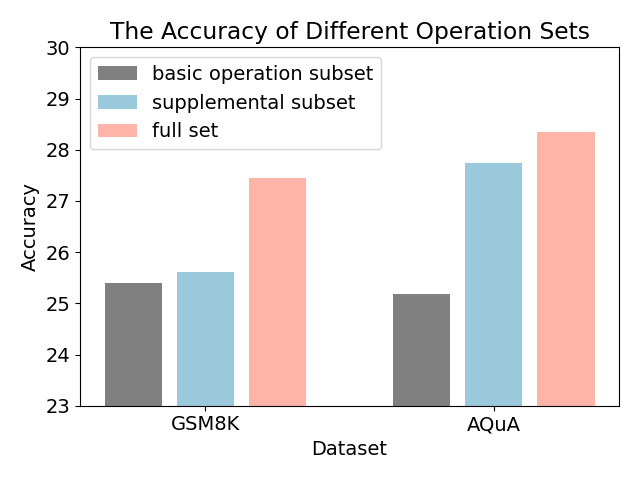
This bar chart displays the accuracy of different operation sets across two datasets: GSM8K and AQuA. The accuracy is measured on the y-axis, and the datasets are presented on the x-axis. For each dataset, three bars represent the accuracy achieved using a "basic operation subset," a "supplemental subset," and the "full set" of operations.
### Components/Axes
* **Title:** "The Accuracy of Different Operation Sets"
* **Y-axis Label:** "Accuracy"
* **Scale:** Ranges from 23.0 to 30.0, with major tick marks at intervals of 1.0 (23, 24, 25, 26, 27, 28, 29, 30).
* **X-axis Label:** "Dataset"
* **Categories:** "GSM8K" and "AQuA".
* **Legend:** Located in the top-left quadrant of the chart.
* **"basic operation subset"**: Represented by a dark gray color.
* **"supplemental subset"**: Represented by a light blue color.
* **"full set"**: Represented by a light red/salmon color.
### Detailed Analysis
**Dataset: GSM8K**
* **basic operation subset (dark gray):** The bar reaches approximately 25.3.
* **supplemental subset (light blue):** The bar reaches approximately 25.6.
* **full set (light red/salmon):** The bar reaches approximately 27.4.
**Dataset: AQuA**
* **basic operation subset (dark gray):** The bar reaches approximately 25.2.
* **supplemental subset (light blue):** The bar reaches approximately 27.8.
* **full set (light red/salmon):** The bar reaches approximately 28.3.
### Key Observations
* For the GSM8K dataset, the "full set" of operations yields the highest accuracy (approx. 27.4), followed by the "supplemental subset" (approx. 25.6), and then the "basic operation subset" (approx. 25.3).
* For the AQuA dataset, the "full set" also yields the highest accuracy (approx. 28.3), followed by the "supplemental subset" (approx. 27.8), and then the "basic operation subset" (approx. 25.2).
* The "basic operation subset" shows relatively consistent accuracy across both datasets (approx. 25.3 for GSM8K and 25.2 for AQuA).
* The "supplemental subset" and "full set" show a more significant increase in accuracy for the AQuA dataset compared to the GSM8K dataset. Specifically, the accuracy gain from the "basic operation subset" to the "full set" is more pronounced in AQuA (approx. 3.1 percentage points) than in GSM8K (approx. 2.1 percentage points).
* The "supplemental subset" performs better than the "basic operation subset" on both datasets.
* The "full set" consistently outperforms both the "basic operation subset" and the "supplemental subset" on both datasets.
### Interpretation
The data suggests that for both the GSM8K and AQuA datasets, employing a more comprehensive set of operations leads to higher accuracy. The "full set" of operations consistently provides the best performance, indicating that a broader range of operations is beneficial for the tasks represented by these datasets.
The "supplemental subset" also shows an improvement over the "basic operation subset," suggesting that additional operations beyond the basic set contribute positively to accuracy. The fact that the "basic operation subset" has similar accuracy across both datasets might imply that its capabilities are limited and do not significantly vary with the dataset's characteristics.
The larger gains observed with the "supplemental subset" and "full set" on the AQuA dataset compared to GSM8K could indicate that AQuA is a more complex dataset or requires a wider variety of operations to achieve optimal performance. This implies that the effectiveness of operation sets can be dataset-dependent, with more complex or diverse datasets benefiting more from richer operation sets. In essence, the results demonstrate a clear benefit of increasing the complexity and scope of operation sets for improved accuracy, with the magnitude of this benefit potentially varying based on the dataset's nature.